

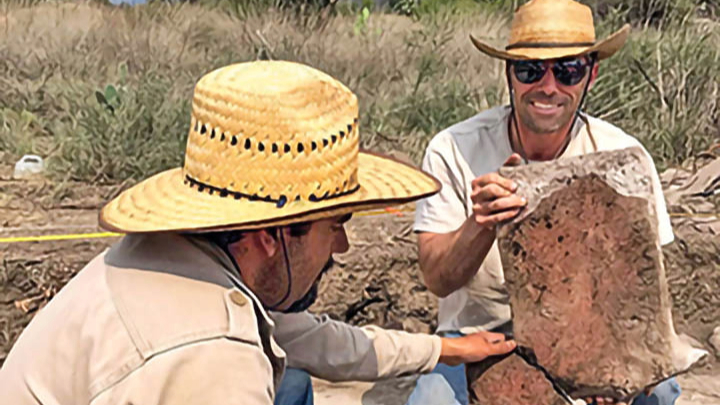

David Carballo ’95 (right) in Teotihuacan, Mexico
David Carballo ’95 was excavating in Teotihuacan, Mexico, in 2013 when he and a colleague found an elaborately painted ceramic pot with patchwork over its cracks. “I liked the story it told,” says Carballo,
an archaeologist who studies the lives of working-class people in pre-Hispanic civilizations of central Mexico. “These are people who had access to some nicer things, but they had to take care of it like it was an heirloom in the family, and we were getting some of that textured history.”
Holding an object that someone else hasn’t held in 15 centuries is part of the thrill for the archaeologist — but, he says, “it’s not just what you find; it’s what you find out.”
A professor at Boston University, Carballo has written several books and is currently writing a new book about Teotihuacan while on sabbatical. He’s been studying the city since 1999, most recently focusing on the Tlanjinga district, where the demographics skewed toward working-class people and immigrants. “There has been a bias for centuries,” he says of his field. “[It’s] mostly looked at the monuments to elite members of society and less of the daily life of most people.” Understanding how this urban society functioned — from government to infrastructure to finding unity among a diverse population — can provide answers for our modern society. “Trying to understand an ancient city like Teotihuacan only through its pyramids and palaces would be like trying to understand urban life in Washington, D.C., today when you only knew of the White House and a few of the monuments along the Mall.”

Carballo and a colleague found this patched-up painted ceramic pot while excavating in Teotihuacan.
Carballo travels to Mexico at least once a year for excavations and lab work, but his very first visit to an archaeology site in the country — the one that put him on this career path — was as a Colgate senior with Professor Tony Aveni. “That was a life-changing experience,” says Carballo, who remembers the group traveling around in two minivans, meeting “people who I now realize to be luminaries in the field,” and sleeping on the site at Teotihuacan. “It was really special to be there when it was [closed to tourists and] quieter.”
The adventure made “me realize that this is actually a profession, not just [something in] Indiana Jones.”
Carballo has stayed in touch with Aveni as they’ve co-authored several articles and both recently appeared in the same documentary in the making. Carballo and his wife even named their son Tony — for a number of reasons, but one of them being the positive association with the name of his mentor. When Carballo started touring colleges with his now high school–age son, “I got to introduce Tony to Tony, which was a lot of fun.”
Now as a tenured professor himself, Carballo balances teaching with research trips. He has colleagues and graduate students who run his lab in Mexico when he’s not there. “We have a storage issue in the discipline because in any summer, [there could be approximately] 100 boxes of artifacts we might uncover. Someone needs to be working almost year-round cataloging and classifying everything.”
Like any good historian, Carballo hopes that putting together these little pieces of the past will help us have a better perspective on the future. “Teotihuacan has some interesting lessons for us,” he says. “It was extremely multiethnic, it was a city that saw migration for 700 years and held together, almost all of its inhabitants lived in multifamily apartments, and it had probably five different languages spoken in it. It was a powerful and prestigious city for that time…. That’s something that, as a nation celebrating 250 years, I think we could appreciate and learn from.”
