

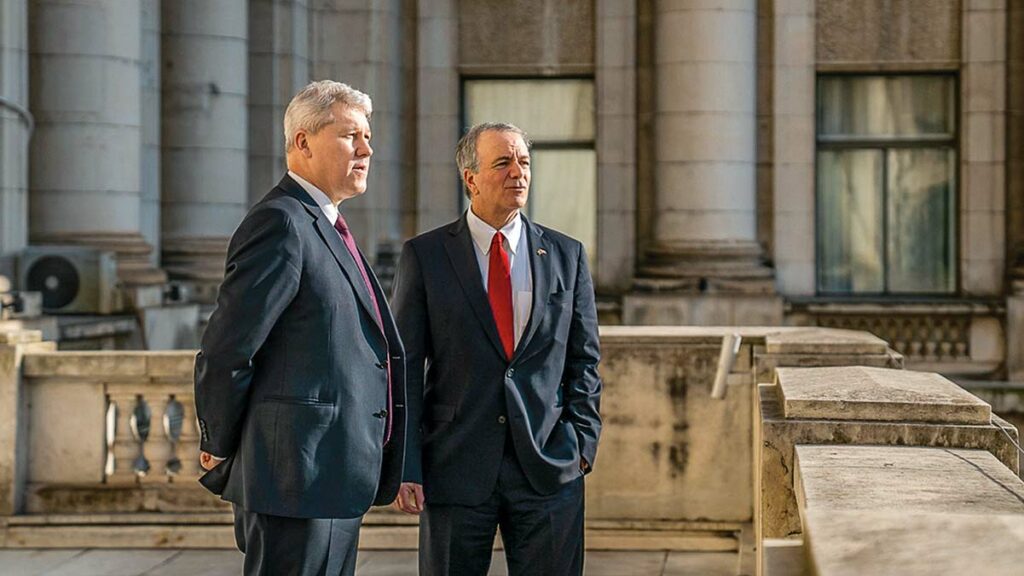
Romania Ministry of Internal Affairs
It’s not unusual for successful people to have colorful employment histories. Abraham Lincoln was a professional wrestler, Christopher Walken was a lion tamer, and Darryl Nirenberg ’81, the United States Ambassador to Romania, was a candy salesman.
The Ellenville, N.Y., native entered Colgate on a state scholarship and earned money bussing tables. When Nirenberg’s father learned that efforts to widen a road through their Hudson Valley town had failed — making it the busiest two-lane road in the state during the summer — he challenged his son to capitalize on the situation.
“My dad said, ‘I’ll give you a $1,000 non- recourse loan to start a business. If it fails, you’ll know in the first month and I’ll forgive the $1,000. If it succeeds, you can pay me back,’” Nirenberg recounts during a video interview from his office at the embassy in Bucharest. He decided to sell premium candies along the side of the road — it “succeeded and it was nearly enough money to pay my way through college.”
The same year that he began his confectionery career, Nirenberg went to D.C. to participate in Colgate’s foreign policy Jan Plan for four weeks of study. It was led by Professor Robert H. Johnson, who Nirenberg says was a “rock star.” On the last day of class, Nirenberg raised his hand and asked how one got hired at the State Department. “He started explaining the foreign service exam process and I started thinking, ‘This is not going to work. I’ll have to figure out another way,’” Nirenberg recalls. “It only took me four decades,” he adds with a grin.
A spring internship in the office of Sen. Jacob Javits, R-N.Y., gave Nirenberg his entrée into politics and reaffirmed his interest in foreign policy.
Within days of graduating cum laude with a degree in history, Nirenberg was back in D.C., working for Sen. S.I. Hayakawa, R-Calif. When the senator retired, Nirenberg moved to the Agriculture Committee and attended George Washington University Law School at night.
With his law degree in hand, Nirenberg joined the Senate Foreign Relations Committee as minority counsel and later minority deputy staff director. That’s where he was in 1989, during the fall of the Berlin Wall and Romanian Revolution.
“I was on the committee staff when Romania gained its freedom from communism. It was a big deal for us. It was the last of the Iron Curtain countries to gain its independence and we were laser focused,” says Nirenberg, adding that his appointment brings the experience full circle.
Nirenberg was nominated by President Donald Trump in May 2025, confirmed by the Senate Foreign Relations Committee the following December, and sworn in Feb. 18. He says his appointment fulfills a dream of serving in the diplomatic corps and is especially meaningful because his grandparents immigrated to the U.S. from Eastern Europe. “Growing up, my grandparents were a big part of my life, so this area feels comfortable to me,” says Nirenberg, who lives in the ambassador’s residence in Bucharest with his wife, Lori, and dog Gatsby. “I can see similarities between the values [my grandparents] had and the way they approached life.”
During his confirmation hearing, Nirenberg said he was committed to advancing Trump’s America First Agenda, making America stronger, safer, and more prosperous, and strengthening ties with Romania.
“The job of an ambassador is three things: manage, listen, and advocate,” Nirenberg says, adding that his first goal is to leave the team and mission as strong as he found it. His second goal (as with any ambassador,
he notes) is making sure that Americans who are visiting or living in Romania are safe.
In terms of policy, Nirenberg says the first priority is strengthening the already- strong strategic partnership between the two countries. Second is building commercial ties, especially those that create jobs in both Romania and the U.S. “Romania has the potential to be a game-changer when
it comes to energy production in Europe,” Nirenberg says. “IT and critical minerals are also very strong.”
The third priority is sharing American values. “The relationship between Romania and the United States has never been stronger, and it’s strong because we share fundamental values.”
From the time of his nomination until presenting his credentials, Nirenberg says, he had about a year to prepare. He met with a dozen ambassadors, including six who served in Romania, but credits an additional unlikely source for his preparedness — his professors at Colgate.
“Bob Kraynak gave me an appreciation for political theory, the foundation for everything I’ve done in politics since. But also, an understanding of Western civilization, its foundations, roots, and how it carries itself in modern political life,” Nirenberg recalls. He also cites his philosophy and religion professor Huntington Terrell (who he says taught him how to write, along with the philosophical foundations of Western civilization) and Rev. Coleman Brown, who Nirenberg mentions in the same breath as noting the important role religion plays in Romania.
Lastly he credits Doc Reading’s Russian history course. “I still have his books, and with the last Russian invasion of Ukraine, I pulled out a Russian history book to refresh my knowledge of the Russian resolution period. That background has served me a number of times during the course of my career.”
Nirenberg says he’s wanted to return to public service since he left the hill three decades ago. “And but for Colgate, none of this would ever have happened.”