

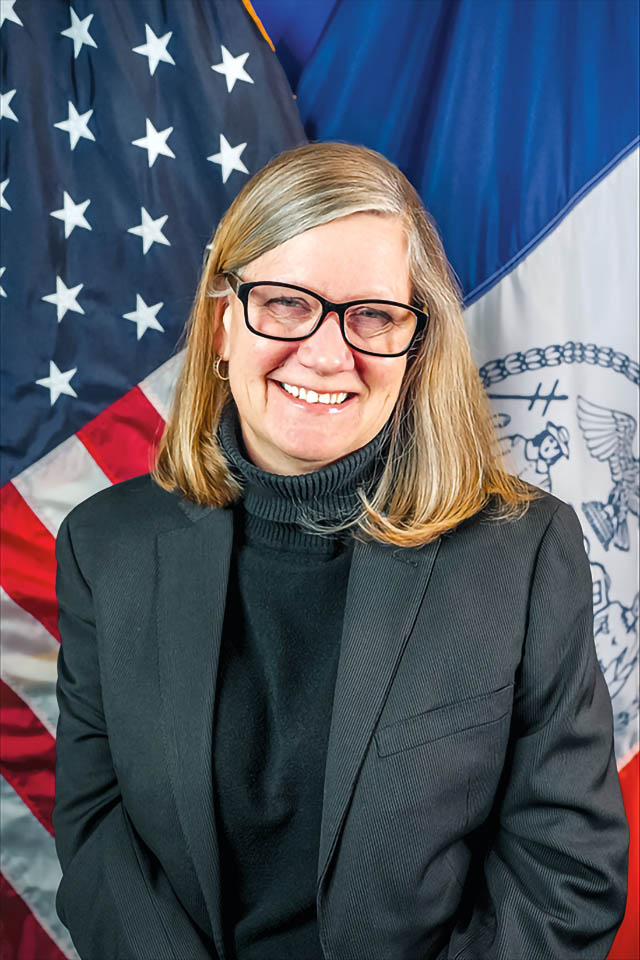
When New York City’s new mayor, Zohran Mamdani, appointed Christina Farrell ’90 commissioner of New York City Emergency Management in February, Farrell stepped into one of the city’s highest-stakes jobs. A 23-year veteran of the agency, Farrell now oversees New York’s response to everything from blizzards and heat waves to cyber attacks and public health crises — the kinds of emergencies that can upend millions of lives in an instant.
Colgate Magazine talked with Farrell about the lessons of 9/11, the threats facing modern cities, and why preparedness, she says, is one of the best antidotes to fear.
Most New Yorkers probably only think about emergency management during a crisis. What does your office do on a day-to-day basis?
We talk about our “blue sky role” and our “gray sky role.” Today is a beautiful day here, and people are working on plans, they’re making sure that our supplies are set for coastal storm season, but then quickly we can pivot to the gray sky work when a storm comes in. One of our biggest missions is to make sure New Yorkers are prepared. We do hundreds of presentations every year for different groups about how to prepare for all sorts of crises and emergencies: when you should go, when you should stay, and once you’re prepared, how do you help vulnerable relatives, friends, and neighbors.
You were working in the mayor’s office on 9/11. How did that experience shape the course of your career?
After 9/11, emergency management became its own agency and [the agency] needed to assume a lot of administrative roles. One of those roles was a grants director, and I helped create and administer funds from the newly formed U.S. Department of Homeland Security, which was implementing terrorism preparedness grants. Over time I took on more responsibility and eventually built the external affairs division, which handles public outreach and media relations. Four and a half years ago, I became the first deputy commissioner, and then in February, the commissioner. So 9/11 is really why I ended up here.
What emergencies since 9/11 have most changed the way the city prepares?
Hurricane Sandy was a big one. New York has always had a coastal storm plan, but it was not a detailed operational plan, just a bunch of phone numbers and things like that. When we saw what happened in New Orleans after Hurricane Katrina in 2005, we did a deep dive into that plan and made it very operational. So when Sandy hit in 2012, we were in a good position to respond. We had a lot of mutual aid set up. People came in from Maine, California, [and] Philadelphia to work with us and help. Most of New York City went back to its regular cadence pretty quickly, though there were swaths of the city that were in recovery for several years.
What kinds of threats keep you up at night?
Cyber is at the forefront now. Everybody’s become so reliant on technology, and I think about how quickly things can go down and cascade. It’s crucial for [our office] to make sure people have a plan A, B, and C. That is something we spend a lot of time thinking about and trying to mitigate.
What has it been like working with Mayor Mamdani?
I have really enjoyed working with this city hall. From the start of his term, the mayor was hands-on. He was even here for weather calls during the winter storms. I don’t think the National Weather Service rep expected the mayor to get on the call and start asking him questions, but he really wanted to understand, what does this mean? What are the impacts going to be? What are the recommendations? Before the blizzard in February, [Mamdani] did a video for us about signing up for Notify NYC, our emergency alert system. It went viral. We got 70,000 new subscribers overnight.
What makes someone well suited to emergency management work?
If you ask my colleagues, family, and friends, they’ll tell you I am very calm. Obviously I can get upset and emotional, but in general, that’s not my demeanor. I stay pretty level. I tell this to my kids — they’re now in high school and college — when they’re stressed or upset: “What is the absolute worst thing that can happen?” Sometimes it’s horrible. Sometimes it is 9/11 bad, but 98% of the time it’s not so bad, and you can take some steps to feel like you have control and can manage parts of that worst-case scenario if it happens.