


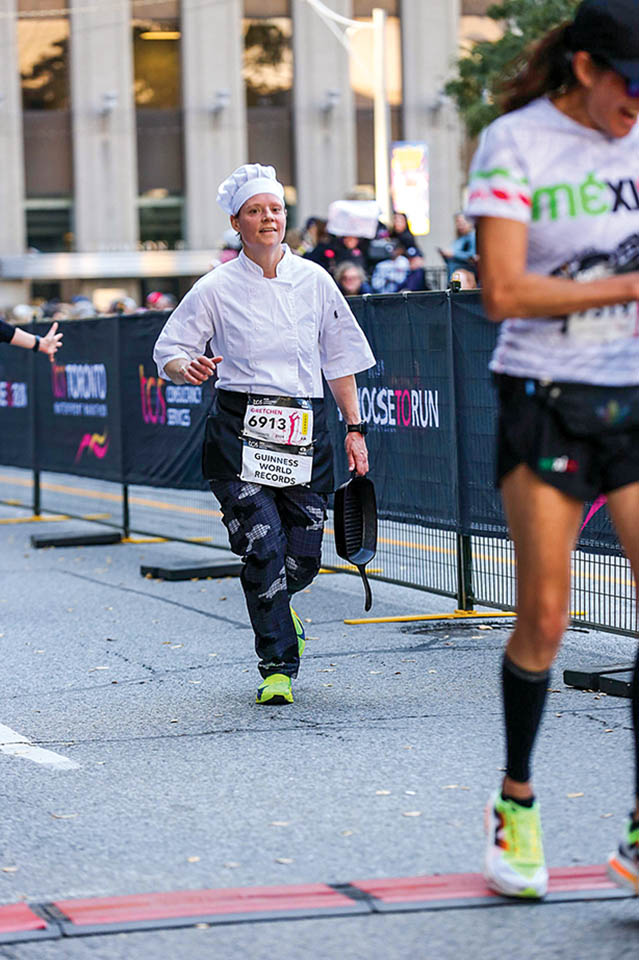
Last October Gretchen Swarr ’07 was surrounded by VIPs: a woman in a head- to-toe tree costume, a man donning full beekeeping garb, a nurse in an inflatable coronavirus, and a sloth trying to outrun its slow reputation. Swarr wore a chef’s white double-breasted shirt and a toque — while gripping a cast iron frying pan.
In these costumes, the 2024 Toronto Marathon VIPs were all attempting Guinness World Records. Finishing in 3:57:10, Swarr became the “fastest female dressed as a chef.” This victory required Swarr to overcome challenges even harder than training for a 26-mile race while carrying a 7-pound pan.
Swarr’s race goals started when she was 4 years old, while watching her dad and brother run the Boston Marathon. Her family lived in the city and would root on the runners every year. By the time she met the 18-year-old age requirement, though, she had only been running short distances with her high school track team and wasn’t sure she could complete a full marathon. “But there was still that nugget in the back of my head.”
At Colgate the psychology major/geology minor was on the swimming and diving team. Post-graduation she stayed as a research associate and lab technician with Professor Karen Harpp. It was the first time Swarr wasn’t involved in sports and she started to get out of shape, so she agreed to join Harpp in running the Marine Corps Hudson Mohawk Half Marathon. “I credit Karen for what I do now [professionally], in addition to being the catalyst I needed to break into distance running,” Swarr says.
She left Hamilton after working at Colgate for three years to become a research associate at Woods Hole Oceanographic Institution, where she still works today. Swarr ran her first full marathon, in Cape May, N.J., in 2011. She met her husband- to-be and they ran a half-marathon together as their third date; the two competed in Ironman Lake Placid in 2013 — while planning their wedding. (“I wouldn’t recommend that, but we did it.”)
The birth of their daughter in 2015 was a joyful event following a difficult pregnancy. With a desire to get back in shape, and because having a child of her own renewed her childhood goal, Swarr decided to try qualifying for the Boston Marathon. Doing so proved harder than she anticipated: “I remember I was running behind this older woman — she was walking and I was running, and I couldn’t catch her. I was like, ‘I’ve got a long ways to go.’” But, she adds, “eventually your body heals, and it came back.”
Swarr ran the Boston Marathon in 2022, and instantly thought, “Check this goal off the list. I need another goal.” She set out to complete the Abbott World Marathon Majors Six Star Journey: marathons in Chicago, London, Boston, Berlin, New York City, and Tokyo. She’d finished the first three and had three remaining.
In the meantime, she learned about the Guinness World Records for running a marathon in costume. “That’s a cool goal,” she thought. Perusing the categories with her husband and daughter, they picked “chef” — not only because she likes to cook for her family, but also because it required carrying a “3 kilogram [minimum] stockpot or kitchen utensil.” She says, “Three kilograms [approximately 6.6 pounds] is a lot. It wasn’t just something I could throw on a costume and do… It would actually be a challenge.
Swarr started weighing random kitchen items in her house; in the basement she found a rusted cast iron pan that she’d gotten for free. Weighing in at a little more than 3 kilograms and with a handle to grip, the pan became her training partner as she prepared for Toronto in the fall. She also qualified for two duathlons in Australia that summer and thought, “I might as well throw in a marathon while I’m there.”
Summertime, however, brought a major setback. While competing in a local duathlon, Swarr crashed her bike and experienced a bad concussion, among other injuries. “I hit my head hard enough that it caused a seizure and loss of consciousness,” she says. Her injuries put a question mark on the Australia races.
Unable to work or drive, Swarr began physical and speech therapy. “I was struggling cognitively,” she says. “I threw myself into training because it was the only thing I could really do, and it seemed beneficial for my healing.” Because she’d injured her shoulder, though, she had to put the frying pan on the back burner.
Swarr’s doctors initially told her that Australia was off the table, but by the end of her therapy, they told her she could go — as long as she didn’t overdo it. “I did these races, not quickly, not well, but I did them.” Back in the States, she picked up the cast iron again, re-setting her sights on the Guinness World Record. Running wasn’t difficult, but she had to rebuild her pan-carrying muscles. Two months later, she was at the Toronto Marathon — which she’d chosen because it has a support network for people attempting Guinness World Records, simplifying the verification process.
During the race, spectators commented, “Can you make me breakfast?” And, “Oh, gosh, those are heavy.” (Swarr set a watch timer to switch hands every 10th of a mile.) This was her fourth marathon in 12 months. “It was probably a lot,” she says.
A week later, she sent in the paperwork for Guinness’ approval. “That was actually the hardest part, with the brain issues that I’m having,” she says. On Nov. 25, 2024, the organization informed her that she is the official title holder of the record.
By the time this article publishes, she’ll have run her second Boston Marathon, in April, and she has two more goals in mind. Swarr’s ultimate goal is to run a marathon on all seven continents (four down, three to go). “This is a long-term goal; it’s going to take a while.”
A much easier goal is one she’d set when finding the frying pan in the basement: “My plan was to get the Guinness World Record and then cook a nice dinner on it. I haven’t done that yet, but hopefully soon.” For now, it sits on a stool near her kitchen counter.