

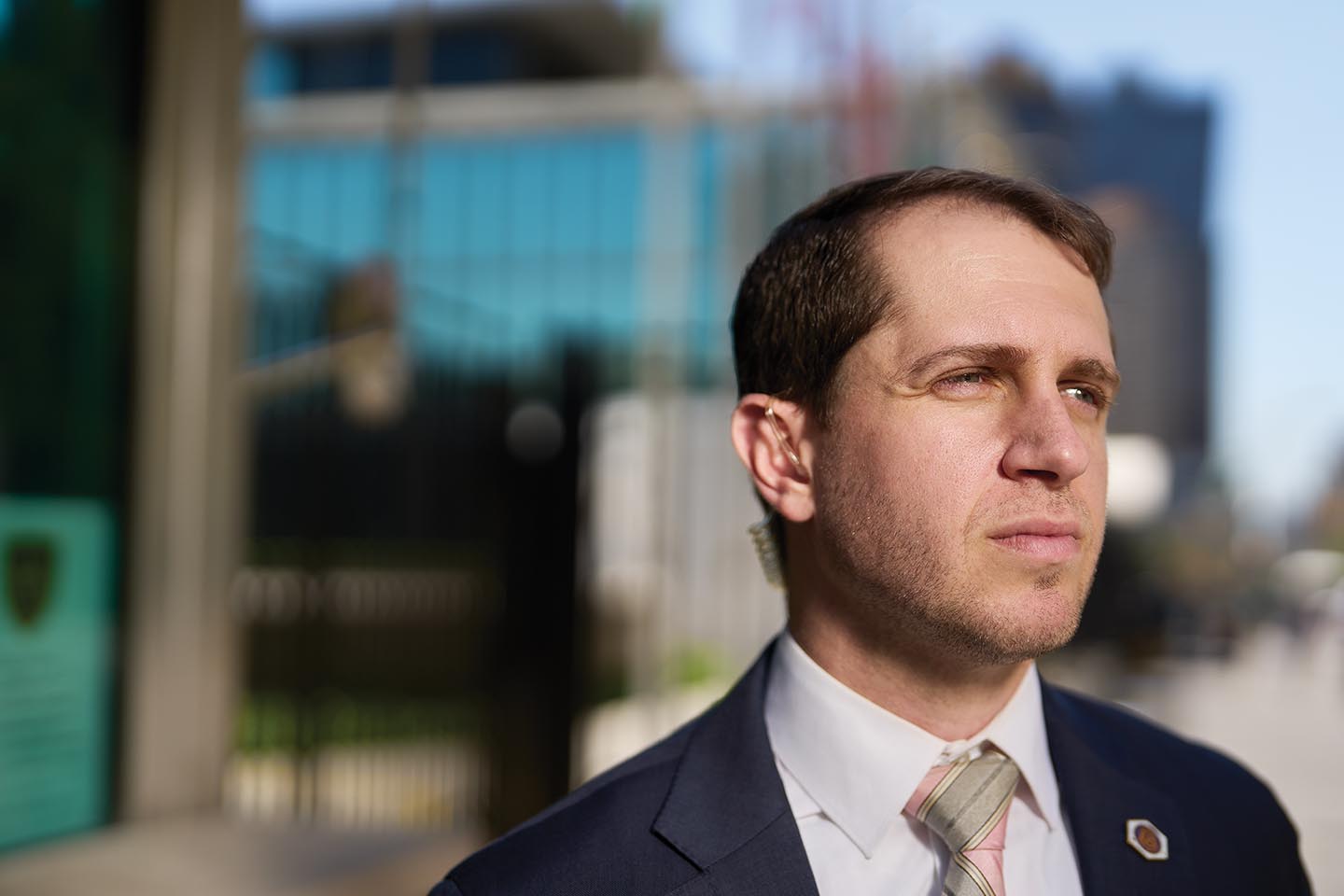
DSS special agent Salem Hoffman-Sadka ’17 works protective detail for U.S. Ambassador Linda Thomas-Greenfield.
Salem Hoffman-Sadka ’17 is “not a big person,” he says. The special agent for the U.S. Department of State’s Diplomatic Security Service (DSS) mentions his physical stature because, for the type of work he does, one might picture a tall, imposing figure. “I’m 5’5″/5’6″ on a good day,” he jokes.
That’s not to say Hoffman-Sadka doesn’t work to stay fit. He regularly practices martial arts and stays active, as required. But, he says, he prefers to lean into his interpersonal skills. “That’s a strong suit of mine…. When you win someone over, they’re going to go the extra mile. I’ve found it’s always beneficial and helps with the job.”
His current assignment is protective detail for U.S. Ambassador Linda Thomas-Greenfield. “Basically, I’m with her all the time,” says Hoffman-Sadka, who is part of a larger protective detail of men and women. Thomas-Greenfield is based in Manhattan — as is Hoffman-Sadka — so he handles protection for her in the city, but he also accompanies her on domestic and international trips. “It’s incredibly rewarding to provide a secure environment for such a high-ranking figure to conduct diplomacy,” he says.
The security detail members rotate through positions, so sometimes he’ll be in the protective circle that walks her through the crowd, or as detail leader by dictating agent responsibilities, for example. “My favorite position is ‘lead advance agent,’” Hoffman-Sadka says. That means he’s the one who enters the venue first in order to make contact with the staff and assess the security factors so his team knows what they’re heading into. The responsibilities in this role can range from securing the event venue, to the hotel where she’s staying, to the plane on which she’s traveling. For an international trip, it involves planning and delegating the security elements of the ambassador’s entire visit, which often requires tight working relationships with security and protocol for the host nation.
When there are high-level meetings — like a joint conference with Vice President Kamala Harris — Hoffman-Sadka needs to work with the Secret Service and other government employees. On trips abroad, he’s making contact with the police chief of Freetown in Sierra Leone and the director of national security or Iceland’s “Viking Squad” (the country’s special police unit), for example.
“[It’s important to] remember common courtesy,” he says. “You’re showing up at someone’s place of work, and you’re coming in hot with all of these questions. It’s a lot.” To establish rapport, Hoffman-Sadka likes to spend a few minutes in the beginning asking someone how their day is going and express genuine interest in the individual. “I find they’re much more helpful,” he says.
Hoffman-Sadka credits his previous experiences with helping him hone his personal skills. At Colgate, the peace and conflict studies major was involved in Outdoor Education, and after graduation, he was a field guide at a wilderness adventure therapy organization for young adults in Utah. Afterward, he became an after-school instructor teaching elementary-age refugee children. “It’s funny how those experiences help here and there in a totally different circumstance,” he says.
Working for the Department of State had long been his goal, which was reinforced by a DSS special agent who was a Colgate alumnus visiting campus when Hoffman- Sadka was a student. The two kept in touch and “he would give me advice, like recommending I get my foot in the door by doing uniformed division (a police officer for the Secret Service),” Hoffman-Sadka recalls. “I’m sure he was right; it would’ve been the easiest way in. But I ignored him and did things I was excited about.”
Hoffman-Sadka’s postgraduation 10-year plan to join national security was rooted in a life-changing event: living in New York City when 9/11 happened — he was 6 years old. Hoffman-Sadka’s mom worked in the twin towers “and thank God she was OK,” but afterward, he was constantly making sure the doors were locked, double-checking windows, and buckling up his brother. “I was probably pretty annoying,” he notes. In middle and high school, “if I found a book about the FBI or CIA, I would read it in a day. I became fascinated with it, and really excited about it.”
In 2020, after a process that took approximately a year and a half — from the online application to the interview to the background check and fitness test — Hoffman-Sadka officially received the job offer from DSS. His first assignment was to the DSS New York field office’s criminal investigation unit. There he was part of a human trafficking investigation that rescued two Indian women who were being held in a house and forced to work for the equivalent of a dollar an hour. It was a happy ending for the women, and Hoffman-Sadka remembers it as “really powerful to go through” personally.
As part of the foreign service, he receives a new assignment every two to three years. His next tour will be at the U.S. Embassy in Brussels, handling security management. Brussels is considered a tri-mission because there’s the embassy to the Belgian government; a mission to the European Union, which is housed there; and a mission to NATO, which is also housed there.
“It’s amazing the experiences you get in this work by connecting with all these different folks,” he says. “It’s a cool gig.”
This article does not represent the opinions of the United States Department of State.