

Oct. 14, 1928 – Jan. 14, 2024
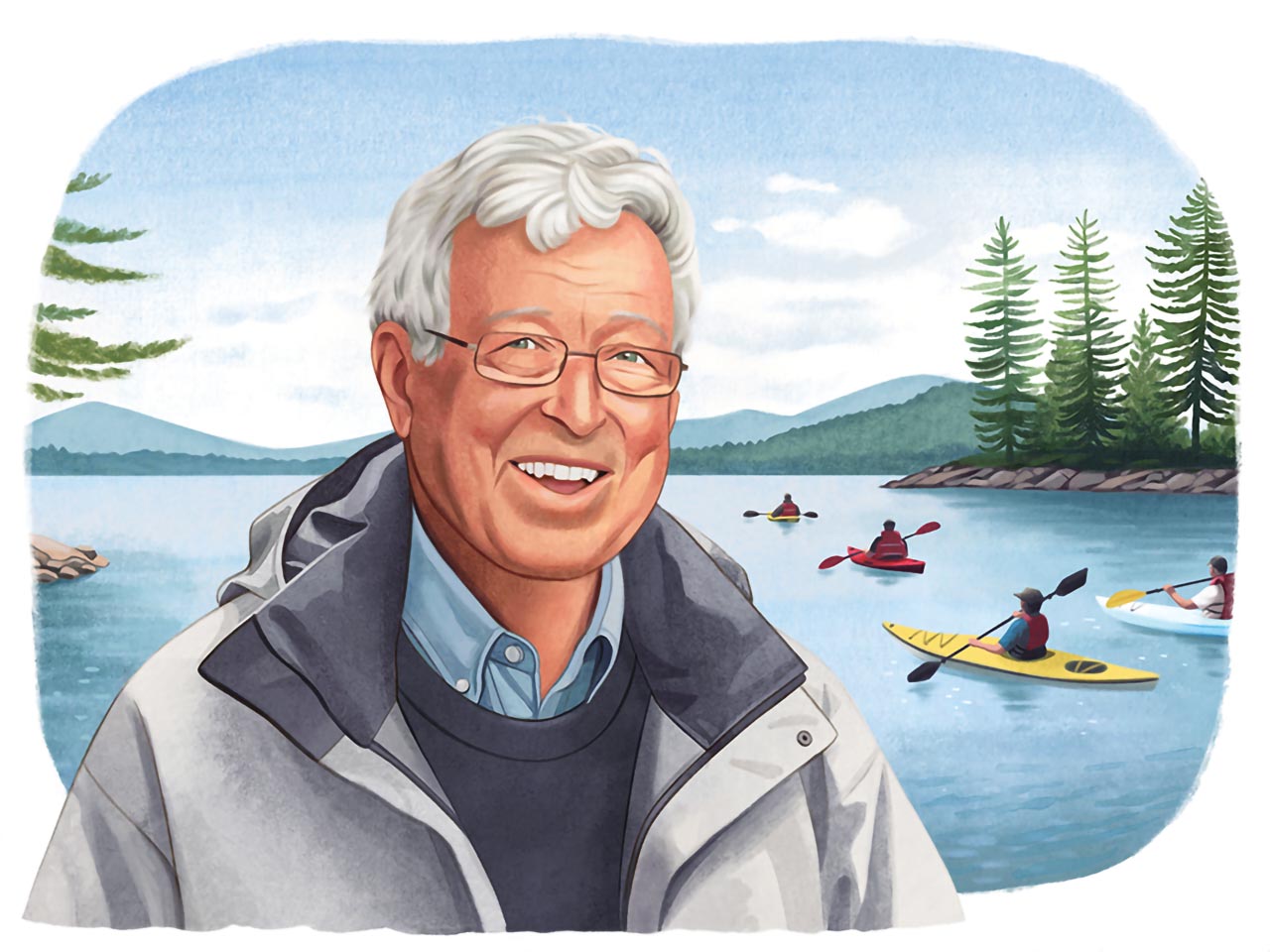
Charles “Charlie” Morrison Jr. ’50 had a “key role in most of the major land-protection efforts in New York State in the last 25 years of the 20th century,” according to a tribute written by two Sierra Club Adirondack Committee members. He was known as a soft-spoken, behind-the-scenes player who was “sometimes not-so soft spoken” in his fight to protect the environment both as a government employee and a citizen activist.
Morrison grew up in New Jersey and started exploring upstate New York while attending Colgate, where he was a member of the swim team and Theta Chi. He majored in geography before graduating to pursue a master’s in economic geography from Columbia University.
He began his career as a research assistant for the American Geographical Society (AGS) in New York City, studying North American glaciers and volcanoes in Mexico. He met his wife, Marie, through the AGS, where she was his glaciology colleague; they wed at Colgate Memorial Chapel in 1958.
“It was North American landscapes being cut up, dug up, and paved over for industrial, commercial, highway, and residential developments that motivated Charlie to join the secretary of interior, Stewart Udall, in Washington, D.C.,” explains colleague David Gibson on the online forum Adirondack Almanack.
Starting in 1964 at the then-newly formed U.S. Department of Interior’s Bureau of Outdoor Recreation and the Recreation Resources Review Commission, Morrison helped develop reports that led to the creation of the Land and Water Conservation Fund and the Wild and Scenic Rivers Act. He also helped prepare the first Nationwide Plan for Outdoor Recreation and the 1965 National Recreation Survey.
In 1967 Morrison moved to Saratoga County — which would become his home for more than 50 years — to become director of the new Commission on Natural Beauty, reporting to Governor Nelson Rockefeller. During that time, he worked with the governor’s Temporary Study Commission of the Adirondacks. He also led the community assistance office and founded the Environmental Planning Lobby (now Environmental Advocates), one of the first organizations in the nation to advocate for the future of a state’s environment.
Morrison’s long career with the Department of Environmental Conservation (DEC) began in 1970, when he joined the newly established organization as director of land resources planning. He was active in planning for Lake George, helped to establish the Champlain-Adirondack Biosphere Reserve, and led the DEC’s work on the state coastal management program. In addition, Morrison was involved in the state’s scenic byways program.
While he worked for many years for federal and state environmental agencies, he also valued the importance of public and independent environmental advocacy. “Many people acting in an official capacity within national or state government would shun all intrigues with outside environmentalists. Charlie was not one of them,” wrote Gibson. “While working for DEC, Charlie conspired with nonprofit advocates to try to make things happen that would strengthen ‘forever wild,’” he added, referring to the phrase used in the New York Constitution that protects the forest preserve.
After retiring in 1995, Morrison devoted himself to nonprofit volunteerism. He continued to work on regional environmental issues through board and committee service with the Sierra Club Atlantic Chapter, the club’s Adirondack group, Environmental Advocates of NY, the Association for the Protection of the Adirondacks, Protect the Adirondacks (of which he was a founding member and led the organization in its first years), and Adirondack Wild: Friends of the Forest Preserve. While living in Saratoga Springs, he was a citizen activist, working on its conservation committee to protect wetlands in the area, expand Saratoga Spa State Park, and address problems with the city’s water supply.
One of Morrison’s greatest environmental achievements, according to a Protect the Adirondacks post, was his pivotal role in championing public navigation rights on Adirondack waterways. In collaboration with the Pace University law school and Sierra Club activists, Morrison’s work led to a New York State Court of Appeals ruling that the usefulness of a stream for recreational travel, not just traditional commercial use, must be considered.
In 2022, at age 93, Morrison left New York State to be closer to family in Seattle. A group of friends and fellow activists calling themselves “the Charlie Committee” gathered at his home to say farewell. As he told them all, “I still have environmental work left to do — with my grandkids.”
Predeceased by Marie, his wife of 52 years, Morrison is survived by four children, a granddaughter, a great-granddaughter, and nieces and nephews.