

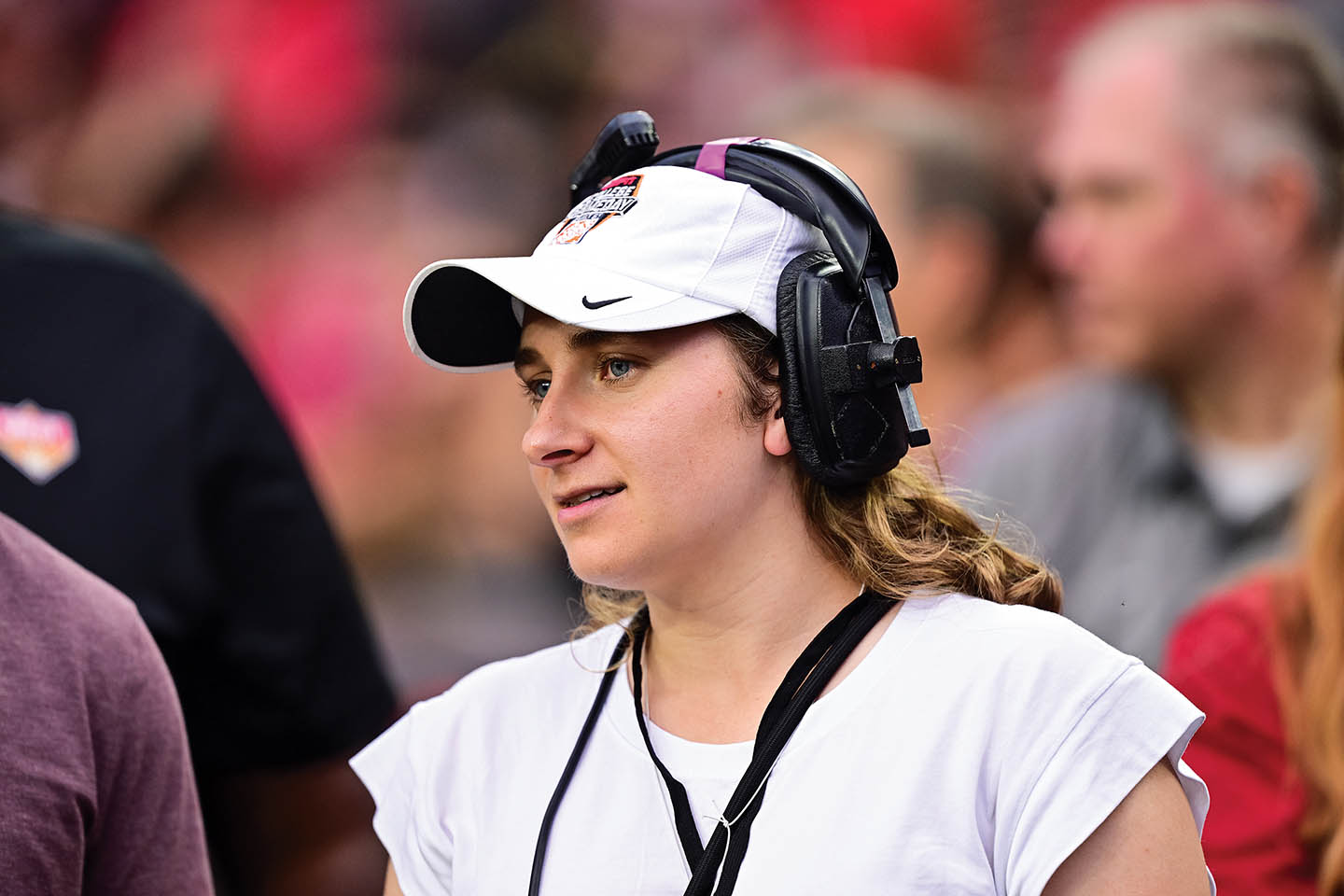
With fist-pumping, face-painted fans as a backdrop, ESPN’s College GameDay is a weekly TV must for nearly 2.8 million college football fans around the country. The tailgate-style pregame show isn’t just adrenaline fuel — its smart analysis helps fans understand the facts and figures that set the stage for some of the game’s most important matchups. Behind it all is research producer Marisa Dowling ’16, who provides show hosts with data ranging from the compelling to the quizzical. She’s about to embark on her seventh year in the role. Says host Pete Thamel: “Marisa is the backbone of what we do.”
Down on the Farm
Dowling’s passion for all things sports started as a kid in the backyard of her family’s Stratford, Conn., home. “My brother and I would play Wiffle ball until dark,” the lifelong Yankees fan says. “We would imitate players’ swings. We’d do Gary Sheffield and Ken Griffey Jr., and I always wanted to be Derek Jeter, of course.”
Dowling’s parents were multiple-sport athletes in high school, and they encouraged both of their kids to play a variety of team sports. “It helped us see where our interests lie and what our strengths are,” says Dowling, who especially excelled on the softball field.
Team Player
Dowling’s softball prowess earned her a scholarship from Colgate, where she played shortstop and was team captain for three years. For Dowling — on the field or behind the scenes for a national broadcast — teamwork is her lodestar. “It’s more fun when you succeed together, because then you can share in that joy,” she says.
In the classroom, the English major and philosophy minor learned the power of discernment and incisive thinking, skills that help Dowling in her work today. “I liked hearing professor and student perspectives in my philosophy classes, which are applicable to almost everything,” she says. “It led me down paths I hadn’t thought of previously.”
In the Huddle
In weekly production calls, Dowling and ESPN hosts brainstorm talking points for potential games the network will cover the following Saturday. She’ll then scour the internet for information about the teams and players and interview athletic directors for background.
Her research has generated compelling insights. Recently Dowling collaborated with host Rece Davis to highlight the impact of travel on team records.
“The Big Ten proved to struggle the most, going 5–12 when traveling multiple time zones in conference play in 2024,” Dowling says. “And in the past couple of seasons, the University of Southern California did not do well when traveling more than 1,000 miles. I immediately took the deep dive and was able to document and definitively say that USC is 2–8 when traveling more than 1,000 miles, including a 1–9 mark against the spread under head coach Lincoln Riley.”
Life on the Road
Dowling faces many of the same travel rigors as the players she covers. During college football season, she flies to a college campus on Thursday and doesn’t return to her West Hartford, Conn., home until Saturday night. Work weeks can stretch to 70 hours.
“When I first started, there was so much thrown at me that it was hard to balance everything, but I’ve felt better each year about the way I’ve budgeted my time,” she says. “I try to carve out time to grab dinner with a friend or prioritize seeing my family on Sunday afternoons.”
Game Day
College GameDay is broadcast live from college campuses. The setting is its own kind of tonic. “We’re living in the moment, we’re going with the crowd,” Dowling says. “When we see a really energetic crowd, it gives us that extra kick we need. These fans, these students, they get so excited when we’re there. We feed off of their energy, and we know we’re going to have a great show.”