

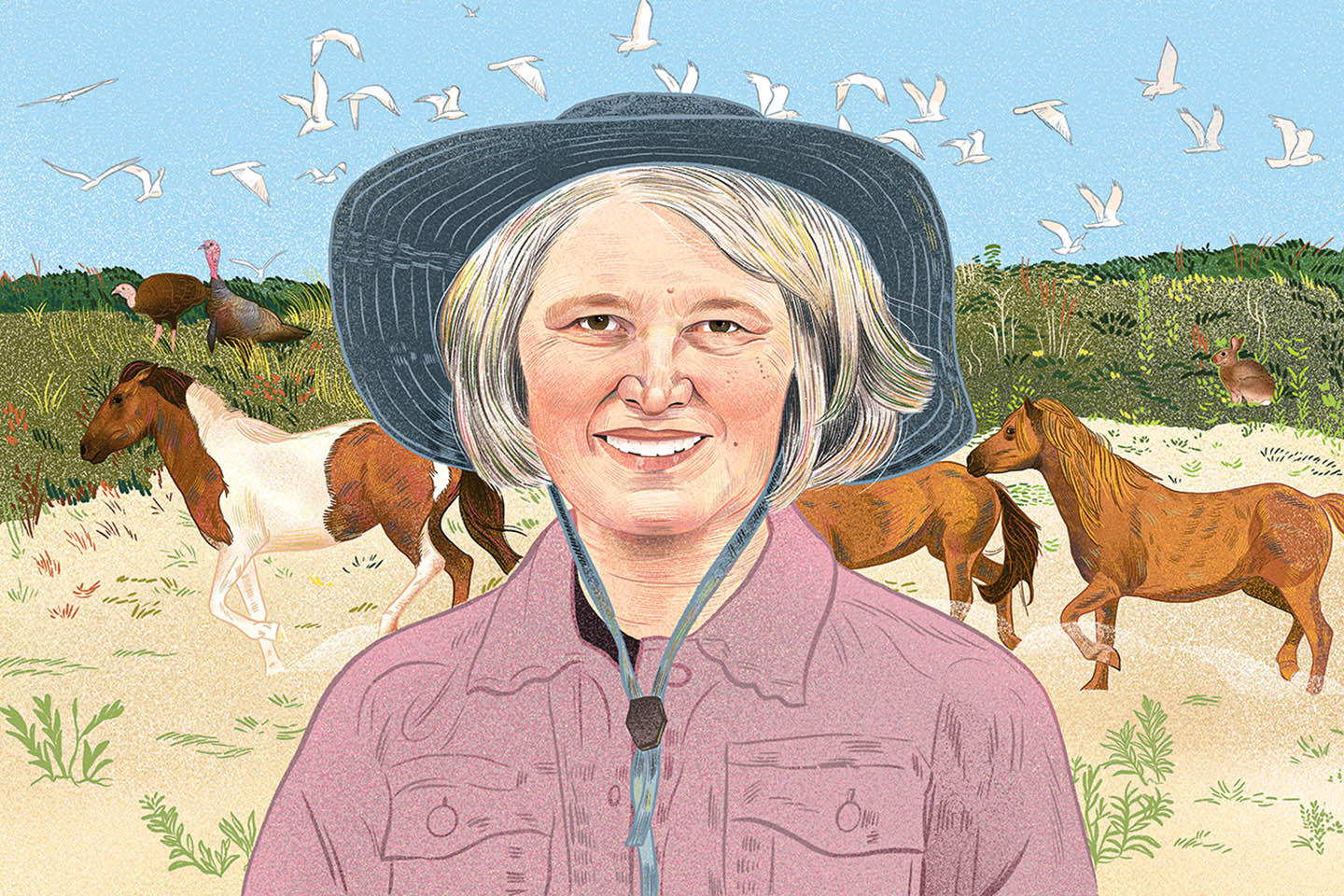
It’s a place like no other, Holly Nye ’82 says of Assateague Island.
“The sun rises over the ocean and sets over the bay. We can walk two minutes to the dune crossover in the morning and evening to witness both,” says Nye.
Along with her husband, Ken Williams, Nye makes the barrier island in Maryland her home for about six weeks each year. As volunteer educators at Assateague State Park — on the northern end of the island’s 37 miles of undeveloped coastline between Ocean City, Md., and Chincoteague, Va. — the couple has lived and worked at the park each summer since 2022, first as campground hosts and then as naturalists in residence. Their compensation is a campsite and electrical hookups for their RV.
A retired United Methodist pastor, Nye majored in English at Colgate and went on to earn a master of divinity degree at Drew University Theological School. “Apart from my general interest in marine science and conservation,” she says, “my main qualification [for the naturalist job] is a lifetime of interacting with all kinds of people of all ages.”
Nye’s love for the island runs deep. Camping near the ocean was an annual summer rite for her family when she was growing up. She and Williams, who live in Saratoga Springs, N.Y., took their own family to Assateague State Park over the decades. “People can hike, paddle, camp, fish, surf, and birdwatch in peace and quiet,” she says. “I love this place, and my children grew up loving this place.”
Their six-week roster is packed. The couple leads environmental education workshops with school groups from the area all week; on weekends, they work at the campground nature center, hosting scout groups and educating other campers.
“I appreciate interacting with the children, teachers, parents, and bus drivers who come with the school groups,” says Nye. “We teach a range of subjects: sharks, whales, horses, beach erosion, ‘killer trash,’ the effect of plastic in the food chain, and more.”
The island’s diverse ecosystem provides plenty of opportunities to learn about nature firsthand, she explains. Pelicans, gulls, osprey, and oystercatchers are among the birds who call the island home, along with foxes, rabbits, deer, and wild turkeys. Dolphins and sharks frequent the coastal waters, and in the colder months, visitors can spot seals and migrating whales.
“But the star of the show is the wild horses,” she says of Assateague’s famous inhabitants, who have lived on the island since the 1600s, adapting to harsh weather and sparse food and water. For many campers, spotting a band of horses is the highlight of a visit — and it’s Nye’s job to make sure they do so safely.
“They are very much wild animals, and part of our work is helping people understand that they cannot be treated as domestic horses would be.” Case in point: While chatting with a group of campers earlier this season, Nye recalls, “a band of wild horses came into our camping area, and we reminded people to keep 40 feet of distance and photograph from a safe space.”
Adapting to the weather is also among the challenges Nye and Williams encounter during their residency. “We get to ‘enjoy’ all the storms and gale-force winds that happen in springtime along the coast,” she says. “It’s all part of the island experience.”
There is a bonus at the end of their busy days, says Nye: “Most nights we fall asleep to the sound of the waves.”