

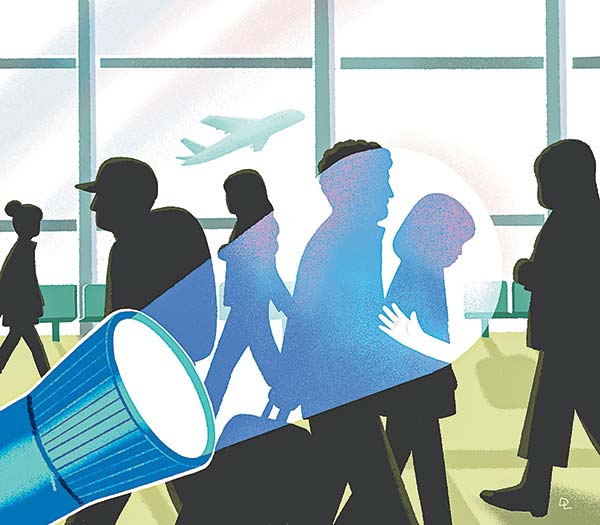
Worldwide there are more than 27 million victims of human trafficking, according to the International Labor Organization. It’s Beth Pfenning’s job to raise awareness and provide education about the issue in her role as international relations specialist and counter-trafficking adviser for the Office of International Transportation and Trade at the U.S. Department of Transportation (DOT).
Why is Pfenning ’09 at DOT? “Bad actors are using our roads, airspace, waterways, and railways,” she says. “We also see the risk of labor trafficking within supply chains, like mining and manufacturing.” Construction, security, warehousing, custodial work, and baggage handling can also include forced labor.
She explains, “My role is rooted in public safety” — getting materials to these workers so they can have the knowledge to recognize and report trafficking.
Take the Blue Lightning Initiative, a DOT and U.S. Department of Homeland Security joint project in aviation. It equips gate agents, flight attendants, pilots, and customer service staff with trafficking indicators to watch for, how to report it, and how to proceed safely. “Trafficking victims have used the restroom in an airport or aircraft, seen signage, and chosen that opportunity to identify themselves to an employee,” Pfenning says, “which has set in motion a positive response.”
The victims are targeted, Pfenning says, because of prior abuse or neglect, poverty, unemployment, or unstable living conditions — often exploited by people they know. Officially, human trafficking involves force, fraud, or coercion to compel someone into labor or commercial sexual activity against their will.
Raised in a military family, Pfenning has long been drawn to public service. Her first jobs were with the Center for Reproductive Rights and the Washington- based nonprofit Polaris, which aims to stop human trafficking. She then joined the U.S. Department of Health and Human Services, where she was more involved in the field of direct services grants, survivor engagement, and public health trainings.
Even though she now works in policy, shaping systems and building new programming can be intense work. “As is often the case in Washington, the changes we’re pursuing can seem incremental,” she muses. But the effort is still critically important for challenging “the status quo and advocating for the rights of others. That hard work is one of the absolute privileges of my life.”
What You Can Do
At an airport, train station, or rest stop, you may come across a situation that makes you think of Pfenning’s work. Here’s where you can play a small part to help. Call 911 (for mandated reporting situations), call the National Human Trafficking Hotline at 1-888-373-7888 or text 233733, or flag down someone in a position of authority or security. Include details: the date and time, the place, who or what you saw, and what led you to report. Don’t worry about whether a tip is actionable. Sometimes “victims have a brief moment away from their trafficker where they can ask for help,” Pfenning says. “The transportation workforce and the traveling public are our eyes and ears.”
The views and opinions expressed in this article do not necessarily represent the views or positions of the U.S. Department of Transportation or the United States government.