

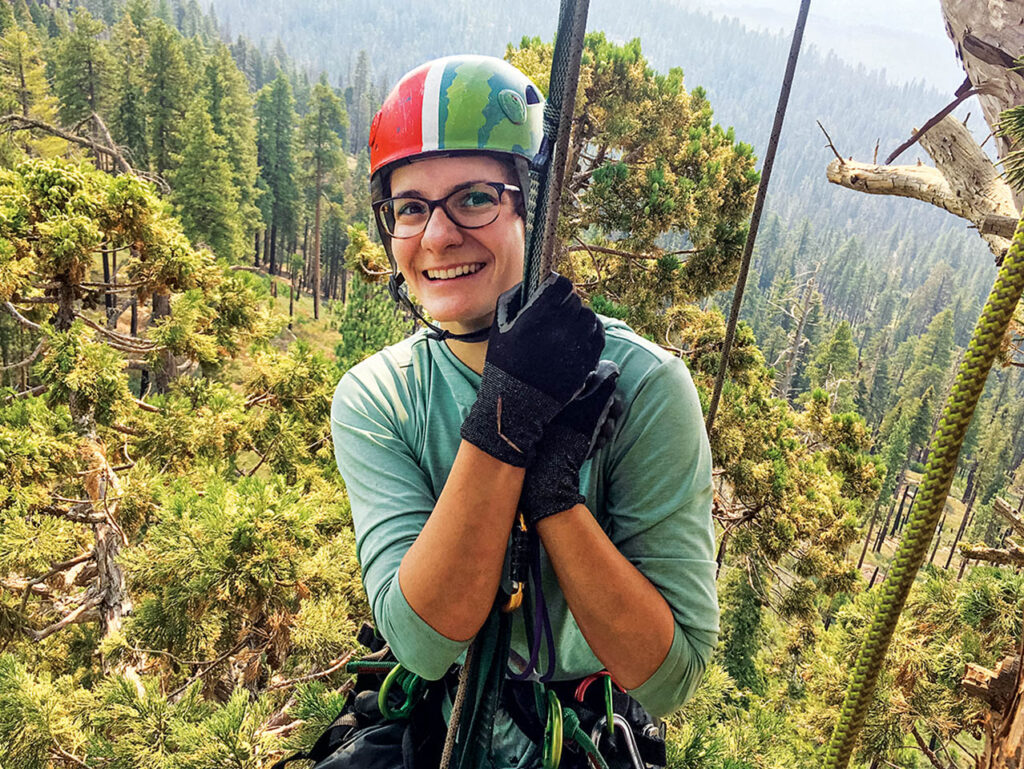
Growing up close to New York City, Ana Tobio ’18 was surrounded by man-made structures for much of her young life. So, when she arrived in Hamilton for her first year at Colgate, she found herself immersed in an entirely different environment — one filled with more greenery than she’d ever known.
“I felt like I entered this new world,” says Tobio. “I was like, ‘Oh my god, how have forests and open space been kept from me while I was living in suburbia?’ It was very eye-opening.”
Those early moments on campus made a lasting impression on Tobio, sparking a lifelong fascination with the natural world — and eventually a career in environmental science. Today she lives on the eastern slopes of California’s Sierra Nevada, where she investigates the state’s diverse ecosystems as an ecologist. When she’s not working, she spends much of her free time in nature, too, rock climbing and exploring the American West in her converted camper van.
Finding Herself in Nature
Tobio may have grown up far from nature, but her family hails from rural Spain, where they lived as subsistence farmers and had an everyday connection with the landscape. “I see [my career and lifestyle] as going back to my roots in a way,” she says. “They spent a lot of time outside and were very familiar with the world around them.”
When her parents immigrated to America, they settled in New York City before moving to New Jersey. Like many first-generation Americans, Tobio felt pressure to succeed and validate her parents’ sacrifices. She enrolled at Colgate with plans to study computer science, hoping to land a stable, high-paying job as a software engineer.
But once she got to campus, her aspirations shifted. She joined the rock climbing club, went cross-country skiing, took geography courses, and started working as a research assistant with Professor Michael Loranty, who directs the environmental studies program.
“Those classes and that work, coupled with my budding outdoor hobbies, got me really curious about ecosystems and what is influencing their processes, structure, and composition,” she says.
After graduation, Tobio dabbled in a variety of environmental science roles before settling into ecological research. She now works for the California Native Plant Society, supporting efforts to develop a statewide hierarchical classification system for interpreting vegetation patterns across the state.
As an associate vegetation ecologist, Tobio analyzes data to understand which plants are present, how they’re grouped together, and which underlying environmental factors are shaping their distribution. These plant communities also have unique characteristics in terms of fire and disturbance regimes, climate feedbacks, wildlife habitat, and more.
“We are working to inventory, classify, and map vegetation across California,” she says. “The best way to think of it is similar to plant and animal hierarchies, where you have kingdom, family, genus, and species. We’re doing the same thing for plant communities. You could have a conifer forest, and then you could get more specific — you have a sugar pine forest. And then even more specific — a sugar pine forest with huckleberry oak on serpentine soil. Using that classification system, we can map vegetation across the state.”
One of the project’s overarching goals is to identify plant communities that are threatened or sensitive and in most need of protection.
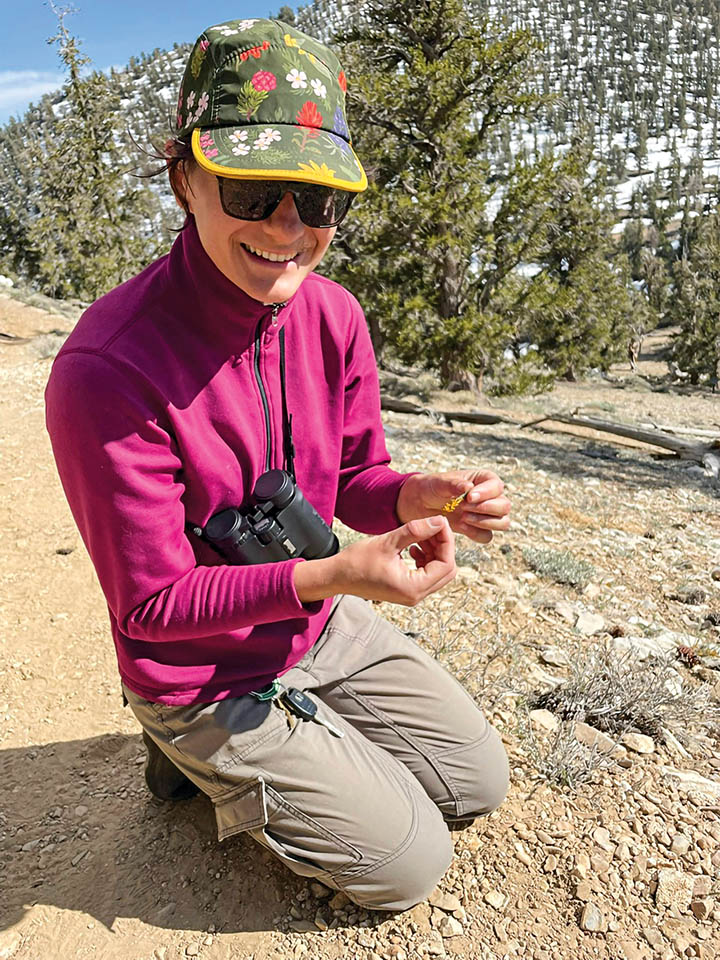
“We don’t save individual plant species in isolation — plants belong to communities, and those play foundational roles in ecosystems,” she says. “Other researchers can use this data to look at wildlife habitat or fire dynamics or watershed health, or land managers might use it to help better steward their land and determine the best areas to conduct prescribed burns.”
Because of budget cuts, she’s spending summer 2026 on sabbatical, with hopes of returning to the organization once funding becomes available again in the fall. In the meantime, she’s pursuing her other passions. She’s focusing on rock climbing, with a goal of climbing El Capitan in Yosemite National Park.
Additionally, Tobio is volunteering with the nonprofit Yosemite Conservancy as a member of the climbing management team, helping to restore degraded sites, patrol popular routes, and provide education and outreach on proper climbing practices and ethics.
At press time, she was also hoping to have time for independent botanizing across the Sierra Nevada mountains. “There are historical records of where [rare plant communities] have been observed, and I’d like to revisit those to see if they are still intact and take notes on population health, threats, and phenology,” she says. “Maybe I’ll find some new populations along the way.”
Resilience and Reinvention
Though the natural world is changing fast — because of climate change, human development, pollution, wildfires, and other pressures — Tobio maintains a clear-eyed perspective. Her time in nature has taught her that the world is constantly evolving, and that there’s no one “best” state of being.
“All of these ecosystems might seem like fixed witnesses across space and time, especially compared to our limited human existence, but they’re actually really dynamic,” she says. “It’s hard to see the places we care about changing, but what gets me through is not viewing these changes as black or white, good or bad — they’re just different. Nature is so adaptable and resilient.”
Over the years, Tobio has come to see that same adaptability reflected in human life too. Like ecosystems, individuals and societies also face disruption — a lack of funding, for instance, or larger forces like social injustice, political violence, and corruption — and must decide how to respond.
“We can begrudgingly hold on to the past, or we can take note from nature and use the tools we have available to us to build [something] new,” she says.