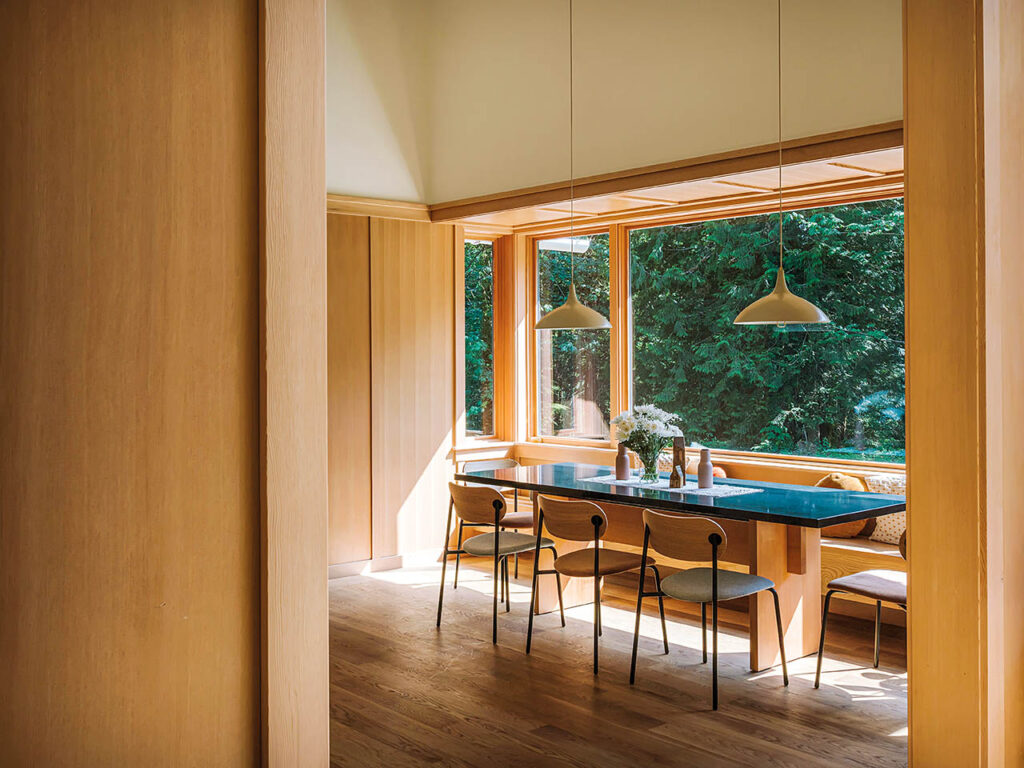
When Neal Barber ’14 designs a home, he draws inspiration from his native landscape: the Pacific Northwest.
The striking mountain retreat he designed in Maple Falls, Wash., for example, recalls the scenic wooden barns that dot the region’s hillsides. Rustic planks on the exterior contrast with corrugated siding used on another portion of the façade. Situated in the foothills of the Cascade Mountains, the 2,600-square-foot residence features large, two-tiered windows built into the wood paneling, making it look as if the landscape were a picture hanging on the wall.
“Rather than having the home dissolve into the landscape, we were intending for it to be the frame by which one views the landscape,” Barber says.
Beyond aesthetics, sustainability was also a driving force behind Barber’s vision. For its high-performance systems and energy-conscious design, the home received a 2023 U.S. Department of Energy Housing Innovation Award.

Since founding Studio Nocturne Architecture in 2021, Barber has garnered national recognition for projects that marry sustainability with what he calls “alpine aesthetics.” Rooted in the Pacific Northwest tradition of drawing from nature, his approach diverges from the region’s modernist style, in which structures are designed to blend seamlessly into the surroundings. Instead, his buildings are meant to stand as visible presences in the terrain and “interact with nature in a different way,” Barber explains.
Barber became interested in architecture as a high school student at UPrep Seattle, where he took an introductory architecture class. When it came time to apply to college, he chose Colgate because it offered a concentration in architecture in the art department.
By the end of his first year, Barber was committed to the field. He was inspired by an introductory architecture studio class taught by Robert Petrie, a visiting professor from Syracuse University. “It was the kind of work that didn’t feel like work, and I was excited to spend extra time on the material,” he says.
Besides exploring as many architecture, art history, and studio classes as he could, Barber became a leader in Colgate’s Outdoor Education Program, taking students on backpacking trips before firstyear orientation. Not only did he learn to whitewater kayak in the Adirondacks, but he also developed a curiosity about nature that would later inform his architecture work.
“The Outdoor Education Program gave me the skills and confidence to pursue hobbies that take me into the mountains,” he says. “Those experiences have shaped my work’s relationship to nature and landscape.”
While earning a master’s degree in architecture at the University of California Berkeley College of Environmental Design, Barber won a traveling fellowship. For his project, he proposed studying the design of mountain huts and spent a year visiting alpine shelters in the United States, Iceland, France, Switzerland, Italy, and Slovenia.
His travels led him to home in on a style of architecture that would become his trademark. “The traveling fellowship was the most singularly influential event in developing my own take on architectural design,” he says.
After working for two architecture companies in Seattle, Barber launched Studio Nocturne Architecture and now works from a studio in the home he designed for his family in Kenmore, a Seattle suburb.
Since opening his firm, Barber has focused on custom residential design that combines sustainable building with sensitivity to the surrounding landscape. Whether designing a new home or renovating an existing one, he integrates the environment in ways that serve each client’s needs.
In Bothell, Wash., for example, a new entryway features a steel frame and a mirror finished canopy that bounces daylight into the house — a design choice that reflects his larger, nature-inspired approach.
“Architecture influences the way we view and interact with the world around us,” he says. “We take that fact very seriously when we design.”