

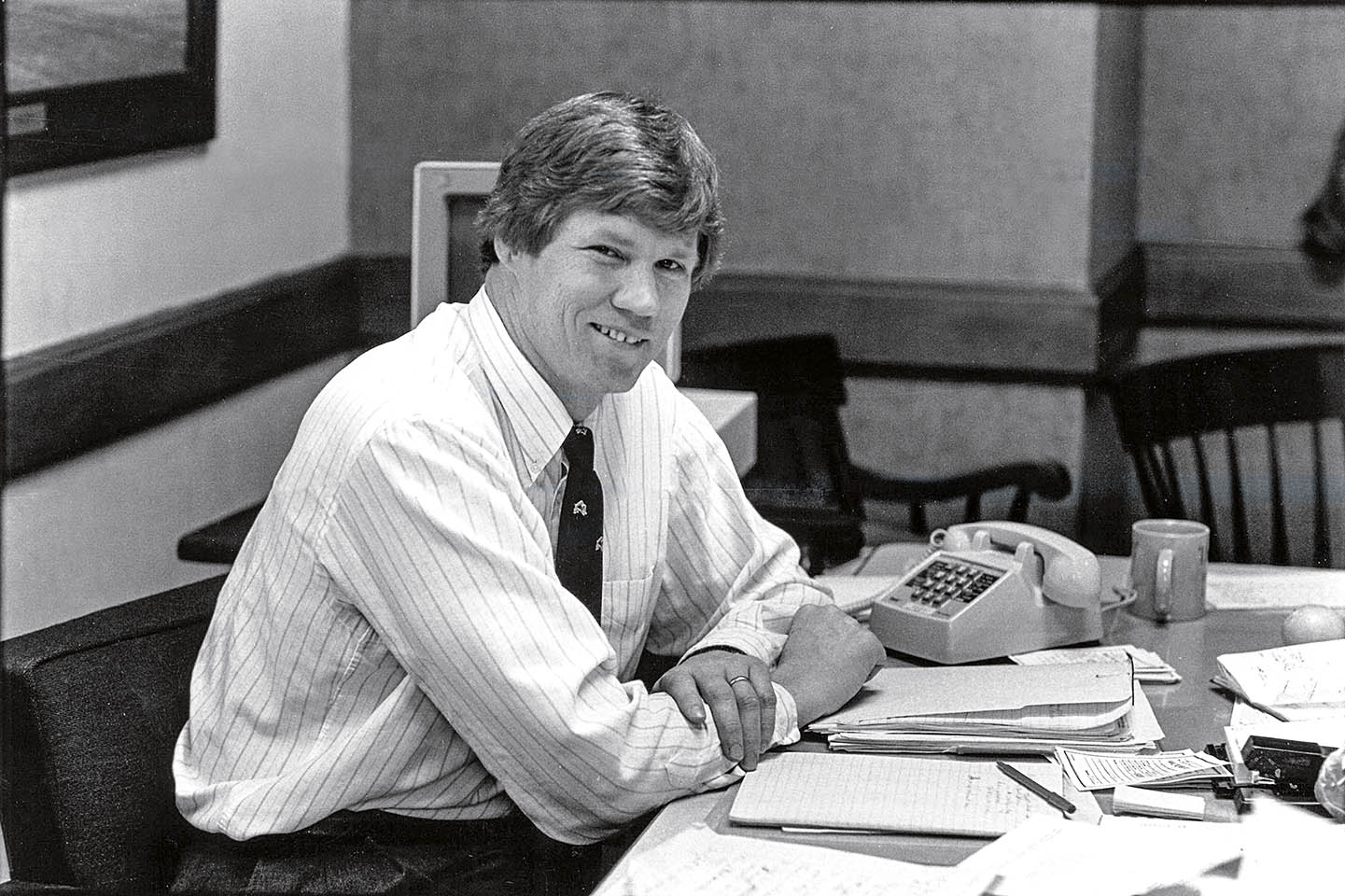
In the early ’90s, Mark Murphy ’77 was an attorney with the U.S. Department of Justice (DOJ), a career he enjoyed and was expecting to continue for years to come, when a new opportunity emerged.
Colgate, his alma mater, was searching for a director of athletics.
Murphy had a degree in economics from Colgate and played four seasons of football with the Raiders. He played eight seasons as a safety with the then-Washington Redskins, winning a Super Bowl and earning one trip to the Pro Bowl.
After retiring from pro football, he landed a job with the NFL Players Association, then later spent three years as a federal prosecutor with the DOJ. By this point, roughly 15 years after leaving Colgate, he had plenty of experience in various roles, but little when it came to running a collegiate athletics department.
Nevertheless, he applied.
When he interviewed for the job, one of the people who had a major say in the hiring was then-Colgate President Neil R. Grabois — who was impressed with Murphy’s vision for Colgate athletics. Murphy got the job, and just like that, his career veered in a whole new direction.
“As I look back, I’m really appreciative that Colgate and Neil Grabois hired me as the athletics director,” Murphy says. “That completely changed my career trajectory. I was looking at a career as an attorney. I enjoyed my work at the Department of Justice, but I missed my involvement in athletics.
“Colgate really took a chance on me,” he adds. “I was relatively young and inexperienced in terms of intercollegiate athletics.”
Murphy was Colgate’s athletics director from 1992–2003. Afterward, he took a similar role at Northwestern University, where he spent four years before he returned to the NFL, this time as the president and CEO of the Green Bay Packers.
He would go on to achieve a remarkable career, managing the franchise for 17 years. In that time, the Packers had a record of 172-101-2, becoming the winningest team in the NFC North. He signed quarterback Aaron Rodgers to a long-term deal after one season as a starter, a move that helped cement Green Bay as a division powerhouse.
The Packers made eight consecutive playoff appearances with Rodgers, winning the Super Bowl in 2011. Rodgers’ career with the Packers later earned him a spot in the Hall of Fame.


In addition Murphy helped lead a project to expand Lambeau Field, adding 6,700 seats. Under his watch, the Packers built the Titletown District, a development that brought residential housing along with commercial and public spaces near the stadium. The Titletown District played a big role in bringing the 2025 NFL Draft to Green Bay, which was a proud moment for Murphy, who got to introduce the Packers’ first-round pick.
Murphy, 70, retired in July, leaving Lambeau Field as a beloved executive who helped take the Packers to new heights. “I know I can’t completely retire,” he said at the time, adding, “I’m looking for things that will keep me engaged.”
To that end, not long after, Murphy decided to go back to college. In August he became the University of Wisconsin-Green Bay’s first executive in residence, a role through which he will help strengthen the Division I program, build partnerships, assist with strategic projects, and mentor coaches and staff. “With all the changes that are taking place to athletics, I look forward to being helpful there,” he says.
Mark Murphy ’77 met his wife, Laurie (Young) ’78, when he and a friend were driving to Florida for spring break his junior year and the car broke down. Through a ride-share program at the Coop, Mark and Laurie ended up in the same car — and they’ve been traveling through life together ever since.