

In rural Tulare County, Calif. — the heart of the state’s vast Central Valley — agriculture is king, and cows outnumber people. In many of its poor, unincorporated communities, manure and nitrate fertilizers have fouled drinking water, threatening the health of residents, up to 70% of whom are undocumented laborers working the grape, orange, and pistachio fields.
A few months after graduation, Tom Collishaw ’80 came to this hardscrabble place through VISTA (Volunteers in Service to America, a federal anti-poverty program), after majoring in English and history at Colgate. Upon witnessing the need firsthand, he never looked back.
“Everybody is just a paycheck away from a real crisis,” says Collishaw, president and CEO of Self-Help Enterprises (SHE), a nonprofit housing and community development organization. He took permanent work at the organization in 1983.
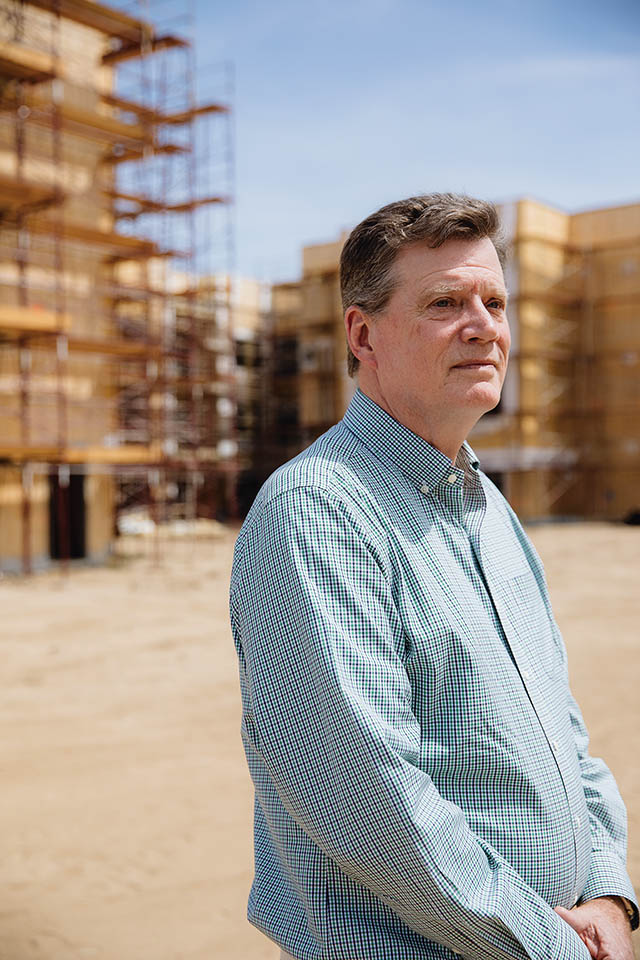
In that 42-year tenure, Collishaw has installed water tanks in 160 impoverished communities where the tap water is unsafe to drink. He’s also helped to create 10,000 affordable housing units through SHE’s pioneering mutual self-help housing model, in which families build their own homes together in nine counties that traverse the state’s spine.
SHE started as a bold experiment in the 1960s, a Quaker initiative inspired by a farmworker’s simple dream: “I want a home for my family.” It was the first effort of its kind in the country, and it would spur the creation of similar rural efforts in 38 states.
The need has never gone away.
Besides nitrates, naturally occurring arsenic contaminates wells in unincorporated communities that don’t have access to municipal water systems. Today, given heightened immigration enforcement, undocumented workers are loath to draw attention to their plight.
“There is such fear in the communities,” says Collishaw, noting that SHE distributes “red cards” to community members detailing their constitutional rights, should they encounter federal immigration agents. “People are not sending their kids to school because they’re afraid they might be picked up. They’ve seen this movie before.”
The challenges transcend the visceral. Federal funding, which once comprised 75% of SHE’s budget, is down to 15% of the total. As a result, Collishaw has helped the organization secure state contracts, access private equity, and enter into fee-for-service agreements with cities and counties.
The organization has grown to 230 staff members (a nearly fourfold increase since 2014, when Collishaw became CEO), the majority of them people of color whose experiences mirror those they serve. They include construction supervisors, policy advocates, and emergency responders delivering water tanks to homes with wells connected to unsafe groundwater.
For Collishaw, the journey started more than 2,800 miles east in Hamilton. He grew up in New Jersey and was recruited to play basketball at Colgate, his father’s alma mater. The younger Collishaw thrilled to the history lessons of Douglas K. “Doc” Reading, who urged his students to “understand” the facts that shape our world.
“My assumptions were continually challenged,” Collishaw says. “That resonated with me, and it’s definitely informed the trajectory of my career.”
These days, just like the early days in rural California, there is much work to be done. Collishaw’s recipe for success is unchanged.
“We believe very strongly in collaboration,” he says. “There’s an old African proverb: ‘If you want to go fast, go alone. If you want to go far, go together.’ That’s what keeps me going.”