

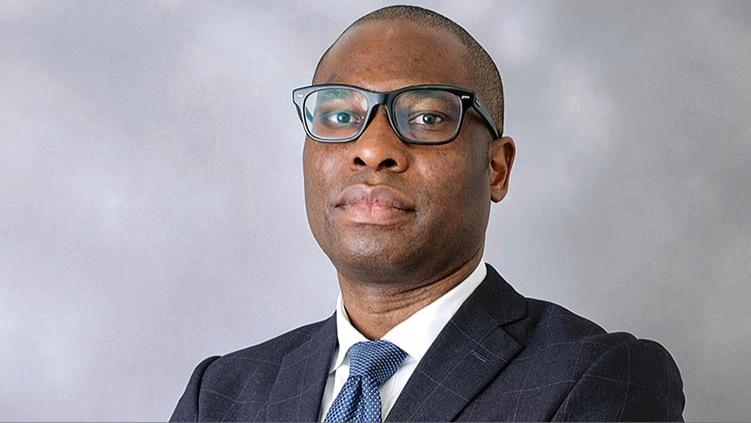

With the global economy in turmoil and the behavior of markets increasingly unpredictable, Jay Percy ’98 has created a tool for economic analysts that could shine a light into the future and forecast the behavior of currencies that investors flock to in tempestuous financial periods.
Based in Tokyo, Percy is a business analyst and quantitative researcher with First Derivative, a capital markets consulting firm. His model looks at the volatility and prices of three safe haven currencies: the U.S. dollar, the Swiss franc, and the Japanese yen. These are currencies that markets deem to be reliable places investors can park their funds during uncertain times. He published his model last year in an article in the econometrics journal, the International Review of Economics & Finance.
To build the model, Percy used a statistical tool called GARCH-M to analyze the forward rate, the price an investor will commit to pay for a given currency in the future, in 60 or 90 days, for example. A higher forward rate for a currency like the yen, which is known to be a safe haven when the U.S. dollar is in flux, would indicate that investors are “risk off” and seeking a port in the storm for their funds. The yen becomes pricier versus the dollar as more investors seek to buy yen. Percy also added volatility data as a component to his model.
The model output indicates periods when investors appear willing to bear risk and whether the currency being examined is likely to appreciate or lose value against another currency in the coming months. Percy pulls up the model’s forecast based on 2025 data. “You can see that the Japanese yen has become more valuable against the dollar. It was 155 yen to the dollar in January, and it’s 140 today,” he says. “That tells you there’s a flight to safety.”
The model also appears to predict market shocks ahead of time, by telegraphing market moves to safe havens before the shocks appear. Percy plugged 2008 data into his model, and it showed a rush to safe haven currencies months before the crash in September of that year, well before the spaghetti hit the fan. “The risk-off sentiment was present in the currency markets before these actual shocks occurred,” he says. “Our model begins to register that volatility a few months ahead of time, and it does so for other periods of market shock later on as well.”
This proprietary model, Percy says, could be useful for central banks like the Federal Reserve or Bank of Japan, because it could show the direction of a nation’s currency months out. “A central bank, knowing its currency is likely to appreciate — which will make their goods more expensive in other countries — may intervene to prevent that.”
Percy, who grew up in New York City, majored in economics and English literature. He has been in Japan for more than 20 years, but ended up there through an act of generosity. In his final year at Colgate, a friend asked him to take an introductory Japanese course with him. Percy agreed, and he was hooked. “I really liked the language and decided to continue,” he says. Professors Yoichi and Michiko Aizawa encouraged him to go to Japan, and he did so soon after graduation.
Percy began working in finance shortly after his arrival in Japan, and in 2017 he earned an MBA at Waseda University in Tokyo — in Japanese. “It was not very easy,” he notes. At Waseda he also met his mentor, the renowned derivatives thinker Daisuke Nakazato. “He’s one of the most celebrated mathematicians in Japan,” Percy says. “His comments can be brutal, but the level of my math has gone way up. I still go to his lectures every Friday night.”