

On 40 Exceptional Alumni
What a great issue — the 40 under 40 section blew me away!
Elizabeth Buchbinder ’77
Reflections on Bernstein Hall, Jewish Life at Colgate
I read the article by Goldie Blumenstyk ’79 (“A Building’s New Name Hits Home,” fall 2024/winter 2025) with great interest. I was a student at Colgate from 1958–1962. I was a philosophy and religion major. I found the academics in both the faculty and curriculum to be superb. There were 12 professors in the P&R department. I could not have gotten a better education anywhere. The rigor, the search for truth, and the commitment to academic excellence were values I took with me. However, as part of my major, I took a number of courses on the Hebrew Bible (which they called the Old Testament), and it became clear that they did not understand it because they looked at it through the filter of Christianity. I attribute that to parochialism and not to prejudice.
The social environment was a different matter. Fortunately I only experienced one small episode of antisemitism, and that was from a student. I had graduated from a very good public high school in which there were many Jewish students. In contrast, many students at Colgate went to prep school, and there was a decidedly “Waspy” atmosphere at Colgate. I knew that I was not part of that culture, and even though I did not have much Jewish background, it became clear that I didn’t want to be part of that world. Further, many Jewish students were ambivalent about being Jewish, and that bothered me. Astonishingly, I became a rabbi and may have been the first Colgate graduate to enter the rabbinate.
In 1993 I was invited to read my poetry at Colgate and I found a much-changed college. There was a chaplain who was a rabbi, and the student body was diverse. I can only remember two African Americans in my class, and no Latino students or students of Asian ancestry. All of that had changed, and there were now women students and faculty. The building donated by Dan Benton ’80 and bearing the name “Bernstein” is not only a tribute to his family, which founded HIAS and helped Jews escape the Nazis, but it is also a testimony to a Jewish presence and diversity at Colgate.
Adam D. Fisher ’62
The Benton/Bernstein story fills me with great pride. What a meaningful, impactful response to the virulent antisemitism that has infected many other campuses. Thank you to the Benton family, President Casey, and the Board of Trustees for affirming the Jewish contributions to the life and legacy of our beloved Colgate.
David J. Goldstein ’67
More Jan Plan Memories
Your recent article on the January studies program brought back fine memories (“Looking Back on Jan Plan,” fall 2024/winter 2025).
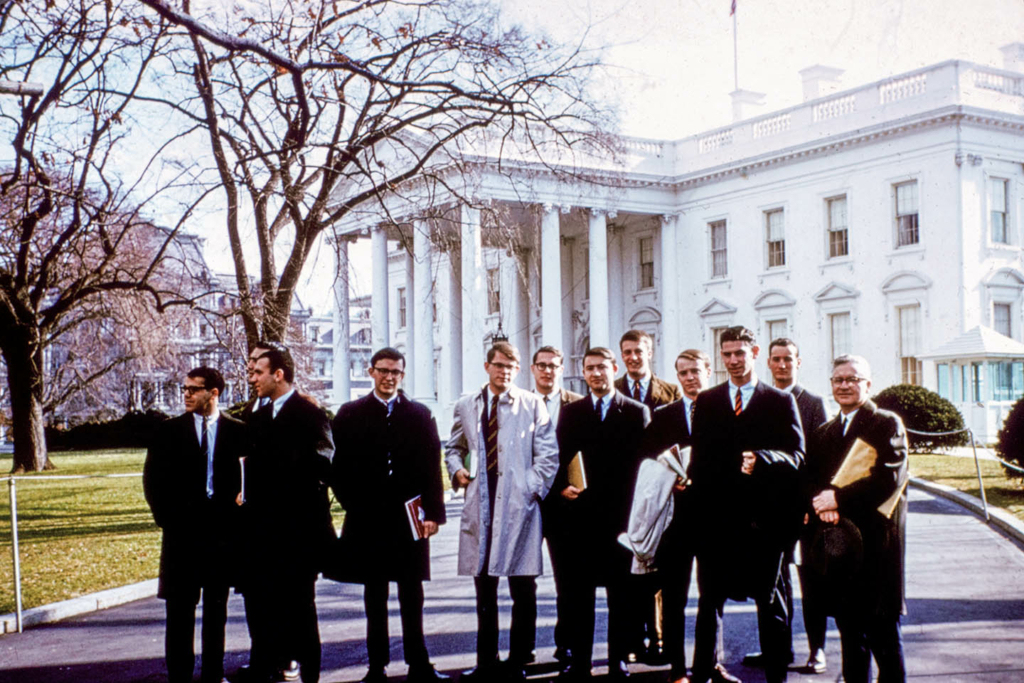
In 1966 Professor [Robert] Elder created a program in Washington, D.C., where approximately 13 of us had the pleasure of getting an inside look at our nation’s capital. Due to his extensive connections, we met with many of the decision- makers, including Secretary of State Dean Rusk and several members of Congress. Most amazing of all was our inside visit to the White House.
During my work experience in high tech (Raytheon, Microsoft, Hewlett Packard, and Caltech), I always felt my liberal arts education allowed me to make contributions within that world, which were usually outside the typical engineering mindset.
Little did I know in 1966 how much time I would spend working in D.C. collaborating with many institutions.
Wayne Johnson ’67
I loved the Jan Plan. The idea of having four weeks to explore a subject and/or place was really exciting. One January in 1984 or 1985, I had the opportunity to spend four weeks at Ghost Ranch in New Mexico — a place frequented by Georgia O’Keeffe who lived nearby (she died in 1986).
Classes were offered in photography, Spanish, and weaving. There was such a great energy about taking that opportunity to immerse myself in the culture and atmosphere of the Southwest. I even learned how to use a loom and did a handwriting analysis with another Colgate student. (That was fun, MJ McNamee ’87!) There was a great feeling of independence and exploration that the Jan Plan allowed. One other January I took a class on campus called Utopias. I know we read Herland by Charlotte Perkins Gilman, among other great Utopian fiction. My fondest memories of that experience were the days of nestling inside while snow fell and blanketed the campus as I studied these very mind-opening works of literature. I also remember going to the pool during those blizzardy weeks.
Jan Plan was a great way to enrich myself, try new things, and feel the love of learning without the pressure of grades. The images and feelings evoked when choosing the classes, as well as being in the immersion itself, are vivid and wonderful to me. I was lucky they didn’t remove the opportunity until the year after I graduated.
Catherine Viscovich ’87 Colt
Back then English was my major but not my thing. The grades showed it too. That’s when George Hudson, my adviser, pulled me aside in Lawrence Hall with an idea. “Why don’t you take my January Term course in Japanese poetry? We’ll spend a little time with Basho together.”
What’s a Basho? Japan had barely ever entered my consciousness.
From the opening verse on that first morning of class in 1986, I was totally transported. George and January Term changed my life, the trajectory of my studies, and all that was to come.
I quickly learned that he spoke Japanese, led trips there for the Smithsonian Institution, and was, in the words of Shel Silverstein, a “magic bean buyer.” I called my parents and told them my plans to go to London to study literature were off. It was onward to Japan. But first to Japanese language class.
When I returned to Colgate from Japan, George invited me to dinners at his home where, together with his amazing wife, Chikako, and Professor Jonathan Kistler, we would discuss Japanese culture late into the evening. George loved Kyoto, the ancient city. He knew well the quiet streets deep in Pontocho and Gion, and their secrets — those narrow alleys dimly lit with lanterns, leading to establishments whose histories are marked in centuries, where entry is granted not by money or fame, but only with the right introduction.
I remember George sharing one story especially. Nearly 40 years after the end of World War II, an old Japanese soldier tumbled out of the woods on an island in the Pacific. He had finally realized the conflict was over. When he returned to Japan, he found it impossible to assimilate into modern society. He had been left behind. So the man took shelter in a tea house in Kyoto, cared for by an Oiran, the most revered of the Geiko. As a gesture of gratitude, he painted the sunset that greeted him all those years on his island on the paper walls of her home. George was her old friend.
In the ensuing four decades, I have studied, lived, and worked in Japan. My graduate degree was in Japanese political economy. My first job was in Tokyo, working for several years in Japanese politics. Since launching my company nearly 30 years ago, while based here in the U.S., I have traveled back and forth over the Pacific roughly 360 times and counting. My wife is from Japan, and each of our daughters has a deep love for its traditions.
None of this would have been possible without the January Term. Everything would have gone in a different direction. As I shared with George so many times, it is a debt that I can never even begin to repay.
George and Chikako spoke at our wedding, and we had special visits together over the years. But it was that last time. He was so sick. Chikako said I had better come. Route 20 seemed to stretch out even longer that morning. My mind went back to Lawrence Hall and the moment when George first read to us from The Narrow Road to the Deep North. Sensei. That January, that book of verse became the metaphor for my life.
gratitude
resting nightingale
along philosopher’s way
i follow you still
Andrew M. Saidel ’88
I had no idea that ours was the first class experiencing the Jan Plan; not surprising because I had precious little awareness of anything that was going on during my freshman and sophomore years. I assume that we had to present our proposed Jan Plan project to a faculty member, but to whom I can’t remember. For no apparent reason other than I can speak and read English, my first two years I did American lit papers, like reading pretty much all of Faulkner and then writing a very forgettable paper.
But by junior year I had at least a scintilla of career interest; architecture had always been held in high esteem by my family in Buffalo, so I thought, why not? I had taken the single architecture course offered, and even considered trying to transfer to Columbia for architecture, but the Vietnam draft made me keep my head low in Hamilton. So I used the Jan Plan to scratch that architectural itch, spending the month in the Case Library pouring over every Architectural Digest in the stacks, as I wrote what I thought would be the seminal treatise on “Concrete’s Potential Utilized in Modern Architecture.” I still have my report in my home office bookshelf.
Fortunately for my entire future, by senior year I had discovered anthropology/sociology and the best teacher I ever had, Warren Ramshaw. He was developing an exchange with Clinch Valley Community College in Wise, Va., in the heart of Appalachian strip mining and suggested I participate for my Jan Plan. So after Christmas vacation, I drove in my VW bug the 600 pre-Interstate Highway miles to Wise and spent an eye-opening month living with and learning from an African American family, a coal mining family, VISTA workers, and even a Wise power family. My eyes, ears, and heart were opened wide by this Jan Plan.
Nine months later my bride and I were living in Lome, Togo, working as Peace Corps volunteers; for both of us this was a seminal (and joyous) experience. I’m pretty sure that without Professor Ramshaw’s Jan Plan, I would not have been ready to immerse myself in — and learn so much from — such a different culture. And as a school builder (seven in 21 months) working in small villages largely with reinforced concrete, my junior year Jan Plan gave me the requisite foundation (no pun intended), and 57 years later I am still a homebuilder. So kudos to the Colgate Jan Plan.
Ned Hengerer ’68
A Surreal View of Taylor Lake
The photo (fall 2024/winter 2025) was taken with my iPhone one gorgeous Colgate morning this past August at 8 a.m. at the Broad Street spillway at Taylor Lake, across from the Case Library.
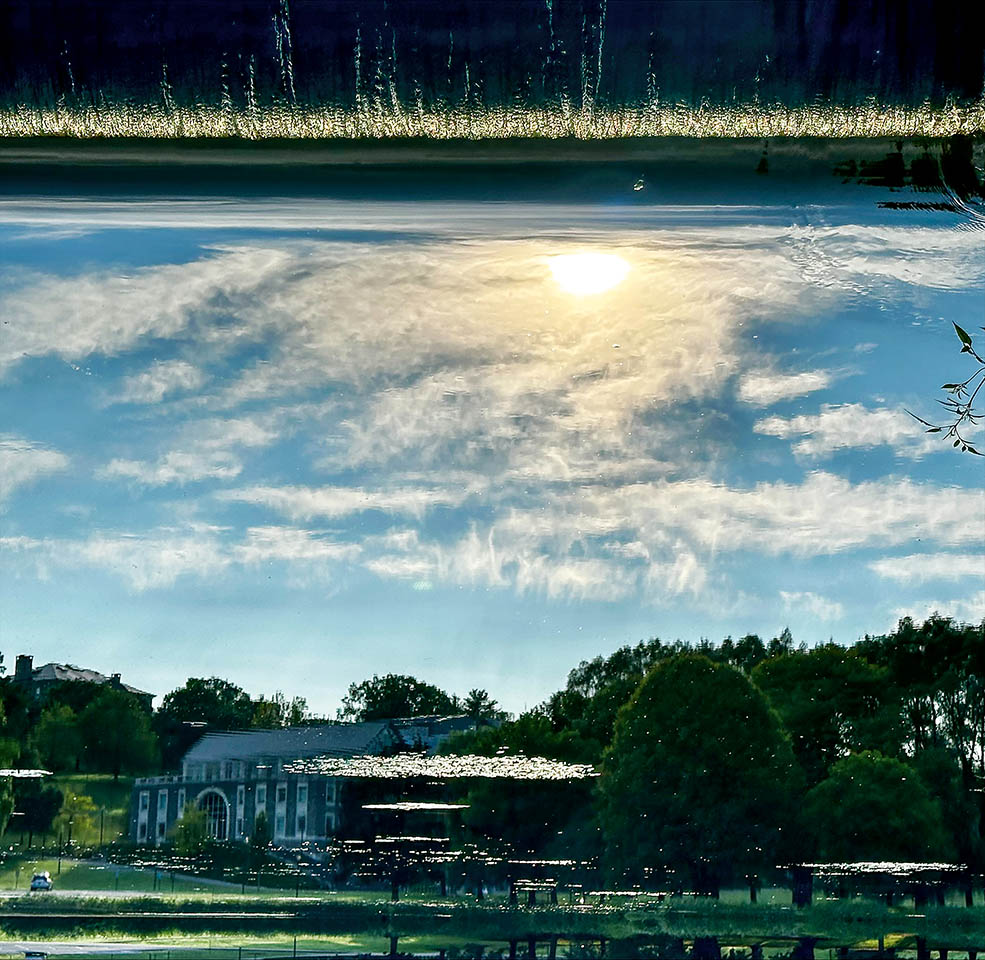
The morning and lake were so still and clear, the water was like a mirror. The reflection of the Colgate landscape and morning sky were as perfect as the landscape and sky itself. In fact, leaning over to get the shot, I thought, “Hey, it’s hard to tell the difference if you don’t know which way is up!”
The photo — which is otherwise untouched — is simply shown upside down, with the spillway at the “top” and the sky at the “bottom” of the photo. To the bottom as printed here, are horizontal ripples and some surface algae in the distant water (but which appear closer here at the bottom of the shot). To the top, as shown, is the spillway edge, with the waterfall falling “up” in vertical lines like tinsel, you might say. Where the water ran perfectly smoothly over the spillway edge, it created the progressively curved reflection of the sun and sky — a bit surreal and mathematical like the falling water itself, but natural.
Anyhow, turn the printed image upside down and it’s like “Oh, I see, that’s obvious,” but upside down the image is pleasantly confusing and, I thought, artsy in a good way.
Bob Austrian ’85
Regarding Institutional Neutrality
The letter included in the latest issue of the Colgate Magazine by President Casey (fall 2024/winter 2025), which speaks to institutional neutrality, occasions this comment. I have written to President Casey expressing my view of the working group addressing what, if any, recommendations are appropriate regarding institutional neutrality. I expressed my hope that the working group does not recommend that Colgate adopt this policy. I also urged President Casey to support any recommendation that rejects institutional neutrality and not to eliminate University thinking on issues that are believed relevant to universities but possibly outside the academic drivers.
Beginning about one year ago, pressure has been brought by the Trump administration and other groups to prevent expressions of antisemitism or support for Palestinian issues. The effort is characterized in broad-based terms but reflects a fundamental desire to reduce meaningful dialogue on issues of importance to our nation, its people, and our universities. Colgate should not feel pressured to get on that bandwagon. Rather, Colgate should stand for its values and continue to promote full, fair, and civil discourse on any topic that the institution believes appropriate; the issues selected, if any, should be left in the judgment of the decision- makers, possibly the president and the Board of Trustees. What should be rejected is a blanket statement that Colgate will always be institutionally neutral. Such a position is contrary to one of the key goals of all universities: dialogue.
Colgate should be proud to take the lead in not following the goals of institutional neutrality, which — while couched in much hyperbole and academic purity — are simply at odds with our nation’s interests and the intellectual commitment of education. Yes, colleges and universities need to be sensitive to their shortcomings and to correct past mistakes. That legitimate effort should proceed. The fact that President Trump and his people have taken a lead to stifle discussion and public engagement is an important reason why those efforts should not be successful. Such efforts have primarily one purpose: to make our universities more supportive of a particular political viewpoint and the values President Trump believes to be important.
Don Bergmann ’63
The actions of those in and near to power in the United States over the past few months have been alarming. An emphatic Nazi salute by the world’s wealthiest man against the backdrop of the seal of the Office of the President of the United States was as clear a wake-up call as one could ask for.
That is why, as an alumnus and former employee, I was dismayed at the position taken in the President’s Message published in the winter issue. In matters of politics, should the University sustain a position of institutional neutrality? Yes. But this statement creates a false equivalency between many of the actions and ideals of the current administration and simple matters of politics. The valuing and protection of civil and human rights is not an issue of politics. Opposition to blatantly unconstitutional orders is not a partisan issue. And the opposition of those who espouse Nazi rhetoric has not been a political issue since the 1930s. It’s an era I am not eager to return to.
As we wade through this pivotal moment in the history of the United States, it is profoundly disappointing to hear that Colgate’s stance is to turn inward. It seems Colgate’s plan is to effectively silence itself under the false impression that an insular and prolonged debate by a faculty committee is a substitute for public leadership and moral fortitude.
You claim this is necessary to return Colgate to “the rigorous pursuit of truth.” How, exactly, does removing Colgate from the public discourse — from challenging the demonstrable falsehoods and fake science championed by those in power — serve anyone in the pursuit of truth?
History is rife with examples of the extremes coming to power in government while institutions like universities lack the courage to act. President Casey, with your background in history, I would have expected you to know how that tends to work out. It is a position that will have the next Colgate generation asking: “Why did they do nothing?”
Jason Kammerdiener ’10
Louis Armstrong’s After-Party
In response to the photo of Louis Armstrong performing in Huntington Gym, 1957 (fall 2024/winter 2025)
Lloyd Huntley, marching band director, was a Phi Delt, and he invited Louis and his entourage for a cocktail party at the Phi Delt house after their performance. I still remember their Greyhound bus arriving in our driveway. After a drink (or two) I approached Mr. Armstrong and said, “Louis, what do you think of Grace Kelly?” His response was “Man, she is all woman.”
Alfred M. Brunner ’58
Lauding the Colgate Spirit
Thank you for the great photography in the summer issue of Colgate athletics teams. Colgate sports fans and supporters are the functional definition of enthusiastic positive thinkers.
One could justifiably argue that 1–5 p.m. Saturday, Nov. 9, 2024, were the darkest hours in world history because of all the wars, mass casualty events, shootings, stabbings, homelessness, disease, mental depression, and people not getting along with each other. But the minute I walked into the Drexel University basketball arena for the Colgate game, I was overwhelmed by the vintage high energy and friendliness of Colgate men’s basketball coaches, players, alumni, parents of Colgate students, and parents of Colgate players — the spirit that is Colgate. There were also many Colgate basketball players from years past, some of whom played for Ed Ashnault and Jack Bruen.
Edward T. O’Donnell Jr. ’70
To submit a letter to the editor, email us at magazine@colgate.edu. Letters may be edited for editorial style, length, clarity, and civility and must be relevant to Colgate Magazine’s editorial coverage. Generally, only one letter to the editor is published in Colgate Magazine by the same author in a calendar year. Letters do not represent the views of Colgate Magazine.