

In 1964, following another scenic fall on Colgate’s campus, students finished their finals and packed lightly — they wouldn’t be heading home for the height of the winter. It was the first year of Jan Plan: a new arrangement shortening the fall and spring semesters to make way for a four-week study period in January. And despite the cold — for the love of academia — students pitched personalized topics to faculty members of interest.
In Becoming Colgate: A Bicentennial History, James Allen Smith ’70 states how, in the words of then-Dean of Faculty John Morris, this new approach to the academic calendar was implemented to “break the educational lockstep” of the standard five courses each semester. By shifting to a 4-1-4 format and engaging students with an independent study experience between the fall and spring semesters, Jan Plan made way for a variety of projects across disciplines.
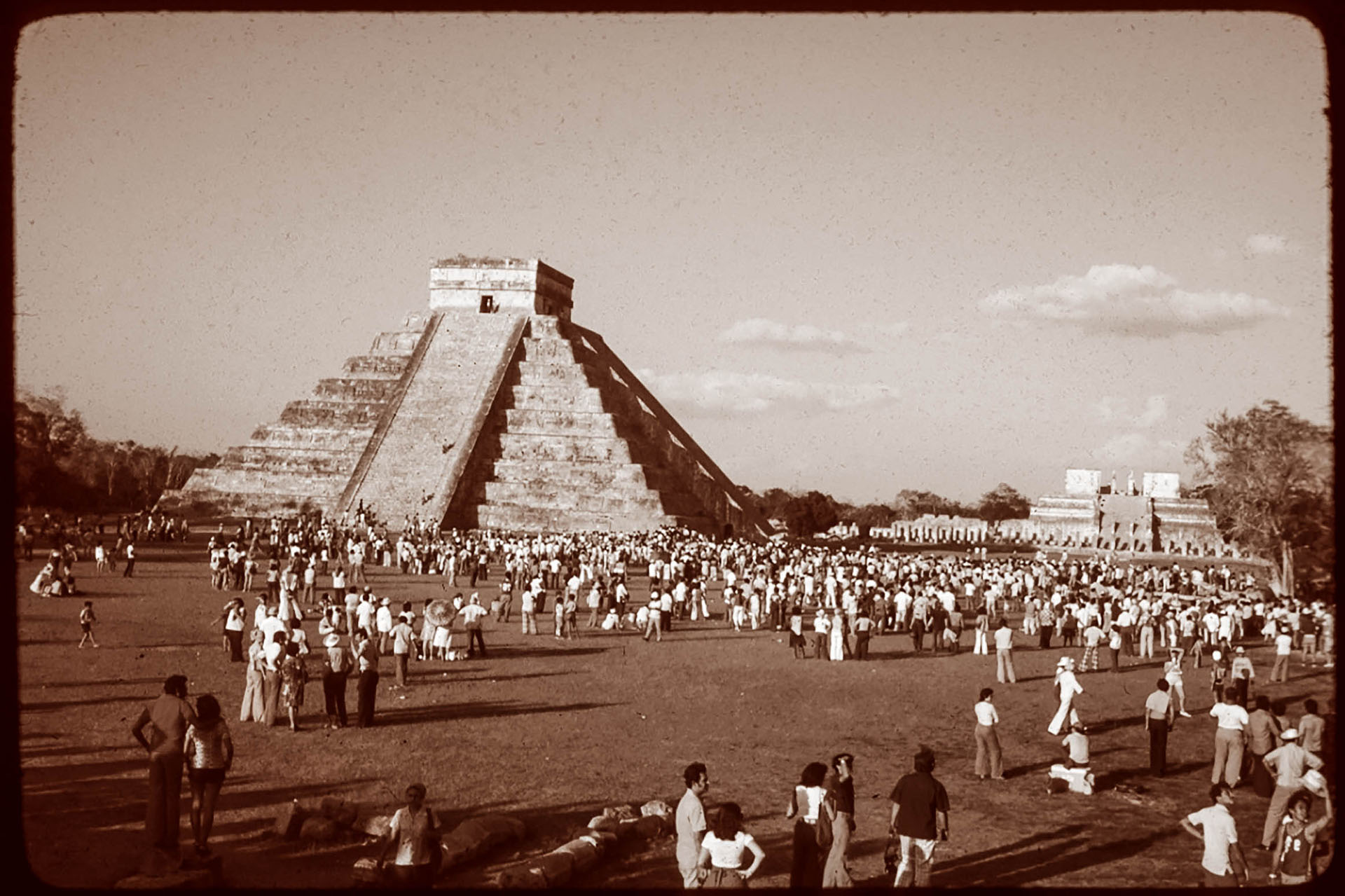
One of the most influential Jan Plan programs — for both the students and faculty involved — was led by Professor of Astronomy, Anthropology, and Native American Studies Anthony Aveni (now emeritus). During the Jan Plan program and subsequently, Aveni coordinated approximately 30 van trips to Mexico, introducing students to ancient Mesoamerican architecture and astronomy on-site.
“I could sense the excitement of young people in a new place, most of them independent of their families for the first time,” Aveni wrote in his 2014 book, Class Not Dismissed, of the first group he brought to Mexico City. “They were eager to explore, to see things, and to encounter new experiences for themselves.”
In the spirit of Colgate’s conversion to a coeducational university, Aveni’s trips incorporated female students as soon as 1970.


- Professor Anthony Aveni coordinated approximately 30 student trips to Mexico. 2. Jonathan Geller ’72 did a woodworking project in Dana Arts Center for his Jan Plan.
“Along the way, we had priceless opportunities to meet and talk with scholars in Mexico and countless culinary adventures that sometimes resulted in Montezuma’s revenge,” Jill Seyfarth ’79 remarked in a submission to the Bicentennial site, Colgate at 200.
In other departments, students and faculty explored a range of projects during Jan Plan, including the study of classical art, chemistry, woodworking, multicultural literature, and genetics. “What’s more, the experience was ungraded, just pass-fail,” says Aveni. “So a science student who wondered what it would be like to write a novel or a humanities student with a desire to learn what goes on in a chemistry lab could indulge in their curiosities without fear of penalty.”
Although the Jan Plan program formally ended in 1988, stretching the academic calendar back to a 16-week schedule, tenets of the program still remain a part of Colgate’s Core. Opportunities for extended and independent study retain the spirit of Jan Plan without breaking the conventions of the academic calendar.
In his 1969 book, A History of Colgate University, former University Archivist Howard D. Williams underscores the impact of this program: “The University’s historian of the future may well evaluate this period as one which saw the most rapid and far-reaching changes of any of the institution’s entire development.”
Do you have memories from your Jan Plan experience to share? Email magazine@colgate.edu