

A Writer’s Passion, Rediscovered
It’s been nearly 20 years since my freshman year at Colgate, which is when I first met Jennifer Brice. I had yet to formally study the craft of writing, and Jennifer, in her patient and persistent way, urged our class to dig deeper, ask the difficult questions, and see where those led us. Her memoir Unlearning to Fly was published during my junior year, and I remember devouring it. Each sentence was beautifully rendered. Under Jennifer’s supportive guidance, I learned to bend painful experiences and explorations into the art of creative nonfiction.
I’ve spent the last two weekends with Jennifer through time with two of her books: Another North, including the essay that was recently published in Colgate Magazine (summer 2024, p. 8), and Unlearning to Fly. As I flipped through pages, underlining and scribbling in the margins, I realized what a profound impact her written words had on me as a young writer. She titled one essay, “My Mother’s Body.” I, too, went on to write an essay that bore the same title. It was absolutely influenced by both her essay and her teaching. In another essay, she writes about being a nonfiction writer: “The genre chose me, not the other way around.” I feel the same way. During our time as university students, our teachers shape us. They expose us to the books and films and places where ideas inspire in us yearning, learning, and the desire to create. Reading Jennifer’s words again reminded me of what it was like to be a student who had developed a deepening passion for the art of writing during my undergraduate years.
As a new alumna, I attended the Colgate Writers’ Conference, craving more time with past professors and now friends and mentors. That week in June with late nights spent on the porch of Merrill House was a special time. In many ways, it encouraged me to keep on writing, and I later went on to get my MFA in creative nonfiction.
One last memory from 2009. The sun poured into the tall windows of a room in Lathrop Hall. I was to defend my senior thesis, a collection of essays. I was nervous to talk about the pages I had produced over the past four years, and also proud that I was able to wrestle these hard stories onto the page. Creative writing and English lit professors — Jennifer, Peter Balakian, George Hudson, and Jane Pinchin — sat across the table. Someone asked about the process of writing, and I talked about the power of discovering my aha! moment and how the essays seemed to write themselves from there. Today, I find myself looking for that aha! moment once again, and after spending quality time with poignant pages written by a past professor, I think I am a little closer to finding it once again.
Kanitha Heng ’09 Snow
Snow will be the director of the 2025 Colgate’s Writers Conference this June. For details: colgate.edu/writersconference or write to writersconference@colgate.edu.
Cherished Memories of WRCU
Thank you so much for “The Music Never Stopped” cover story featuring WRCU alumni (summer 2024). Many of my most cherished Colgate memories include the station “a little to the right of left” — spinning vinyl late into the night, helping eventual MTV VJ Martha Quinn secure her FCC license, and even making the leap to working at WCHN AM-FM in Norwich on weekends. I was there for the transition to 1,000 watts (we were so excited!), and to this day I’ll occasionally pull out my folder of playlists and skim a few shows from back in the day. There’s nothing like college radio.
Craig Peters ’80
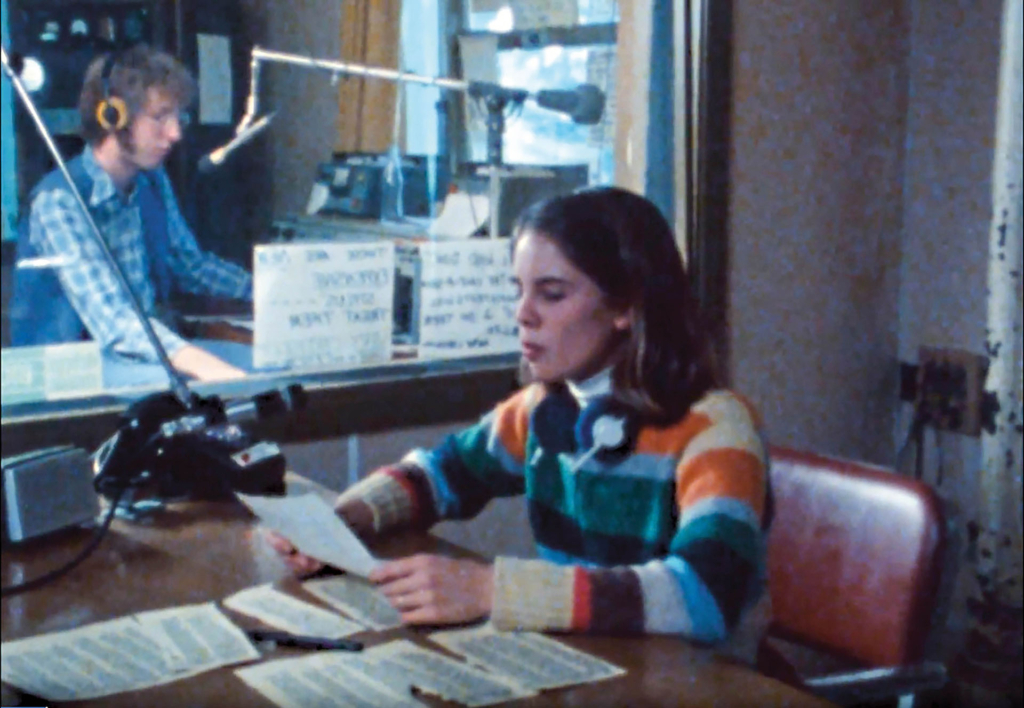
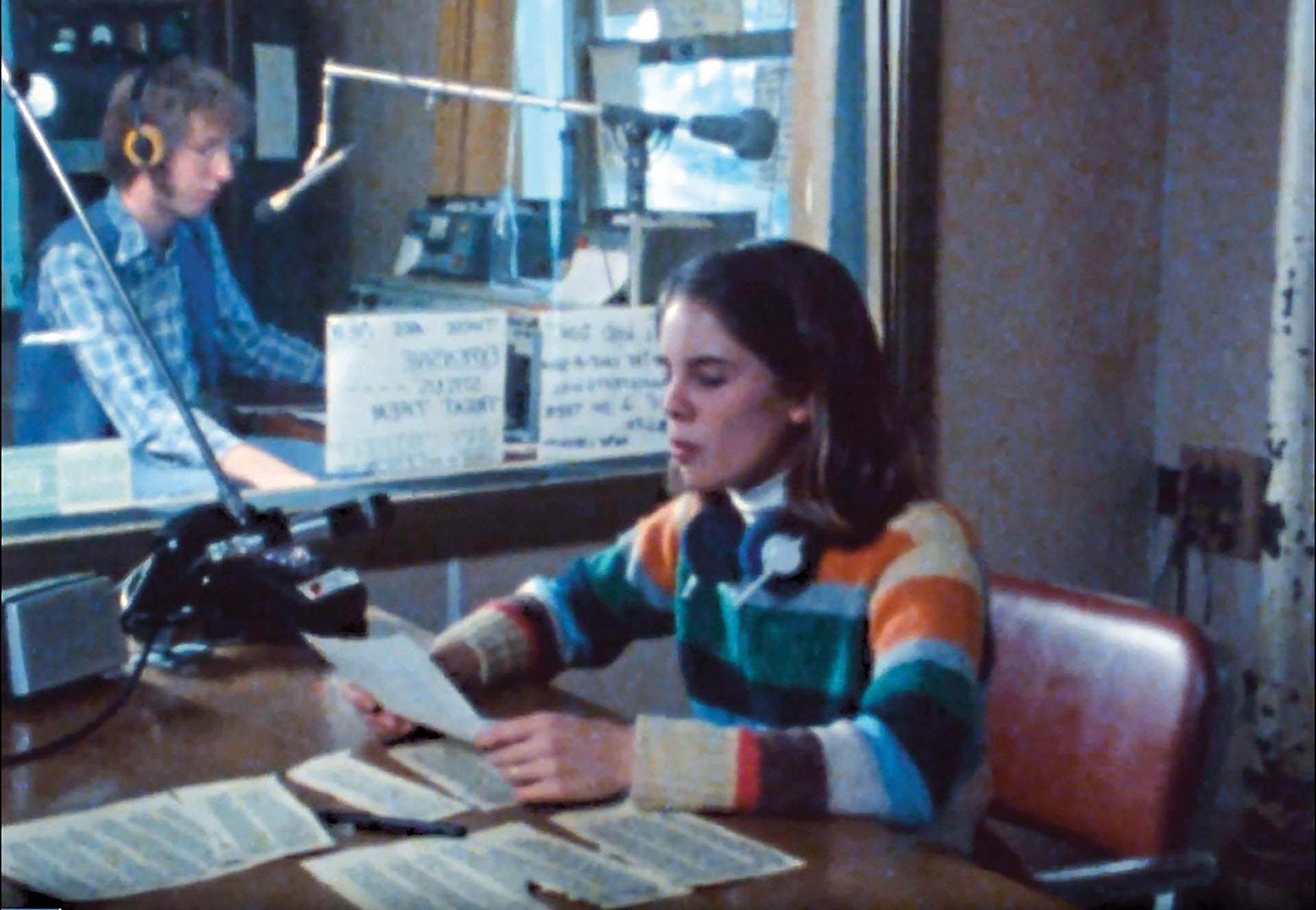
Craig Peters ’80 (background) runs the WRCU board as a student.
Inspiring People
Jon Dolan ’96 — loving what you do and being great at it (“The Music Never Stopped,” summer 2024). Couldn’t happen to a better guy! Also, the whole summer 2024 Colgate Magazine is chock-full of inspiring profiles.
James Nolan ’94
An Educated Public
I confess that Brian’s message (“President’s Message,” summer 2024) was the first one I have ever read in its entirety over all the years that I have been receiving Colgate Magazine. His words summed up our feelings about the importance of an educated public and what happens when education becomes politicized. Education should be a priority in a country that used to celebrate its democratic institutions. Certainly “learning and truth seeking” are worthwhile goals if we are to continue along the path that we have been following for the last 248 years.
Alan C. Brown ’67
Continuing the Debate About Alternative Medicine
I am responding to R.B. Wright’s reductive assessment (Letters, summer 2024) of “Whole-Person Healing” from the Health Issue (spring 2024, p. 36). I am not here to debate the merits of “alternative” medicine; I am more interested in understanding this elitist and frankly Eurocentric point of view. Humans have thrived for thousands of years without modern medicines. In fact, most basic medicines are derived from ingredients that our Indigenous ancestors used due to their healing properties. Do you know how mummies were preserved thousands of years before Christ? While I have never personally used any alternative medicines, I do believe that there is some value to them. There is a reason that they exist, but maybe us modern humans are too obtuse to understand that. We presume that alternative medicines don’t derive value, but have you seen the show Naked and Afraid?
R.B., do you even know the history of some modern medicines? Have you read about the “experiments” that were done on humans during the Holocaust? Are you familiar with the HeLa cells? Have you heard about the Tuskegee Study? Do you support experimentation on animals? I could rattle off a bunch more, but I think you get the point. While you may feel validated in the “double blind studies” and the “demonstrable proof,” one should have a little bit of respect for how others deal with pain and sickness. While it may be a joke to you, people have a right to choose how they want to be healed. As someone who also values the liberal arts and reads, I am still curious about alternative forms of healing that our ancestors used and alternatives to the chemicals that modern people put in their bodies.
Pablo Gonzalez ’01
To submit a letter to the editor, email us at magazine@colgate.edu. Letters may be edited for editorial style, length, clarity, and civility and must be relevant to Colgate Magazine’s editorial coverage. Generally, only one letter to the editor is published in Colgate Magazine by the same author in a calendar year. Letters do not represent the views of Colgate Magazine.