


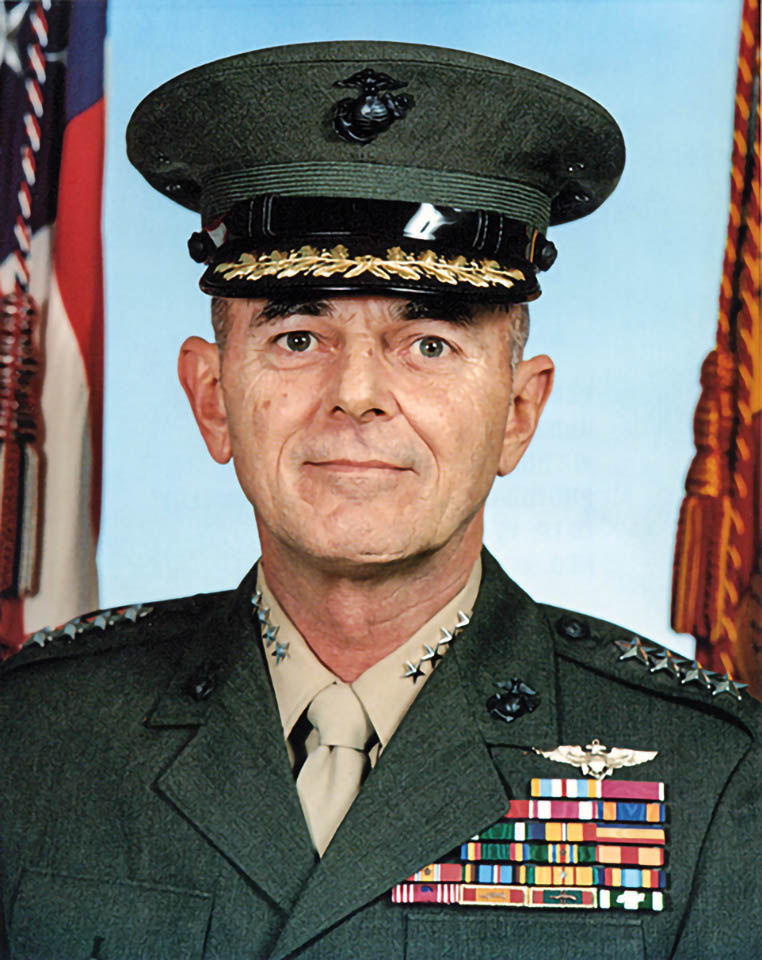
Gen. Tom Morgan ’52 wasn’t enamored with titles or rank, even after 36 years of distinguished service that saw him become the second-highest ranking officer of the Marine Corps.
“He never used his status as a high- ranking Marine or wanted to be called General Morgan after his retirement,” says one of his daughters, Beth. “It was more about being of service: making a difference in the lives of people he met.”
When Morgan met active duty service members or fellow veterans (especially of the enlisted ranks), he was eager to help them realize any dreams they had of a college education.
That is what led to conversations with Gary Ross ’77, Colgate’s Jones and Wood Family Vice President for admission and financial aid, to bring to campus the Leadership Scholar Program, which assists Marines with college admissions nationally.
Morgan also helped connect Colgate to the national Yellow Ribbon Program that bolsters tuition benefits to veterans through the Post-9/11 G.I. Bill.
Kevin Varga ’16 was one of the first Marines to take part in the University’s Yellow Ribbon Program, and he fondly remembered a handwritten note Morgan sent him about Colgate, extolling the strong sense of community on campus.
“My time there was transformational,” Varga says, “with unforgettable educational experiences and professors who are the best role models I’ve ever had.
“All of that would not have happened without General Morgan’s efforts to recruit veterans,” adds Varga, who is now pursuing his PhD in geography at the University of California–Santa Barbara.
When Morgan arrived on Colgate’s campus in 1948, he met World War II veterans utilizing the G.I. Bill, and those interactions would profoundly shape his time in and out of the classroom. He majored in history and political science, played varsity basketball, and was a member of Sigma Chi.
It was soon after graduation that he answered the call for public service, and he was commissioned as a second lieutenant in the Marine Corps.
He was an aviator with more than 2,000 flight hours, including a combat tour in Vietnam. Morgan would eventually take on key leadership roles throughout the world, and the Marines praised his important contributions to aviation operations and military planning.
“General Morgan was a steadfast leader and a true embodiment of the Marine Corps ethos,” Gen. Eric Smith, the 39th commandant of the Marine Corps, told the Marines’ news office. “His legacy will live on through his impact on our Corps.”
Morgan retired in 1988, earning numerous personal decorations including the Defense Superior Service Medal, Legion of Merit, and Bronze Star.
It was his work, though, in helping veterans like Varga that he found particularly rewarding, his daughter says. “Dad believed deeply that everyone deserved the opportunity to pursue higher education, especially those who served our country in the military. He was proud of all that Colgate has accomplished in this area and would want that work to continue.”
At Morgan’s funeral in February at the National Memorial Cemetery in Virginia, his grandchildren had an eye-opening experience, says Beth. “My own two boys, while intellectually aware he was a general, had to process the public scale of him receiving full military honors. Because to them, always, he was just their grandfather. To his neighbors, he was Tom Morgan. It was less about being a general and more about being of service. That’s what was so important to my dad.”
In addition to Beth, Morgan is survived by two other daughters, Lynn and Susan, and their husbands; four grandsons; and a great- granddaughter. His wife of 66 years, Barbara, died in 2023.