

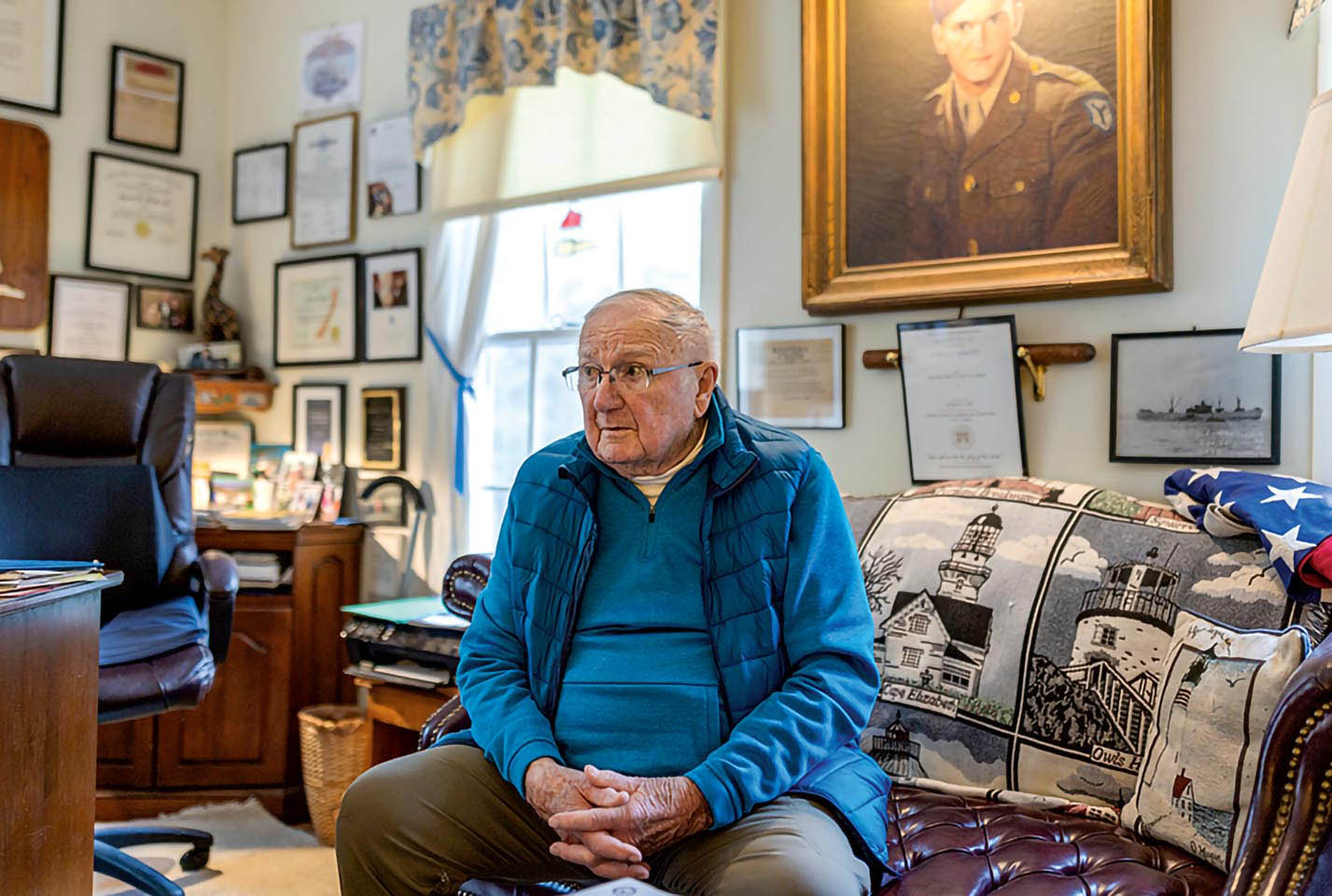
Howard Wright was in middle school in 1944 when he answered a knock on the door and found a Western Union boy carrying a telegram with news that would devastate his family and prompt questions that have lingered for 80 years.
“…Your son Private First Class Elmer G. Wright has been reported missing in action since six March in Tunisia,” the telegram read.
A month later, the family was notified that 23-year-old Elmer had been killed in action when his ship was lost 8 miles off the coast of Tunisia. His body was never recovered.
Howard Wright, now 95, has never stopped mourning his older brother — his eyes still fill with tears when he describes the arrival of that telegram and the gentle way his brother had always watched out for him. He has spent the last 50 years piecing together details about what happened the day Elmer died.
The walls of his home office in East Boothbay, Maine, are covered with framed photos of generations of his family, including a large portrait of Elmer in uniform that dominates one wall.
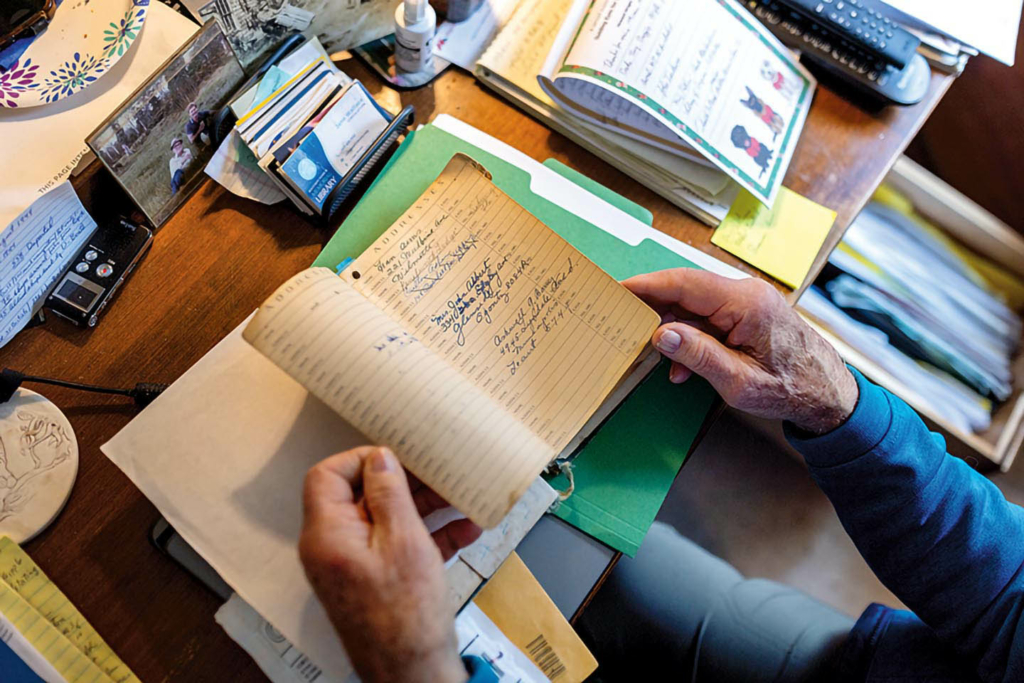
On a small coffee table sits a 4-inch binder full of documents: letters to and from Elmer, photos of him during his service, military records for Liberty Ships, and firsthand accounts of the day Wright’s ship was lost.
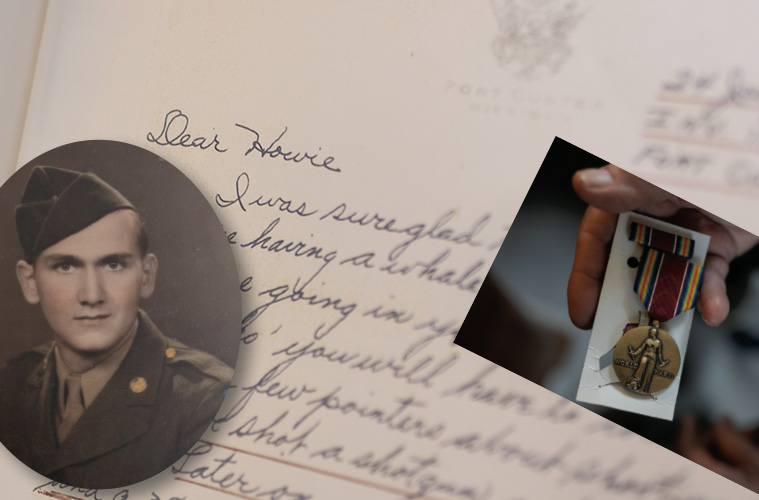
For decades, the only medal the family had marking Elmer’s military service was the Purple Heart awarded after his death. In fall 2024, with help from Maine’s Senator Susan Collins’ office, the Army verified that Elmer Wright was entitled to another five medals: a Presidential Unit Citation, a European- African-Middle Eastern Campaign Medal with one Bronze Service Star, an Army Good Conduct Medal, an American Campaign Medal, and a World War II Victory Medal that was sent to Howard in September.
Receiving those medals has been special for Howard, a tangible acknowledgment of the sacrifice his brother made. But one mystery remains: What was the mission that put Elmer on a ship bound for Iran?
Howard knows there’s a possibility he’ll never know the answer — nearly all of his brother’s service records were lost in a fire, and most World War II veterans have since died — but he won’t let himself give up hope.
“I want (my) son, his wife, and our grandchildren to know the story of my brother so it doesn’t get lost and they can appreciate the sacrifice he made,” Howard said.
A Call to Service
Elmer, who went by Pat, graduated from Colgate in December 1942 with a degree in Spanish and a month later was inducted into the Army. Howard said his brother was supposed to be in limited service, away from combat zones, because he was hard of hearing. But the Army saw value in his ability to read lips and speak three foreign languages.
He was assigned to a small unit of nine men who were all college educated and highly fluent in various languages, Howard said. The unit was sent to Fort Custer in Michigan for special training.
Elmer left Norfolk, Va., on Feb. 13, 1944, aboard the Daniel Chester French, a Liberty Ship bound for Iran, part of a 90-ship convoy that ran into a storm off the North African coast. Records indicate the seas were still turbulent when the commodore ordered some ships to change their positions on the night of March 5.
By the following morning, there was confusion because the convoy was stretched across 12 miles, said Howard, who has been able to piece together the events from military records and firsthand accounts from survivors. The two rerouted Liberty Ships, the Daniel Chester French and the Virginia Dare, were about 4 miles behind.
“It was a monster storm and his ship was directed right through our own minefield,” Howard said.
The Virginia Dare was the first to run into a mine and sent out a distress call at 7:15 a.m. Five minutes later, the ship Elmer was on hit the mines. The ship was loaded with ammunition and soon exploded. Those on board were ordered to immediately abandon ship. It sank within 30 minutes.
Heroic Actions
The men on board scrambled to get to the available lifeboats. But Howard said his brother and the other 86 Army passengers didn’t know that the lifeboats had open drains in the bottom that needed to be closed before they were lowered into the raging sea.
As the ship sank, Elmer swam to a lifeboat alongside Lt. James Boyle, who survived and later wrote to the family about what happened. The men were pulled into the lifeboat and grabbed onto the same oar, working together to row because the seas were too strong for one man alone. The boat was filling with water and Elmer told Boyle he’d help bail it out using his helmet. A few minutes later, the boat was lifted by a large wave and turned over. Boyle never saw Elmer again.
“When many were praying aloud and paralyzed with fright, [Elmer] kept his head and tried to do what he could,” Boyle wrote. “During the short time I knew him, he was always a gentleman, and in the boat, he acted like a man.”
Elmer was among the 37 men from the ship who died that day.
Soon, the telegram arrived at the Wright home in Pennsylvania, followed months later by a letter from Brig. Gen. Robert H. Dunlop informing them that Elmer had died when he was a passenger “on a United States ship that was sunk as the result of enemy action in the Mediterranean Sea near Bizerte, Tunisia.”
Three years later, Dorothy Wright wrote a letter to Army officials, the never-ending grief of a Gold Star mother evident in every line. She relayed Boyle’s details and her fear that her son, “who had a nervous heart and was quite hard of hearing,” couldn’t hear the warnings that the boat was about to go over.
It wasn’t until years later that Howard learned the truth: The Daniel Chester French was taken down by friendly fire, not an enemy.
He said he’s glad that his mother never knew because it would have been so upsetting. But he still wishes he knew what his brother’s unit was doing on that ship. Relatives of other men from the unit have told him it was a “hush-hush” mission that involved frequent contact with both Allied and Axis spies.
Eighty years after he lost his brother, Howard wonders what he’d think of his 50-year search for answers.
“I would hope he would think I’m trying to make sense out of a senseless loss. It’s one thing to be killed in action by the enemy, but to be killed in action by your own, that’s a big pill to swallow,” he said, pausing as his voice was overcome with grief. “He gave his life.”
A longer version of this article by Gillian Graham first appeared in the Nov. 10, 2024, edition of Maine’s Portland Press Herald and is reprinted here with permission.