

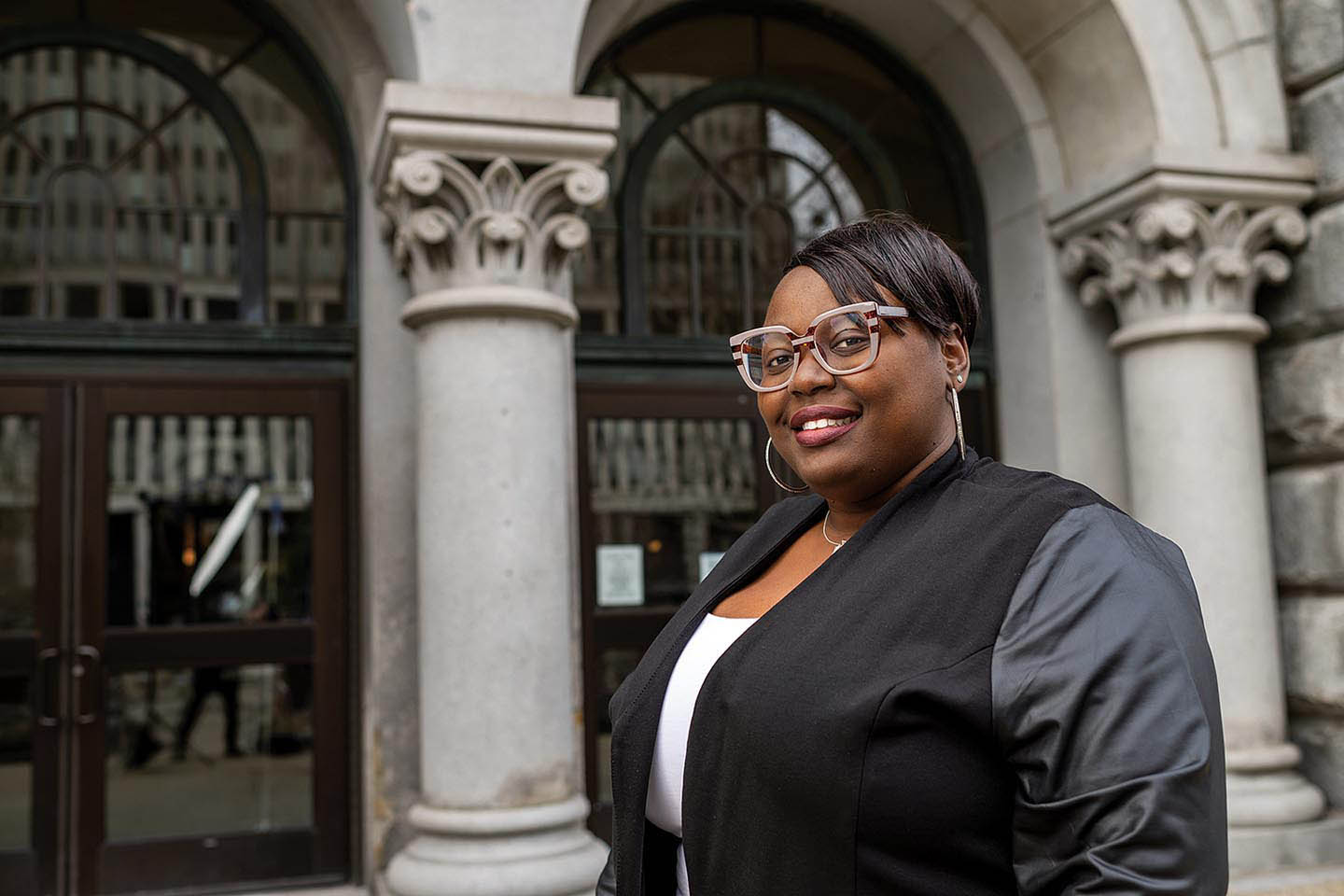
As a child, Norvella Pendergrass ’11 would often go with her father — then a student at the University of Buffalo School of Law — to his classes when she was too sick to go to school or on snow days. On weekends she and her three siblings would pile into her single dad’s car and trek to campus when he had an internship or mock trial competition.
Not surprisingly, this exposure to the law led Pendergrass, by the age of 10, to decide to become a lawyer. “My father always taught me to challenge everything, including him, so we spent a lot of time debating,” she remembers.
After graduating from North Carolina Central University School of Law, Pendergrass joined her father, Anthony Pendergrass, in his practice in Buffalo as a criminal defense attorney. But two years later, she left to become an Erie County assistant district attorney.
Her decision immediately drew criticism: Her father jokingly called her a traitor, and people she had grown up with in Buffalo asked, “So, you want to put people away?” Yet Norvella realized that a prosecutor holds immense power, both inside and outside the courtroom. “One of the things I learned being a Black prosecutor is that a lot of cases are pre-tried before it goes to the open courtroom,” she says. “And so if I truly wanted to make a difference for my community, I needed to be in those rooms, and I needed to be part of those conversations.”
As a member of the Special Investigations Prosecution Unit, Pendergrass has focused on tackling welfare fraud, which she says hurts the people who are most in need.
In a 2022 case, she prosecuted a Buffalo convenience store employee who had misused more than $14,000 in welfare benefits. “Rather than [using] the food stamps to buy food, people [sometimes] trade them for cash to buy drugs and alcohol and everything else,” she says.
At Colgate, Pendergrass, who majored in political science, studied abroad in Denmark and Jamaica, and built houses with her classmates in New Orleans after Hurricane Katrina. On campus she was involved in a range of activities, including serving as a deacon at the University Church and as president of the Black Student Union.
One of the defining moments during her time at Colgate came during her sophomore year, when Pendergrass participated in a weeklong sit-in with a coalition of student groups calling for more diversity at the University, particularly in the speakers invited to campus. The University listened to the students’ demands, Pendergrass recalls, and then expanded its speaker series to include the political activists Cornel West and Angela Davis.
One of her professors, Nina Moore, the Dr. William Boyle, Jr. Chair in political science, says the demonstration not only raised the issue of diversity on campus, but it also helped bring about measurable reforms. “Norvella and her cohort played a key role in setting the tone and direction of the diversity, equity, and inclusion wave that would arrive at Colgate and other college campuses years later,” Moore says.
In her political science classes, Moore remembers Pendergrass as an outspoken student who liked to debate complex scholarly questions. “There was never any doubt that asking questions and probing the responses would become a way of life for her,” Moore says. “It was at the core of who she was, and still is.”
In Buffalo Pendergrass serves as the director of the youth ministry at the Faith Missionary Baptist Church, where she recently organized a career day that brought 19 speakers, including police officers, judges, and doctors, to talk to a group of students.
In recognition of her work with youth, The Minority Bar Foundation in Buffalo gave Pendergrass its Education Award last year. “I believe our youth are the future,” she says. “I want to touch a lot more lives, and I think a lot of times by the time they get to the courtroom, it’s too late. I want to get to these people before we get to the point of the courtroom.”