

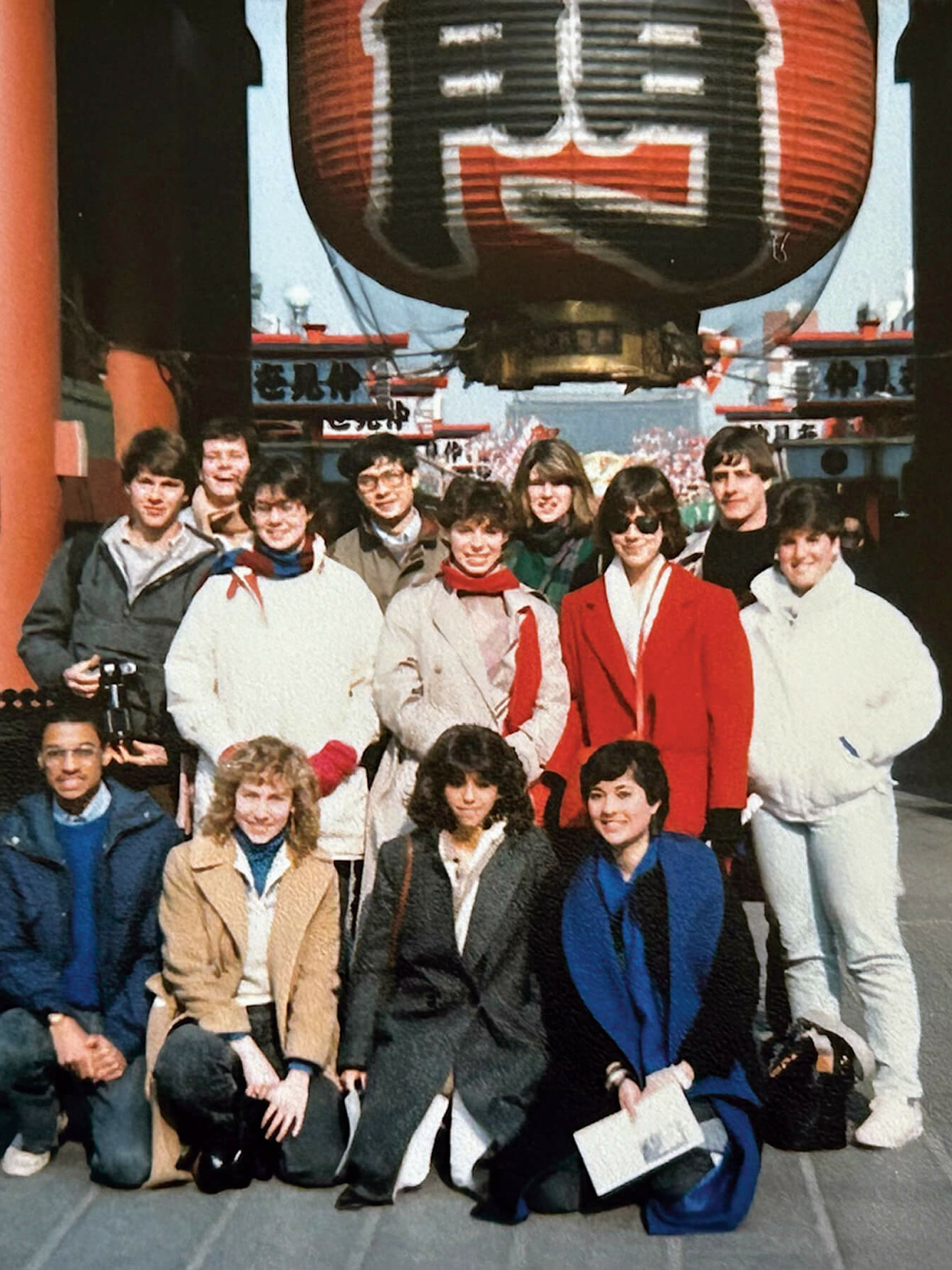
Wendy Gruber ’87 Segal, P’20 reflects on her connection to Japan, which began with her 1986 study group.
January 10, 1986: “We’ll be landing in a half hour! I’m ready for the most exciting, adventurous, and rewarding experience of my life.” This was from my journal entry while flying to Tokyo with the Japan Study Group during my junior year, and my 20-year-old self predicted correctly.
As a first-year, I chose a seminar about Japan because I’d never traveled abroad or studied other cultures. Professor Yoichi Aizawa, who taught the course, suggested I take Japanese and ultimately study in Japan. This sounded like a great idea — and it was. Living in Japan for a semester was an experience I have carried with me throughout my life.
My husband had never been to Japan, but he has heard me talk about it for many years. I have kept in touch with my homestay families, who have sent us cards and gifts. Finally, this past fall, after 38 years, my husband and I decided it was time for the trip.
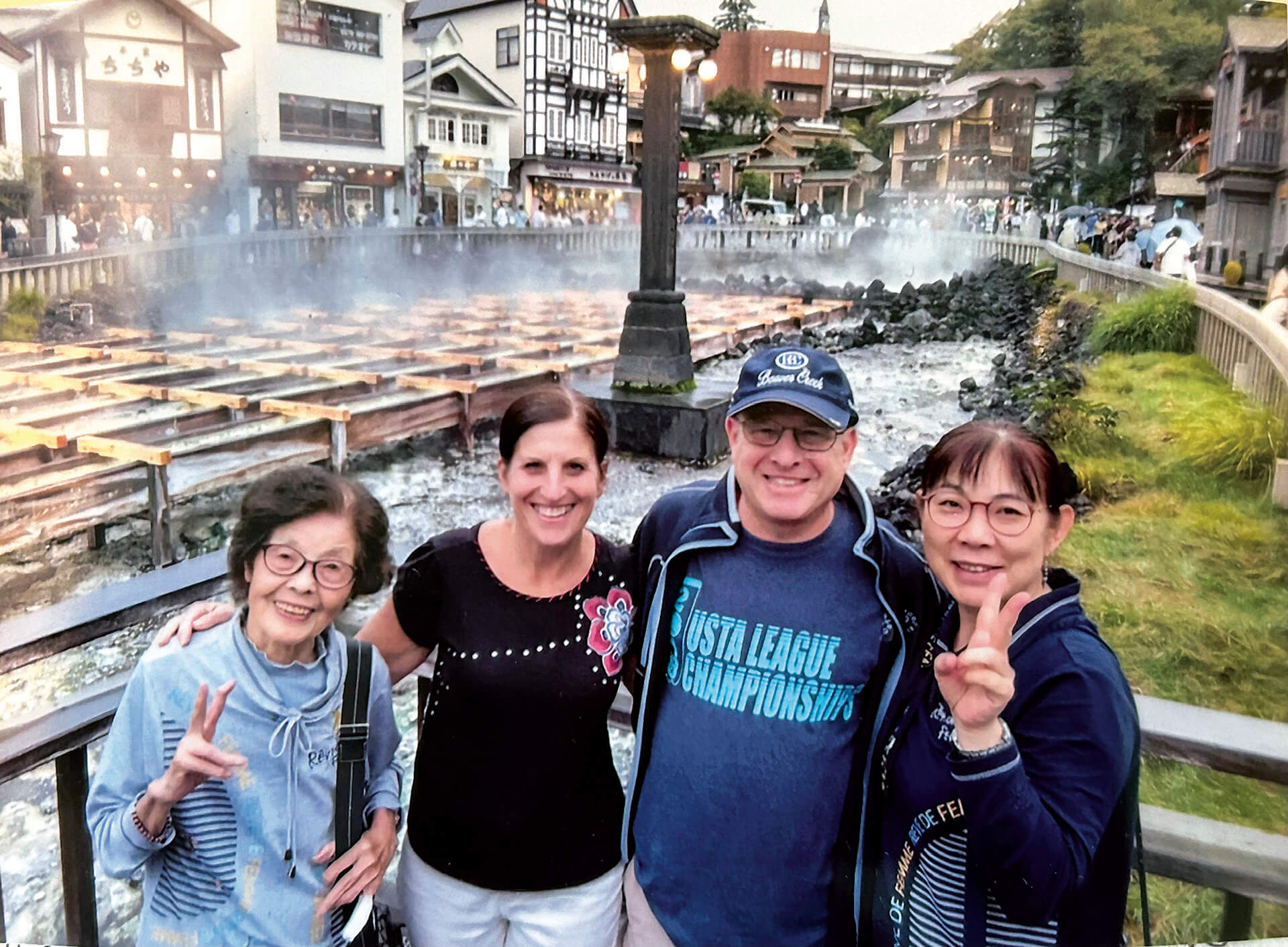
When I contacted both of my Japanese families, they were excited to welcome us. Throughout our trip, we encountered the giving nature of the Japanese people that made such a huge impression on me. My Japanese “sister,” Yasuko, from Gunma, insisted on traveling four hours round trip by train to greet us at the airport — even though she would come back three days later to escort us from Tokyo to Gunma by train. We spent two days with Yasuko, her husband, Akira, and 90-year-old Okaasan (mother) — who still lives in the same house I stayed in. Sadly, my homestay Otoosan (father) had passed away. I was teary-eyed while paying my respects to him at the home altar.
As in 1986, my family made sure we ate as many types of Japanese food as we could: shabu-shabu, sukiyaki, udon, yakitori, and sushi. They drove us up to the mountains to Kusatsu Onsen, one of many hot spring sulfur baths in Japan.
In Kyoto we visited my other family, the Kitajimas. We swapped stories over a home-cooked meal of yose-nabe. I had practiced Japanese for months prior and enjoyed speaking the language with them. I will admit that Google Translate is much better than a pocket dictionary; a big difference from years ago.
Another difference was the number of tourists in Kyoto. When I studied there, it was rare to see gaijin. According to our tour guide, since the Fushimi Inari Shrine appeared on the cover of Lonely Planet, tourists have flocked there.
What remained the same was the kindness of the Japanese people. So many went out of their way for us. When traveling to Kyoto, we asked directions to transfer trains at Tokyo station. I understood to go down the escalator and turn right. When we got to the bottom, there was the woman we asked — she had run down the stairs to ensure we went the right way. There was the taxi driver who took us to the wrong hotel but then turned off his meter and drove us to the correct hotel. One day in Kyoto, we were caught in a downpour and took cover under an awning — a woman ran out with two umbrellas. These are only a few examples of the hospitality we experienced. We were welcomed and thanked in every shop, restaurant, and hotel. We marveled at everything from the cleanliness of the trains and streets to a shopkeeper’s meticulous wrapping of even the smallest gift. All of these little acts of humanity seem to add up to something bigger, something that stuck in my subconscious all those years ago. I was happy to see it still existed.