

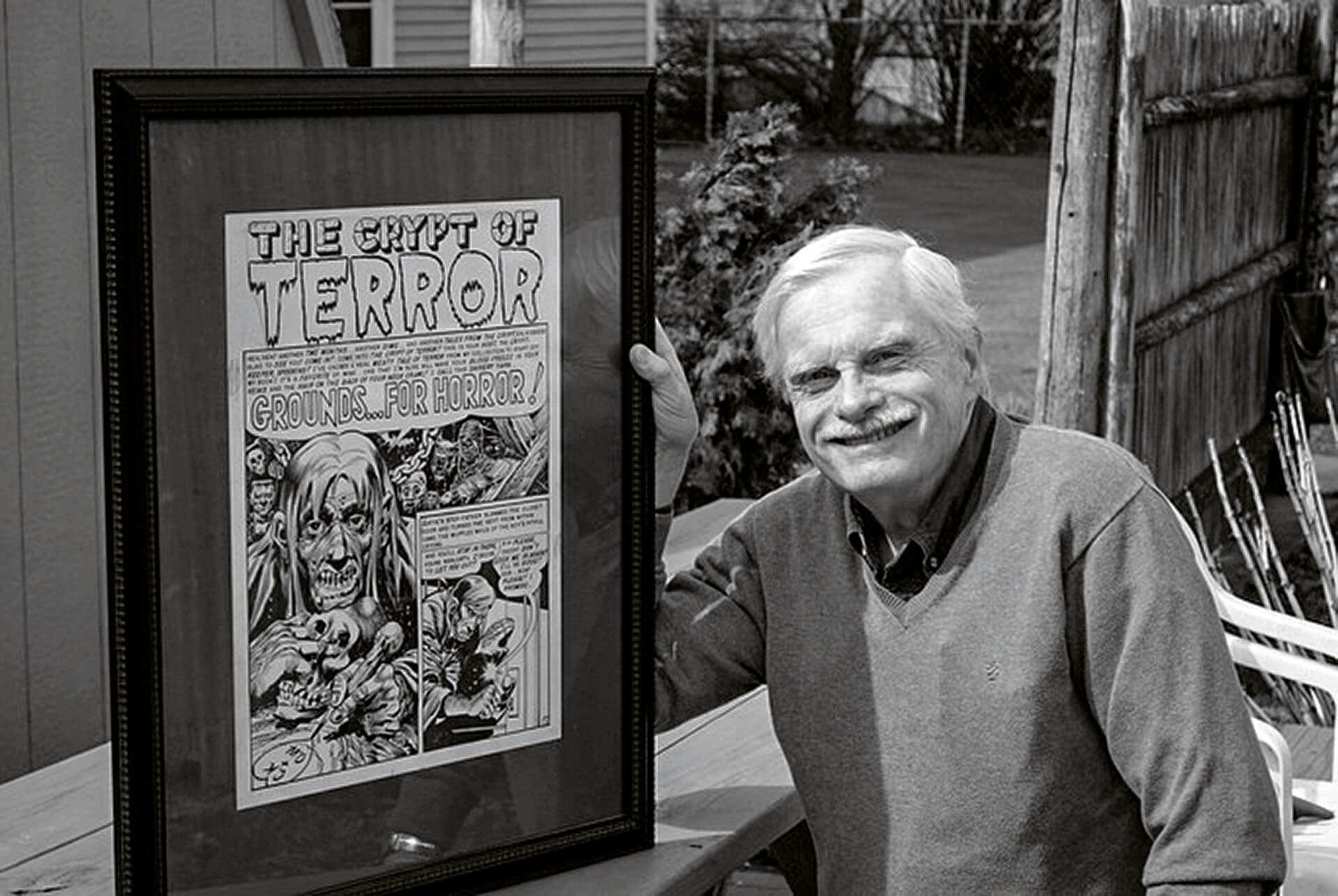
Jack Butterworth ’64 was looking for a paper topic for his Greek and Roman mythology class at Colgate when he thought of an idea that would spark a lifelong passion: creating comic book stories.
While scanning the latest comic books at a newsstand, Butterworth noted that superheroes occasionally interacted with the ancient gods and goddesses, which became the focus of his paper. He also came across the first issue of a new Marvel comic book — The Amazing Spider-Man — an instant sensation at his Tau Kappa Epsilon fraternity house.
“All of the sudden, Colgate got me into comics,” says Butterworth, who began reading comics as a child but veered over to science fiction in adolescence.
After graduating with a degree in English and a love of writing, Butterworth became a newspaper reporter at the Lynn Item, northeast of Boston. Yet he wanted to write more than stories about town government, so he began sending pitches to comic book publishers.
At age 29, he set a deadline to get published before he turned 30. A month before his birthday, his story about a mortician who kept an embalmed body in his funeral home was accepted for the comic book Creepy.
As his comic scripts began to be published, Butterworth developed a specialty in horror stories. “I liked the freedom of writing about characters who didn’t have to stay alive to appear in the next story,” he says. “And I just wanted to tell an entertaining story.”
His comic book scripts were also infused with social justice themes, including stories about slumlords and women who were spaceship commanders.
In 1973 one of his stories caught the attention of Stephen King, who praised Butterworth’s work in an article for Writer’s Digest. “To get an idea how good the form can be when it’s working, see ‘Dead Man’s Race’ in Creepy #54, story by Jack Butterworth,” King wrote.
Over a 23-year period, Butterworth wrote 19 comic scripts, most of them for Warren Publishing, which produced Creepy, among other horror magazines.
Along with his writing career, Butterworth took an interest in another aspect of the industry: collecting the original artwork featured in comic books. His big break as a dealer came in the early 1980s, when he paid a publisher $600 for 650 pages of comic book art. The purchase included the original artwork for a comic book cover from the 1950s that depicted a skull with a bayonet through one eye socket, an ant with a man’s head drooling alongside it, and a strange house in the background. Butterworth later sold the page, which he had bought for $1, through an auction house for $30,000. “That was a pretty good return on my investment,” he admits.
Now retired, Butterworth recently donated a piece from his collection — the first adaptation of Nathaniel Hawthorne’s House of the Seven Gables as a comic book — to the eponymous 17th-century mansion-turned-museum in Salem, Mass.
Though he is concluding his journey in the world of comics, Butterworth still checks the comic book listings at weekly auctions. “The relationship I’ve had with comics was basically about something that I love and enjoy doing,” he says, “which is, I think, the perfect definition of a hobby.”
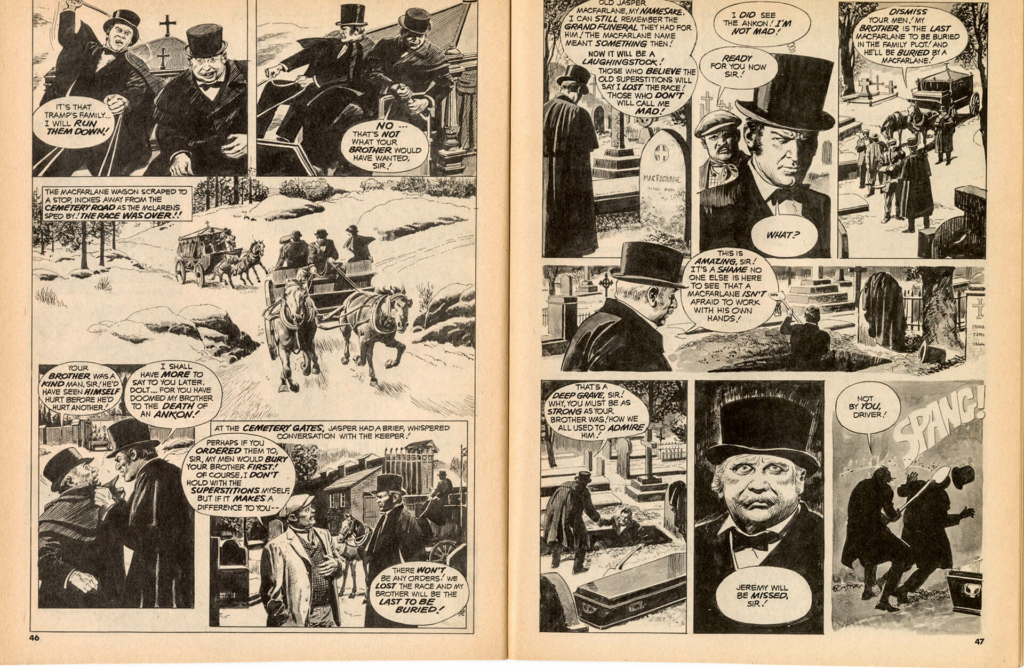
CREEPY (July 1973, #54), “Dead Man’s Race.” Story: Jack Butterworth / Art: Martin Salvador