

Nov. 3, 1943–June 27, 2024
Alexander (Sasha) Nakhimovsky, the founder and longtime director of Colgate’s Linguistics Program, passed away on June 27, 2024, in New York City. An associate professor of linguistics emeritus, Sasha retired in 2018 after three decades at Colgate, where he taught computer science, advanced Russian language and linguistics, and led both “Project Afghanistan” and “The Forum on Security and Democracy.”
Born in Moscow during World War II, Sasha grew up in Leningrad. As a high school student, he was one of five winners of the prestigious Soviet Mathematics Olympiad, which opened a space for him at Leningrad University, where admission for Jewish students was limited. When the police targeted his circle of friends for cultural activity deemed subversive by the Soviet state, Sasha was drafted into the army, while one of his friends was sent to the Siberian Gulag. After his army term, Sasha completed his master’s in mathematics in 1972 and studied English at the Hertzen Institute. His circle of friends included a visiting graduate student, Alice Stone, whom he married in Leningrad in 1974. After a long diplomatic struggle, involving help from the governor of New York and a telegram from Henry Kissinger (which the KGB showed him), Sasha was allowed to emigrate to the U.S. to be with Alice.
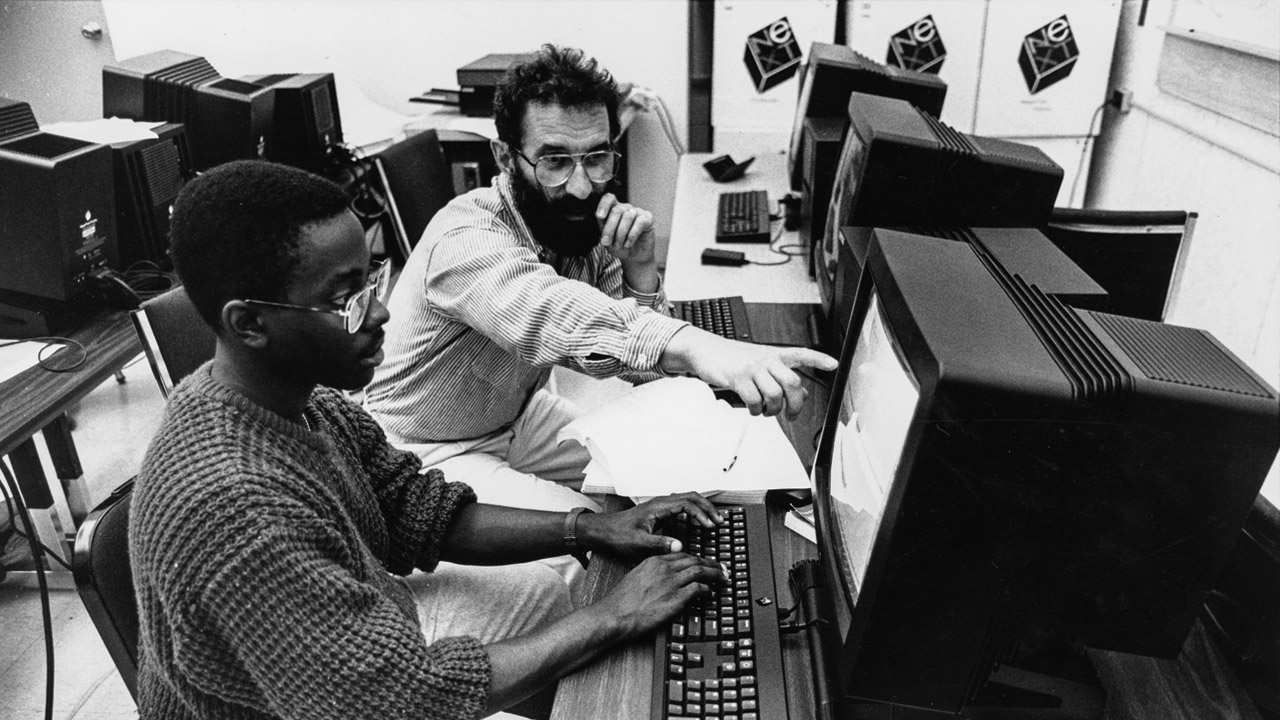
He earned his PhD in linguistics with minors in computer science and Slavic linguistics from Cornell University in 1979. He taught general and Slavic linguistics at Cornell and linguistics and computer science at SUNY Oswego before joining Colgate’s computer science department in 1985.
From the late 1970s on, often working with Alice (Distinguished Chair in Jewish studies and professor of Jewish studies and Russian and Eurasian studies) or other collaborators, Sasha produced many important translations and annotated editions of literary and cultural significance. At the end of his life, he and Alice were working on a translation from Russian to English of some of George Balanchine’s letters and notes for a Guggenheim Museum “Works & Process” series; Sasha’s recorded voice will be featured as part of the performance.
Also with Alice and co-authors at Cornell, in the 1980s Sasha published a series of original Russian language textbooks, beginning through advanced; these lively textbooks utilized many novel pedagogies and exercises, and a great deal of humor, to introduce students to Russian and Soviet culture as a crucial element of their language learning.
Sasha published a number of works in computer software programming, artificial intelligence, and computational linguistics. These intersected throughout Sasha’s career with his work on language pedagogy and linguistic analysis. His later works in particular exemplify his creative use of digital resources to create datasets allowing for a sophisticated analysis of Russian peasant vernacular and Soviet official language, which he called SovYaz.
One of Sasha’s scholarly passions was his work on social linguistics, which drew on these original datasets, his erudition in Russian and Soviet history, and his deployment of an eclectic range of historical sources, such as ethnographers’ reports, peasant petitions and letters, collections of audio recordings, trial transcripts, and much more. His 2020 book, The Language of Russian Peasants in the Twentieth Century, presented peasant speech as a social dialect and offers close analysis of its lexicon, syntax, and formulaic expressions. As with all his other work, Sasha presented linguistic material in both Russian and English, with ample explanation of both historical context and linguistic features to make the peasant discourse he analyzed accessible to Russian and non-Russian-speaking readers alike.
This book painted a vivid picture of peasant thinking, ideology, and life experience across decades of social upheaval, transformation, and war. Sasha was engaged in further work on this wide subject at the time of his death.
Focusing on another realm of Soviet speech, Sasha published an article in the journal East European Jewish Affairs in 2018 analyzing what he called the “extended conversation” in the late Stalinera trial of members of the Jewish Anti- Fascist Committee. Here again, Sasha’s fine-grained linguistic analysis, combined with his knowledge of Soviet history and cultural expression, provided original insight into Soviet social categories, public ethics and prejudices, and ideological and emotional frameworks.
Many in the wider Colgate community knew Sasha because of his indefatigable hosting of international visitors, all of them major public figures, scholars, or artists. In the 1990s, Sasha and Alice together brought famous Soviet war photographer Yevgeny Khaldei to campus for his first U.S. exhibition, which led to the book collection Witness to History: The Photographs of Yevgeny Khaldei and Khaldei’s generous gift of dozens of original photographs to Colgate’s Picker Art Gallery.
Passionate and extremely knowledgeable about global issues, Sasha enlivened campus intellectual life, even after his retirement. Through “Project Afghanistan,” Sasha highlighted that country’s political history and the Soviet and American wars there. Among many others, he hosted scholar Ashraf Ghani, who went on to serve as president of Afghanistan, and Tim Hetherington, war correspondent, journalist, and filmmaker.
Later, as director of “The Forum on Security and Democracy,” under the Center for Freedom and Western Civilization, Sasha organized visits of the groundbreaking Ukrainian filmmaker Sergei Loznitsa and leading scholars of Russia such as Mark Galeotti and Fiona Hill. After the full-scale invasion of Ukraine, Sasha hosted many events, including bringing then-Advisor to the President of Ukraine Olena Verbytska and scholar Vera Mironova to talk about the Ukrainian military in conditions of war.
Although devoted to his explorations of Russian cultural history, Sasha abhorred Russia’s long history of authoritarian governance, most recently under the Putin regime. He did everything he could to bring attention to the horrors of Russia’s war on Ukraine and provide aid to people suffering from it. In his last weeks in Hamilton, Sasha and Alice together helped to host the 2024 Commencement speaker, Bill Browder, who is a tireless critic of Putin’s regime and its global corruption and violence.
Sasha leaves behind his wife and constant scholarly collaborator, Alice; his children, Isaac and Sharon; and six grandchildren. He was deeply devoted to and exuberantly proud of them all.