

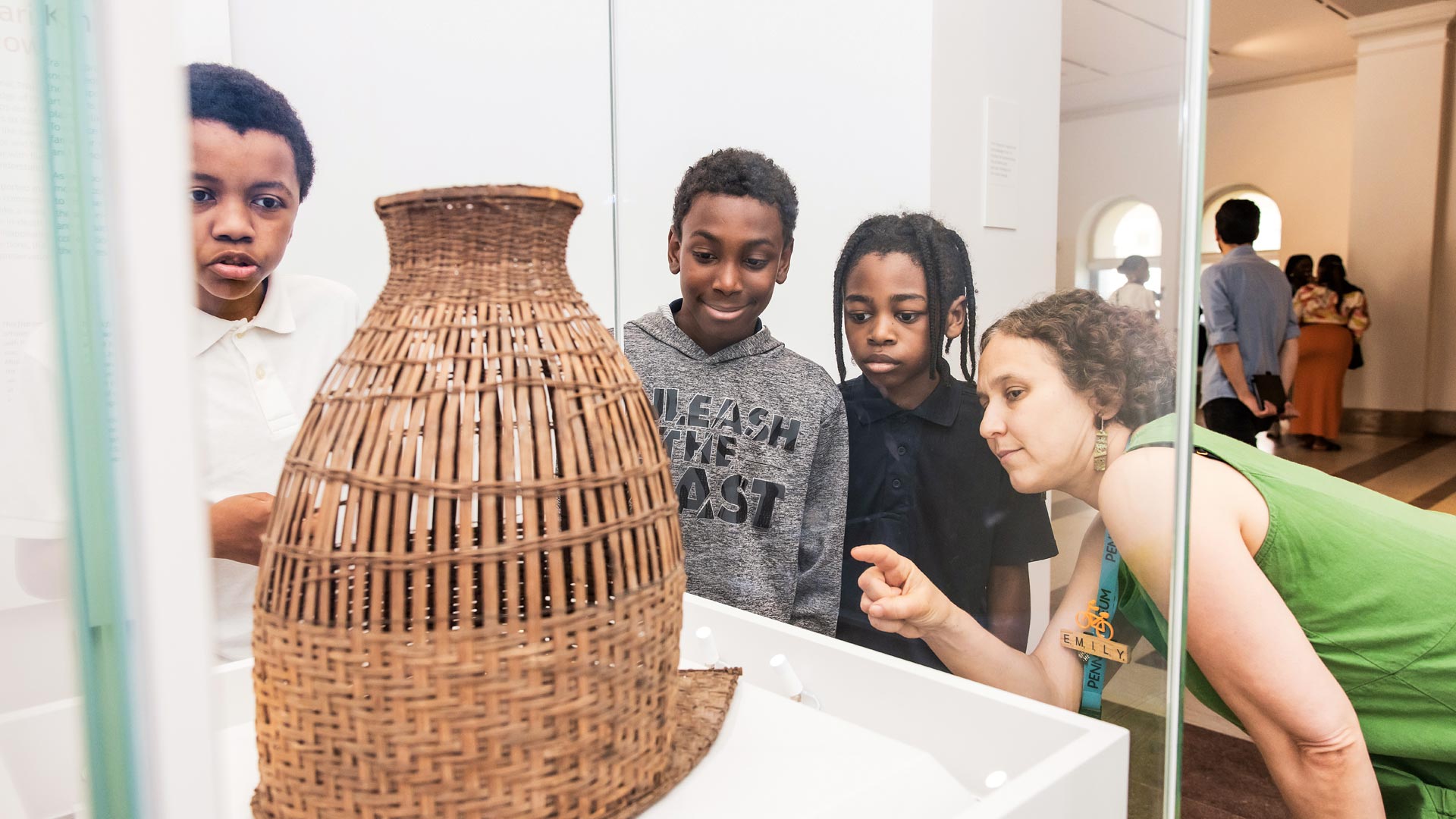
When Emily Hirshorn ’01 was hired to lead a new educational program at the University of Pennsylvania Museum of Archaeology and Anthropology she faced a challenge. Her brief: develop engaging ways to connect Philadelphia public school students to the museum’s collection of 1 million artifacts and archaeological finds, and — in an age of social media and video games — get middle schoolers interested in ancient history.
Hirshorn has pulled it off. Since 2014 more than 60,000 middle-school students have participated in the program, dubbed Unpacking the Past. “That’s a whole generation of kids who have gone on a trip to the Penn Museum,” says Hirshorn, who has since been promoted to be the institution’s associate director of school programs.
Jennifer Brehm, the Penn Museum’s director of Learning and Public Engagement, credits Hirshorn with building Unpacking the Past “from the ground up.” Key to the program’s success is Hirshorn and her team’s focus on incorporating students’ interests into their museum experience.
In an interview at the sprawling museum, Hirshorn, who sports a name tag made of Scrabble tiles, talks about how Unpacking the Past tries to draw kids in by helping them see the connections between life in the ancient world and life today. “We try to show them that what people experienced then has a parallel here,” she says. “We have the same needs as they did — to communicate, feed ourselves, stay safe, have entertainment. They might not have had social media, but they had storytellers traveling through bringing news from other places.”
When students tour the galleries, they are tasked with finding the ancient versions of something they use today. Among these: a clay tablet (the ancients’ version of our paper notebook); or a clay amphora (essentially a shipping container, used to transport wine and oil). One thing that hasn’t changed in thousands of years: tweezers. “We have some on display, and they look the same as ours,” says Hirshorn.
Unpacking the Past serves sixth and seventh graders in approximately 100 Philadelphia public schools designated as Title 1, meaning a significant percentage of the student population is lower income. The free program includes a trip to the museum, during which students tour galleries and participate in hands-on workshops, learning how people in antiquity made twine or rope from grasses, or paint from natural materials, such as crushed ochre (a type of rock) and charcoal. (Those materials are gathered on road trips by Hirshorn, whose hobbies include foraging, and crafts such as spinning, basketry, natural dyeing, and papermaking.)
But it all starts with a classroom lesson. Those visits to the schools are key, says Hirshorn, who notes that many of the kids have never been to a museum before. “If they’re not used to doing these kinds of things, they can be very nervous. So it’s important to make sure they see your face before they go and that they understand the schedule. We set them up for success by bringing artifacts with us and going over some skills that would make the museum visit more fun,” she says. “We show them how you can look at something and ask questions and then try to make some inferences. You just need to be able to share what you see. We can build off that.”
Some of Hirshorn’s pedagogical inspiration comes from her experience at Colgate, where she majored in geology. She remembers her first-year seminar with geology professor Connie Soja in which they mapped out the history of the Earth on a calendar. “Dinosaurs appeared in December, and humans were the last second of the last day of the year,” Hirshorn recalls. “That kind of activity helps you make sense of scale, and it was really impactful for me.”
Following graduation, Hirshorn taught fifth grade in Baton Rouge for two years, before returning to her hometown, Philadelphia, where she worked for several years managing a college readiness mentoring program and later took a job at a charter school running one of the biggest after-school programs in the city. Hirshorn then decided to earn a master’s in nonprofit leadership at the University of Pennsylvania and was then hired at the museum.
A decade later, she still hasn’t tired of seeing eyes light up. “When I first started, I wondered ‘How do you make history feel relevant?’ What I realized is, it’s not about convincing a kid in Philly that it’s important to learn about ancient Egypt. There is a way you can start with something that is important to them and then work backward and connect it.”