


Nov. 17, 1948–June 11, 2024
“Do you have a way to get to Manchester, N.H.?” That’s the question that started it all for me and my mentor Howard Fineman ’70, H’11, who passed away June 11 at the age of 75 after a two-year battle with pancreatic cancer.
In January 2004, Howard was in his 24th year with Newsweek and one of the most venerated political journalists in the country. It was presidential primary season, and he was making a familiar journey from Washington to the Granite State to cover the Democratic field. Somewhere along the way he called to ask me — a sophomore preparing for Colgate’s Day in the Life with him in D.C. — if I’d like to tag along on the campaign trail instead.
The answer was yes, and suddenly I found myself in the passenger seat chasing presidential hopefuls from one pastoral town to the next. In between his master class in politics and journalism, I learned about his deep love for Colgate, and what a profound impact his years there had on his life and career.
Howard arrived in Hamilton in the fall of 1966 by way of Pittsburgh, Pa., where he was born and raised. An English major with a minor in history, he earned Phi Beta Kappa distinction and was a member of the London History Study Group. He was also the recipient of a prestigious Watson Fellowship, which took him across Europe after graduation to explore Jewish history and his family story.
In a 2020 essay Howard wrote for his 50th Reunion, he described the English department — specifically the third floor of Lawrence Hall — as his “home at Colgate.” The classes he took with professors he saw as “giants” — Fred Busch, Jonathan Kistler, Wilbur Albrecht, and Jerry Balmuth, among others — served as the intellectual starting point, his “assiette” (a term he credited to Albrecht) for how he viewed the world.
A legendary editor-in-chief of the Maroon, Howard oversaw the paper’s coverage at a historic time on campus and across the country. A series of racist and antisemitic events rocked the student body and led to the 1968 administration building sit-in, while so-called “Old Colgate” was nearing its end and the first class of women was preparing to arrive in the fall of 1970. “As a Maroon cub reporter, I wrote about silly pranks and fraternity rush,” he said in his 2011 commencement address. “As editor-in-chief, I wrote editorials about Vietnam, Cambodia, the draft lottery, and the first Earth Day.”
The first bit of national attention Howard brought to Colgate came during his senior year. As opposition to the Vietnam War was intensifying, Howard was part of a student delegation that traveled to Washington to meet with Secretary of State William P. Rogers ’34, a Colgate trustee. The students believed the war was incompatible with Colgate’s values and demanded Rogers either quit the Board of Trustees or resign his cabinet position. As retold in a 2001 New York Times op-ed, their meeting garnered national coverage, but it wasn’t until later that Howard realized Rogers had made actual news with them by hinting at his aversion to the Cambodia invasion. “If I had listened carefully that day, I might have heard his opposition to the Cambodia incursion,” he wrote. “He ended the interview by telling us that he would resign from the [Colgate] Board of Trustees.”

Howard (left) and Dennis Riordan ’70 (right) pictured at a press conference regarding their meeting with Secretary of State William Rogers ’34 about the Vietnam War. Photo Credit: Getty/Bettman
Howard went on to graduate second in his class at Columbia Journalism School before starting his career as a reporter at the Louisville Courier-Journal. After five years covering Kentucky state politics and the environment, he joined the paper’s Washington bureau in 1977 (while earning his law degree on the side at the University of Louisville’s Brandeis School of Law).
From there Howard joined Newsweek, where he would spend the next three decades, ultimately serving as chief political correspondent and deputy Washington bureau chief. He became one of the most well-known political pundits on television and a regular on Hardball with Chris Matthews, The Tony Kornheiser Show, The Daily Show, and many other popular programs. His 2008 book, The Thirteen American Arguments: Enduring Debates That Define and Inspire Our Country, was a passion project that became a bestseller. (I think we all know the real reason he chose 13 arguments.)
And in 2010, Howard made one of the most unexpected yet prescient moves of his career — leaving print journalism to join pioneering online news outlet the Huffington Post as a senior editor. “The chance to dive headlong into the future is one that I don’t think anyone could pass up,” he said at the time.
In the years following our campaign trail adventure in New Hampshire, Howard was my professional North Star. His advice was plentiful and sacred as I made my way in media and politics. He and his beloved wife of 40 years, Amy Nathan, opened their home and hearts to me, becoming like extended family in Washington. But as I later learned, I was far from the only beneficiary of Howard’s kindness and generosity. He mentored scores of young journalists and Washingtonians over the years, including many Colgate students.
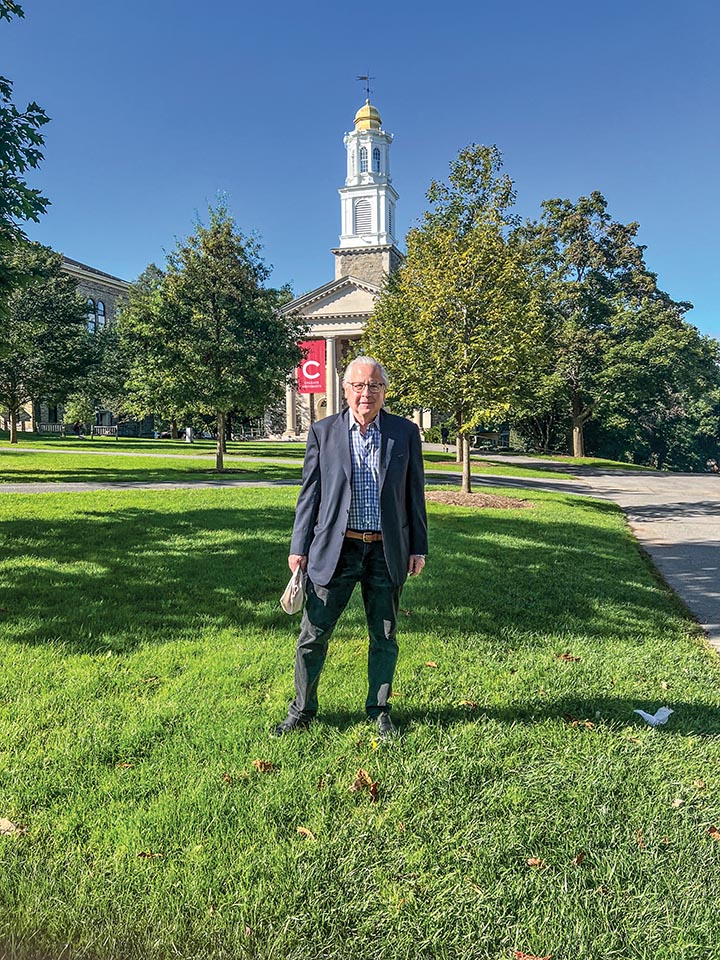
Last September I got a text message: “Amy and I are in Hamilton!” Howard said. He and Amy were on what would be his last visit to campus. Next came three photos — a beaming Howard on the quad, he and President Brian W. Casey, and a favorite view from Lawrence Hall.
In the days following Howard’s passing, the outpouring of love and admiration for him across the journalism world and beyond was truly incredible — from the Today show to President Joe Biden. Hundreds turned out for a celebration of his life at Temple Sinai in Washington, D.C. It was a beautiful service that included tributes from dear friends and colleagues, as well as his two extraordinary children whom he loved more than anything, Meredith and Nick Fineman.
Back at the Fineman house after the memorial, I noticed something that made me smile. It was the latest issue of the Colgate Magazine on the coffee table, proudly displayed atop a stack of books and newspapers. No matter whether he was interviewing U.S. presidents, breaking national news, or preparing to leave this world, Howard never lost sight of where it all began for him.
In honor of Howard’s dedication to the next generation of journalists and public servants, the Howard Fineman Family Memorial Fund has been established at Colgate.