

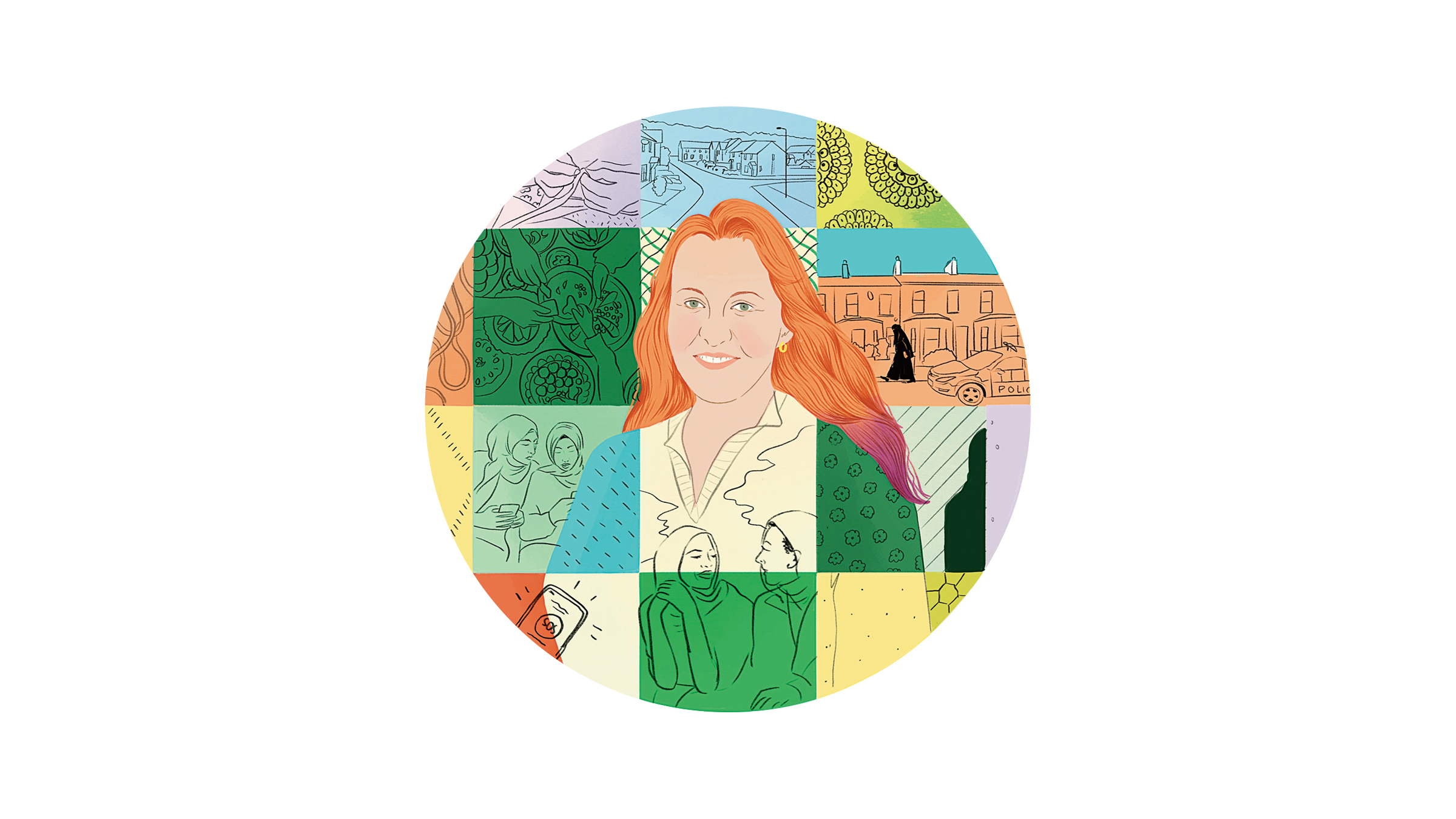
The Arabic word sadiqa can be translated into English as an honest, truthful friendship. Through her ethnographic studies of migrant Muslim women in Belfast, Northern Ireland, sociocultural anthropologist Amanda Lubit ’00 has developed trusted friendships that have enabled her to share the hard truths about the tremendous challenges these overlooked women have faced — and overcome.
Lubit’s work secured her a three-year global Marie Skłodowska-Curie postdoctoral fellowship, awarded by the European Commission in 2024. The program’s objective is to equip researchers at all stages of their careers with new knowledge and skills, through mobility across borders and exposure to different sectors and disciplines. Lubit has split her time between her research in Belfast, as staff at Dublin City University, and as a visiting researcher in Germany at the Max Planck Institute for the Study of Religious and Ethnic Diversity.
“The fellowship has felt like a validation of all the work I’ve put in and all the struggles,” she says.
A history major, Lubit fondly remembers those classes at Colgate, as well as her anthropology courses. “They were about trying to understand how all the big forces happening in the universe — history, politics, economics, etc. — impact real people in their ordinary lives and experiences,” she says.
While earning her master’s degree in anthropology, with a focus on conflict, in Portland, Ore., and her PhD at Queen’s University in Belfast, Lubit was drawn to the experiences of care, crisis, and racism among migrants in urban contexts. Earlier generations of Lubit’s own family had endured forced migration from Austria and Russia; that displacement informs her work.
“That’s why I feel so strongly about giving voice to people who tend to be silenced,” she says.
In Belfast, Lubit first volunteered for a month in 2019 with the group she identifies as the Sadiqa Women’s Space in order to earn their trust. She understood their hesitation. Northern Ireland has been called the race-hate capital of Europe by the media, and anti-immigration violence is on the rise. Its long history of sectarian violence complicates numerous aspects of everyday life. “These women would be asked [by locals], ‘Are you a Catholic Muslim or Protestant Muslim?’ which translated as, ‘Do you side with the Catholics or Protestants?’” Lubit explains.
For her fellowship, Lubit is drawing on her research to write policy recommendations addressing racism in housing issues. The migrants report being continually cycled through housing locations where they’re repeatedly subjects of hate crimes. The women have created a tracking software so they can, in real time, record where hate crime incidents are happening. “They were tired of talking to the police, the housing authority, and politicians and having nothing change,” she says.
Lubit has chronicled how the group has handled successive crises. When the COVID-19 pandemic hit, the women solicited donations of Wi-Fi equipment so they could not only continue meeting virtually but also keep their children in school. They connected online with a group of retired teachers to tutor their children and later created their own school, in partnership with local universities, so that teen migrants deemed too old to enter public schools could receive the necessary instruction. The group has also created community kitchens to bring together the diverse Muslim community dispersed among hotels and transitory housing.
“They’re dealing with desperate situations,” Lubit says, “but I like to focus on the positive side — of what comes out of their unbelievable strength and determination to make a better life for themselves and their children and to contribute to their community.”
A fiber artist, Lubit also has used some of her fellowship funds to sponsor a quilting project in which each woman in Sadiqa Women’s Space contributes a block that represents who they are. “It is a healing and empowering activity,” Lubit says. “They all have different experiences, but this outlet lets them come together to make a statement.”