


Despite being one of the youngest women’s hockey teams in the country, this year’s Raiders coalesced to turn their challenges into triumphs.
“There’s a target on our back,” Head Women’s Hockey Coach Stefan Decosse warned midseason.
The Raiders entered 2024–25 as the program was coming off four straight ECAC championships and a 2024 trip to the Frozen Four.
On the heels of those successes, the team was strong but also managing change.
Decosse stepped into the head coach role this season after nine years as an assistant coach. He brought on new staff members, including two assistant coaches, an athletic trainer, and a strength and conditioning coach.
As for the players: “Frankly, we’re down a few bodies,” Decosse noted. “We don’t have a full roster.” One player transferred late last summer, and two others suffered season-ending injuries in the early fall. That meant that competing teams had three-plus players on the Raiders, and every Colgate skater (except for an alternate goalie) was on the ice for every game.
“It’s been an interesting year,” Decosse emphasized.
Even so, with all of those factors stacked against them, this year’s team — the fourth youngest in the country — clawed their way to finish #2 in the ECAC and #5 in the NCAA. But it didn’t happen without them fighting for those wins, sometimes in the last precious minutes of a game.
An Underdog Story
Six of the team’s strongest players graduated last May and joined the Professional Women’s Hockey League (PWHL), which also recruited longtime Head Coach Greg Fargo to become its head coach last June.
“That uncertainty was challenging for the group,” said Assistant Captain Emma Pais ’27.
When Colgate wasn’t picked by the ECAC preseason poll to win the conference, it stung. “[That] was a little bit of a hit,” said Captain Hannah Murphy ’25. “We’re still really talented, and we’ve shown people that we have a lot of potential as a team.”
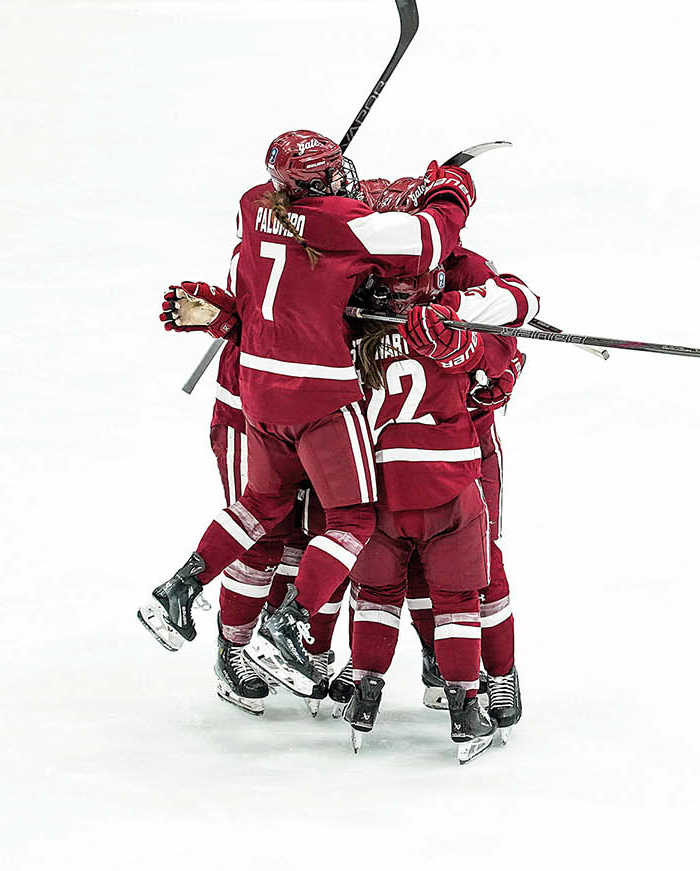
Assistant Coach Breanne Wilson-Bennett ’18 remarked, “[This team has] a bit of an underdog story,” adding that they remind her of her own team. “We weren’t the most skilled in the country; we were just hard workers.” Wilson-Bennett’s team, in her senior year, became the first in program history to go to the Frozen Four and the only one so far to make it to the Frozen Four final. “We had this collective goal, and we wanted to continue to play with each other. It wasn’t necessarily about winning.”
Similarly, she said, “This group really likes each other … they just want to continue to play to play, which was our motto in 2018, and it’s really cool that it’s kind of coming full circle.”
Colgate women’s hockey “competes at a world-class level,” Decosse said. In the ECAC, “8 of the 12 teams were nationally ranked in the top 15 at some point this season. There isn’t an easy night — you can’t take your foot off the gas.”
“In this league, it’s easy to not get complacent because everyone’s so good,” Pais said. “There’s really no game you know you’re going to win, which is a blessing because [otherwise] it’s easy to lose motivation.”
The beginning of the Raiders’ 2024–25 season was patterned with alternating wins and losses, followed by a 10-game winning streak toward the end of the fall. “We truly started to develop an identity within our dressing room and with the way we wanted to play,” Decosse said.
Several games were close calls, with the Raiders coming from behind to tie or win.
On Jan. 4 against Clarkson, two centers — including Assistant Captain Kristýna Kaltounková ’24, MA’25, a major offensive contributor — were ejected from the game, leaving the Raiders down to 13 skaters. “But never at any point was this team saying, ‘Poor us,’” Decosse asserted. “We stuck together and got it done against one of the top teams in the country.” They won 4–2. “And that’s an example of how this group approached the year.”
Other standout performances included a 4–2 win against Cornell on Jan. 11 despite a rink packed with rabid Big Red fans and a 4–0 blowout against Princeton in the Class of ’65 arena. “That was a strong team, and we didn’t even give them a chance because of the way we were playing,” Kaltounková said.
“This team really coalesced around one another,” Decosse added.
Healthy Competition
The team is a cohesive group, players and coaches agree, but a key part of their dynamic is in practice, “they go to war against each other, they push eachother, and there’s no hard feelings,” Wilson-Bennett said. “Our motto is ‘Iron sharpens iron.’ We have some of the best players in the world, and to practice against each other every day, that’s where growth happens.”
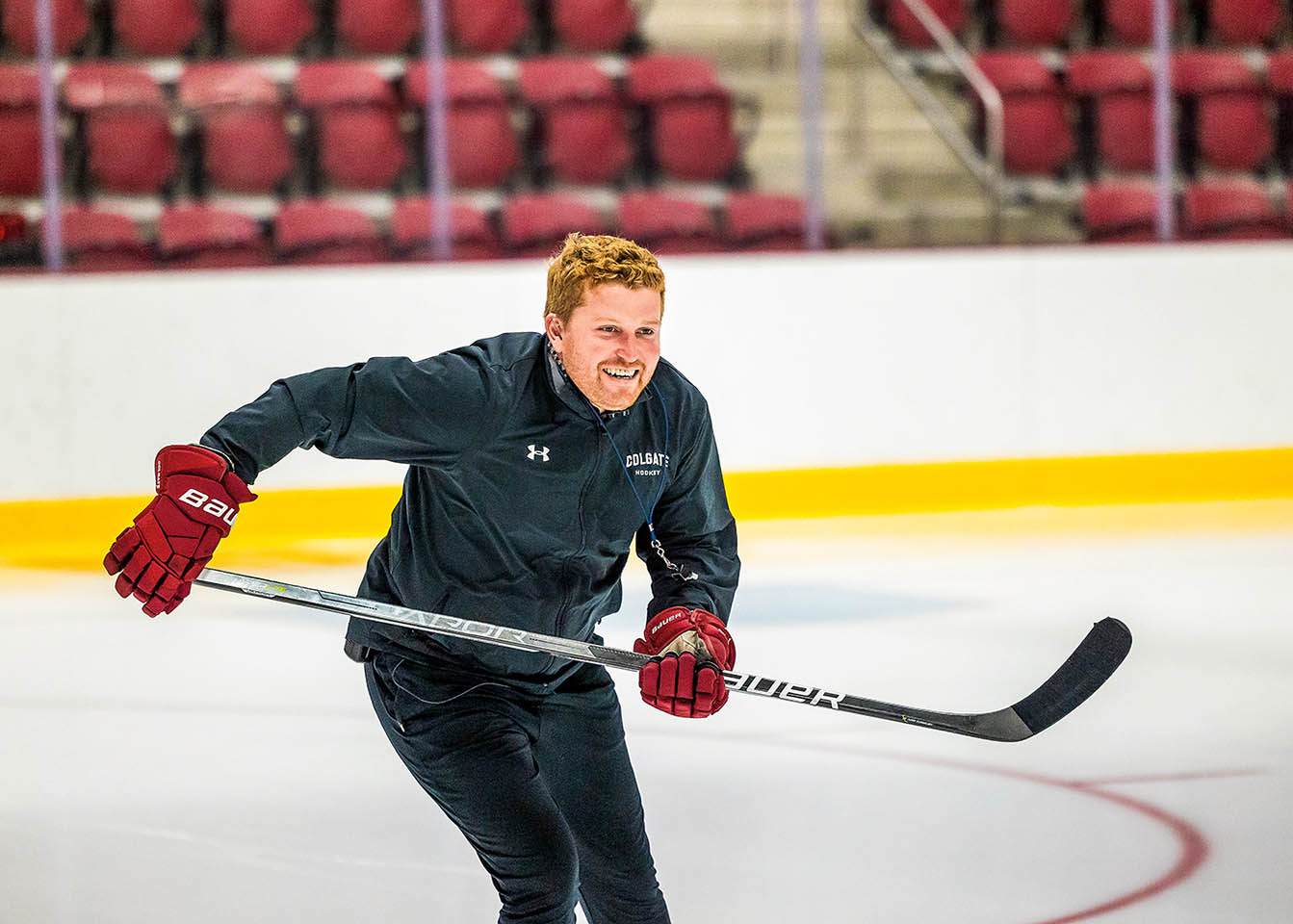
“Stef is always a big energy bubble, [as] we say in French,” Alexia Aubin ’28 says of Coach Decosse. “He brings the best out of all of us.” Photography by Quinn Schmidt
Recruiting players who thrive in a competitive environment is important, Decosse said. “That’s not for everybody, and that’s not always the norm. Every coach has a different philosophy … and ours is we’re very competitive. We keep score on everything.” In practice, he’ll tell the players that the losers will be skating more than the winners. Decosse said: “I know that’s a little old school, but I think it leads to athletic growth … as long as we’re building an environment that will catch you when you fall … we’ll pick you up, dust you off, and go right back at it.”
After battling each other on the ice, the student-athletes prove there’s no resentment. They gather to watch PWHL games and cheer on former teammates, eat together at Frank, take mall trips, and many of them even live together. Almost all of the sophomores, juniors, and seniors live together — with the seniors in a house next to the rink. “Doing different things to stay connected away from the rink is huge for team dynamics,” said Pais, who is a suitemate of Madeline Palumbo ’27 and Kaia Malachino ’27.
Community Connections
Another way women’s hockey comes together is by engaging with the local community, building initiatives started by their predecessors.
Goaltender Averill McCorkle ’25 organized this year’s Learn to Skate program for Pathfinder Village, which serves people with Down syndrome and others with disabilities. Per tradition, members of Pathfinder Village came to the Class of ’65 Arena to support the Raiders during the Neurodiversity Awareness Game.
“They sit in a group right behind our bench, and it’s awesome to have them there,” Murphy said. “It’s really an electric environment, and this year it was against Clarkson — one of our bigger rivals — so it was good for us to feed off of the energy and excitement they bring to the game.”
“Having them there was very motivating for us [because of] how much they mean to us,” added Malachino, who scored the game-winning goal in overtime (2–1).
Through Rising Raiders, which began in 2022, Colgate players serve as female role models for girls from the surrounding area. Every year the 50 available slots fill quickly and each player is paired with two to three girls, for whom they lead hockey clinics and maintain connections off the ice. “It’s a really good opportunity for our players to learn how to be a mentor, especially with the way women’s hockey is growing,” said Pais, who led this year’s Rising Raiders.
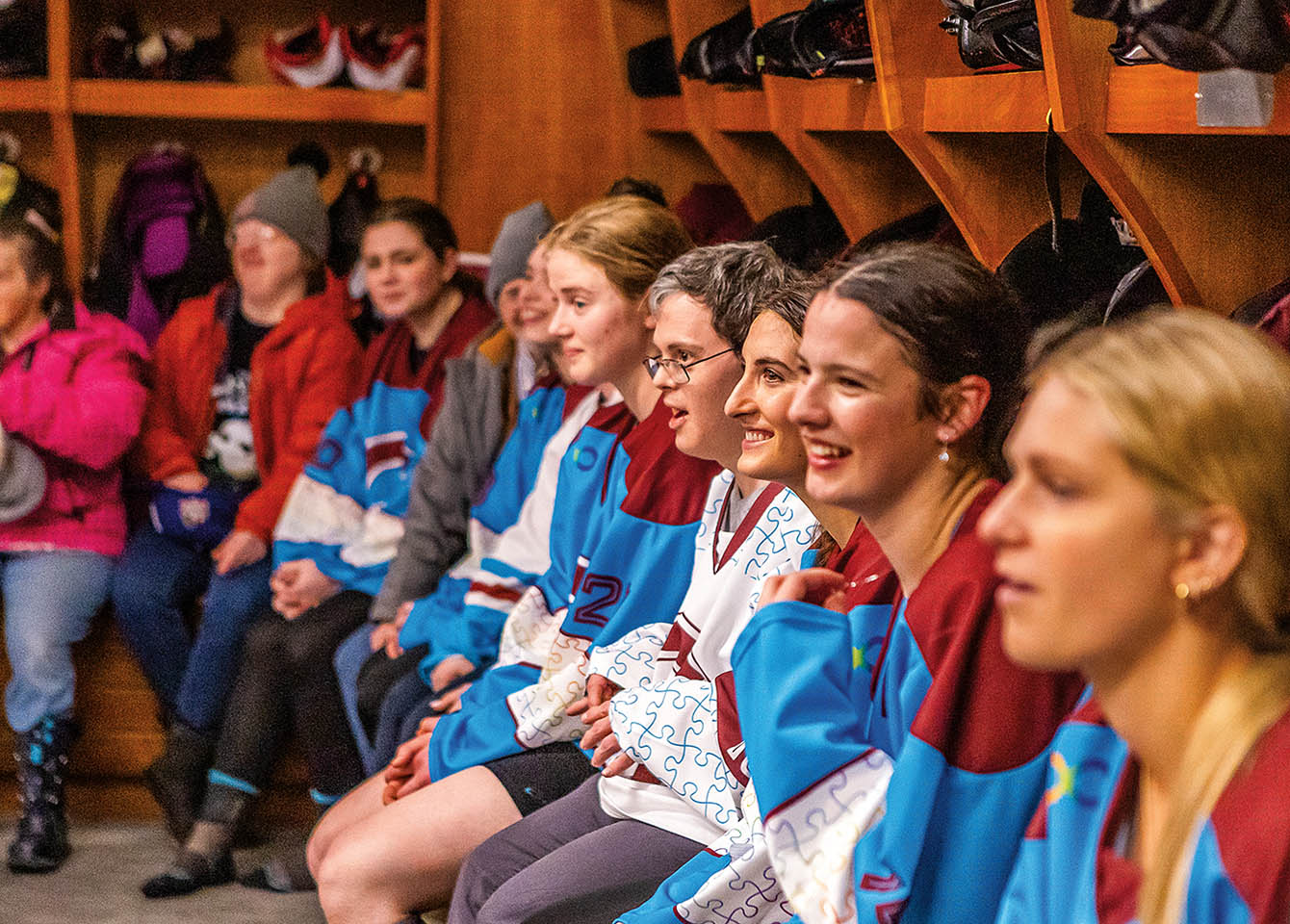
“Having [Pathfinder Village] there was very motivating for us [because of] how much they mean to us.” — Kaia Malachino ’27 scored the game-winning goal in overtime (2–1) during the Neurodiversity Awareness Game against Clarkson. Photography by Olivia Hokanson.
Kaltounková, a master’s student studying secondary education, has been offering private coaching sessions and shooting clinics to area youth. “I love the community here, so any chance I can be a part of it, whether it’s teaching [she was a student-teacher at the Hamilton middle and high schools in the fall], coaching, or playing hockey and going to school here, I’m super excited about it.”
Shared Goals
Two of Decosse’s daughters — 5 and 7 years old — participated in this year’s Rising Raiders program. He and his wife, Erin, also have an 18-month-old son: “He’s got the hockey stick in hand already,” the coach commented. Being a parent, he said, has “broadened my curiosity to learn more about the athletes in our program, about their parents, about their upbringing, and gain a deeper sense of why they’ve become who they are, which then enables me to better engage that person and that athlete.”
Although it’s his first year as head coach, Decosse’s nine years as an assistant coach gave him access to the recruitment process for current players. “I’ve had supper with their moms and dads. I’ve met their siblings. I know their life stories. There’s a trust that’s already been established,” he said. “I also had the good fortune of having an incredible mentor in Greg Fargo. He and I were really close, and I got to see what sitting in his chair looked like from the front row. It’s quite the privileged starting point in many ways.”
Becoming a coach wasn’t part of Decosse’s original game plan. With a master’s in geography from Toronto’s York University, he intended to pursue a career in academia. But in the last year of his master’s, he coached a boys’ team “and it was an incredible experience,” he said. His wife noticed how much he loved the role and encouraged him to consider it more seriously. When he learned that Colgate was looking for a volunteer coach, Decosse called Fargo to sign up full time. “I knew after my first day, this was what I was going to do with the rest of my life,” Decosse said. “It was a moment of overwhelming clarity.”
One of the significant lessons Fargo passed on to Decosse is that “staff cohesion is critically important because it filters on down to the team,” the new coach said. “We have some incredible people in our program working with our tremendous athletes.”
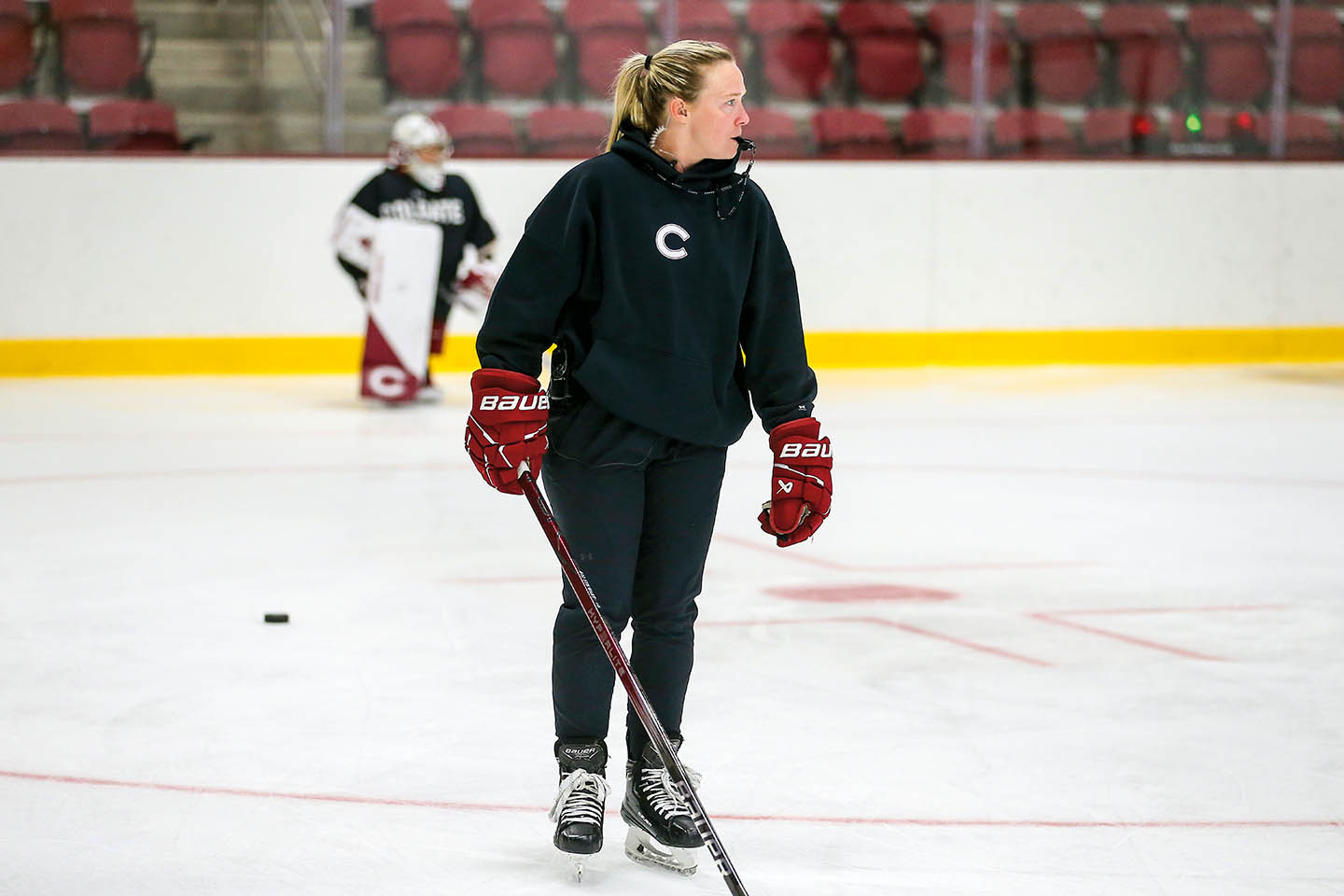
Assistant Coach Breanne Wilson-Bennett ’18 was a forward on the 2017–18 team that made it to the Frozen Four final. Photography by Brian Miller.
Wilson-Bennett, now in her second year as an assistant coach, works with the team’s 11 forwards because that was her position as a player. “As does Alex [Gettens, assistant coach], who is also a goalie specialist; Stefan and Trevor [Coykendall, assistant coach] work more with the defense,” she explained. “We really listen to one another and take bits and pieces of knowledge from each other.
“We have a young staff; we’ve done a great job of coming together and putting our own twist on things this year,” Wilson-Bennett added.
Murphy said it’s been “super relatable” to have an alumna on the bench because Wilson-Bennett has been in their shoes (skates), both playing for the Raiders and professionally.
“She is so committed to the game, but also to the girls. I love that,” Kaltounková said. “Alex is super positive on the bench, but also tells you how it is when it’s needed. Trevor runs the D-course, an awesome guy. They all come from different experiences and backgrounds, but collectively create an awesome team.
“And Stef is so passionate,” Kaltounková added. “I’ve learned how much he cares, not only for the sport, but also for the program and everyone in the locker room. He would do anything for this team.”

Kaltounková, who is from the Czech Republic, said: “Being here the last five years and having my parents across the ocean, these are the people I’ve leaned on.”
Maintaining Motivation
The hockey season runs long, with practices throughout the academic year and games twice a week, back to back, from the end of September until mid-March. “It’s such a whirlwind,” Decosse said.
The coach, who joked that he’s known for his mottos (“I have a lot of lines that get the girls laughing”), tells his players to focus on what’s in front of them and not become consumed with what’s already happened or what may happen. “Be where your feet are,” he says — something he grew up hearing from his mom.
The team hoped to make the Frozen Four this year, “but we came up a little short,” Decosse said. “Collectively, we’re proud of the course the season took. There was so much uncertainty heading into this year, but we stayed with it; we focused on who we were and leveraged our strengths.”
Murphy added: “We’ve had to overcome a lot of adversity, but it’s brought us all closer.”
When the season’s games ended, the team launched right into spring training. “We’re going fairly hard,” Decosse said. “It’s a very motivated group.”
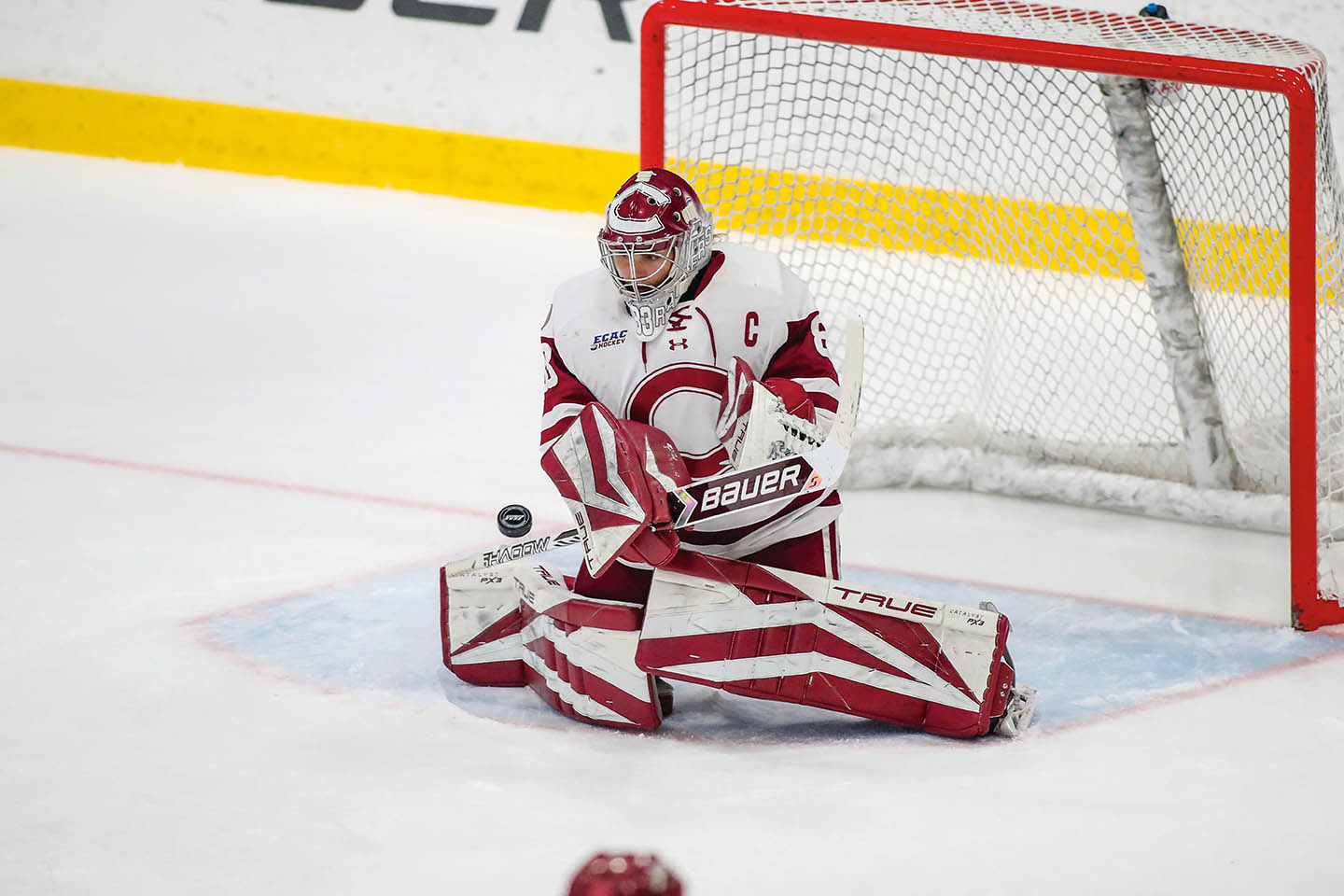
Hannah Murphy ’25 made 937 saves this season, the second most in a season in Raider history, and sits two wins away from equaling Julia Vandyk ’18 at 75 for most career wins. Murphy holds the program records for most career shutouts (17) and most shutouts in a season (6). Photography by Brian Miller
He and the coaching staff build momentum in the gym and on the ice before the players head home for the summer to train on their own. “They’re so devoted,” Decosse said.
At press time, Decosse was also working one-on-one with Kaltounková, who was preparing to play for the Czech Republic in the IIHF Women’s World Championships in České Budějovice, a stone’s throw from where she grew up. (Former Raiders Danielle Serdachny ’24 and Nemo Neubauerová ’22 were also playing in the worlds, for Canada and the Czech Republic, respectively.) “That’s going to be an incredible experience; the crowds will be crazy for Kalty,” Decosse said. “It’s a cool thing to compete at the highest stage in your sport.”
After graduation several of the seniors will enter the PWHL draft or explore opportunities to play overseas. “We’re a step along the way in their journeys,” Decosse said. “We want to further enrich their love for the game. We also want to help them grow as people and players so they’re ready to take on the next challenges that await.”
The PWHL is attracting sold-out crowds, noted Murphy, who will declare for the draft. “It’s awesome to see the progression of women’s sports.”
Building an Ecosystem
Successful coaching begins with recruiting great people, said Decosse, who spent April in Toronto and Vancouver: “It starts with identifying the right people for our environment and for our program specifically. We’re looking for driven athletes who are competitive and have a hunger for continued growth.”
The recruitment class is 10th graders who would join Colgate in three years; next year’s and the following year’s teams have already been determined. “It’s very competitive,” Decosse said “We’re up against the Ivy Leagues and the Big 10 competing for athletes. Everyone’s trying to get ahead of it.”
Forming the team is one of the most fun parts of the job, he noted. “You get to build your own ecosystem within your program.”
Next year’s roster welcomes seven new players: a goalie, two on defense, and four forwards. Four of them have played in the Under-18 World Championships and have won a gold medal for their respective Under-18 teams on the international stage.
“It’s a talented recruiting class, and they have some great role models for what it is to be a Colgate women’s hockey player,” Decosse said. “That’s probably the most exciting piece — when your culture reproduces itself. That’s what you’re looking to build over the long term: When you have exceptional people in the program, they make it easy to follow.”
The next year’s class looks strong, too, he said. “We’ll keep building, one day at a time.”
Alumnae Playing Pro
Professional Women’s Hockey League
- Sydney Bard ’24, Boston Fleet
- Dara Greig ’24, Montreal Victoire
- Jessie Eldridge ’19, New York Sirens
- Olivia Zafuto ’19, Boston Fleet
- Allyson Simpson ’24, New York Sirens
- Kayle Osborne ’24, New York Sirens
- Danielle Serdachny ’24, Ottawa Charge
- Noemi Neubauerová ’22, Toronto Sceptres
- Kaitlyn O’Donohoe ’24, Minnesota Frost
Swedish Women’s Hockey League
- Malia Schneider ’22, SDE HF
Chinese Women’s Hockey League
- Maggie MacEachern ’23, KRS Shenzhen