

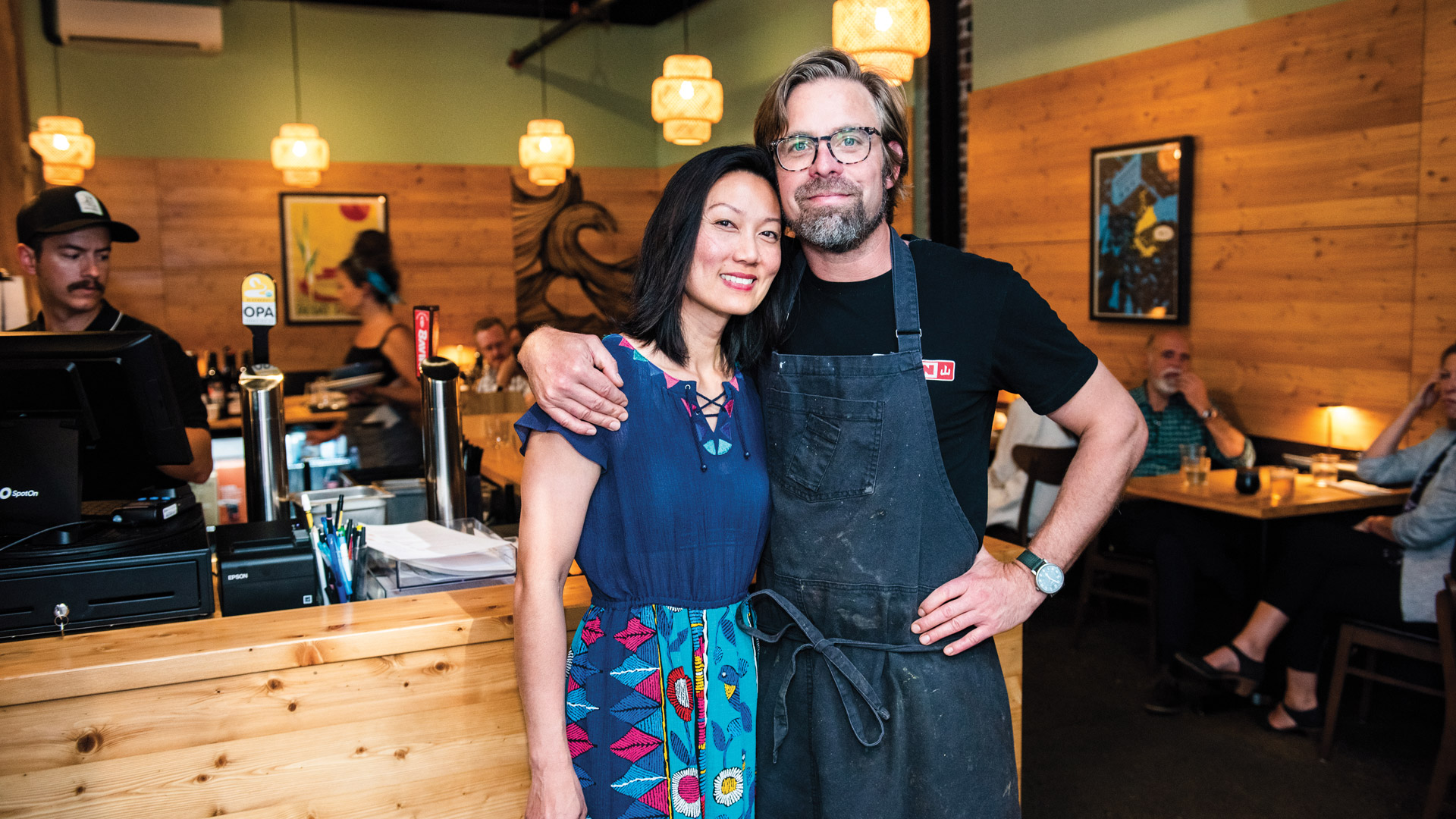
Just eight months after opening for business, Chef Jarrett Wrisley ’02 got the call that his new Bozeman, Mont., restaurant, Shan, had been nominated for the James Beard Foundation’s 2024 best new restaurant in the U.S.
“It was a shock,” says Wrisley, and Shan (rhymes with “pan”) was a finalist at the ceremony in Chicago. Now, after nearly two years as Shan’s proprietor, Wrisley has settled comfortably in the Rocky Mountains, half a world away from his culinary roots in the Far East.
Majoring in Asian studies and Chinese at Colgate, Wrisley’s on-the-ground introduction to China was a semester at Beijing University. That was followed by an internship with the New York Stock Exchange, and he was mulling a Wall Street career, but his heart was not in it. A week following his last day interning, the events of Sept. 11, 2001, devastated international finance. “That made the decision for me,” says Wrisley, and he went back to China. “I traveled, learned Chinese with greater fluency, and worked as a freelance food writer.”
For several successful years, he penned travel and culinary pieces for magazines and newspapers in Asia and the U.S., including the Atlantic, Time, Food & Wine, Travel + Leisure, and National Geographic. “I got paid to travel and eat,” he says. “A lot of my stories were centered around culture, socioeconomic conditions, and politics. Food intersected all of these.”
When he moved to Thailand in 2008, he arrived in the middle of a coup d’état, and he was assigned to cover the crisis for the Atlantic. “My way of explaining what was happening in Thailand in political terms was to go to the rallies and write about the things people were eating there because what they were eating reflected where they were from, and where they were from was a reflection of their political identity,” he says.
However, a financial crisis forced another pivot as magazines went digital, and the Great Recession caused payments to shrink, and checks were late, he says. “At that time, I didn’t see a future in journalism for me.”
With the considerable culinary knowledge he digested while researching Thailand’s regional cuisines, Wrisley took a leap and opened his first restaurant, Soul Food, in Bangkok, which received the Michelin Guide’s Big Gourmand award. A second location was established in Hong Kong, and he wrote two Chinese food cookbooks.
The plaudits and honors kept coming when he opened two Italian trattorias, both called Appia (named one of the world’s best 50 restaurants by Monocle magazine), in Bangkok with friend and frequent collaborator Paolo Vitaletti. Appia was born of extensive travels in Italy, which also resulted in an award-winning cookbook, The Roads to Rome. In 2017, Wrisley opened a Thai restaurant with Black Restaurant Group in Hong Kong, and he launched a fast casual noodle and sandwich shop and a pizzeria in Bangkok.
The frenetic pace and yearslong toil shaped the work he loved, but like so many, his life changed once again with the COVID-19 pandemic in 2020. “The scene in Bangkok was dire. It went from the most visited tourist city in the world to having zero arrivals,” he says. In 2020 and 2021, he closed all but the Appia restaurants and the pizzeria, which catered to the Bangkok upper class unable to leave the country.
It was time to start anew. Leaving his home and businesses in 2021 was humbling, he says. “I said goodbye to my life in Asia. I just let it all go.”
He bought an old Subaru, a tent, and some sleeping bags and drove around the U.S. for four months with his wife, Candice, and their son, August, looking for a place to live, he says. “I hadn’t lived here in 22 years.”
The trio traveled to Montana because they’d never been there before, but they knew immediately Bozeman was their new home. “I swore I’d never open a restaurant again,” he says, “but I didn’t want to work for anyone else.” The couple found a small restaurant space — its name, Shan, is the Chinese character for “mountain.”
“I cook traditional mountain food from China and Thailand with products from Montana, even from this valley,” says Wrisley, who, for example, makes dan dan noodles with Meishan pork, “which is a Chinese breed, but it’s raised by a pig farmer 10 miles up the road.”
He’s reaching back to what he knows, he adds. “My goal when I opened Shan was to build a bridge between this little mountain town and my previous life in Asia, and I think I’ve accomplished that. I think that’s one of the coolest things I could possibly do.”
Wrisley admits he’s always been food obsessed: “I started cooking when I was 6 or 7 years old, and by 9 or 10, I was cooking dinner for my family. I could always remember every dish I’d ever eaten at a restaurant from the age of 5.”