

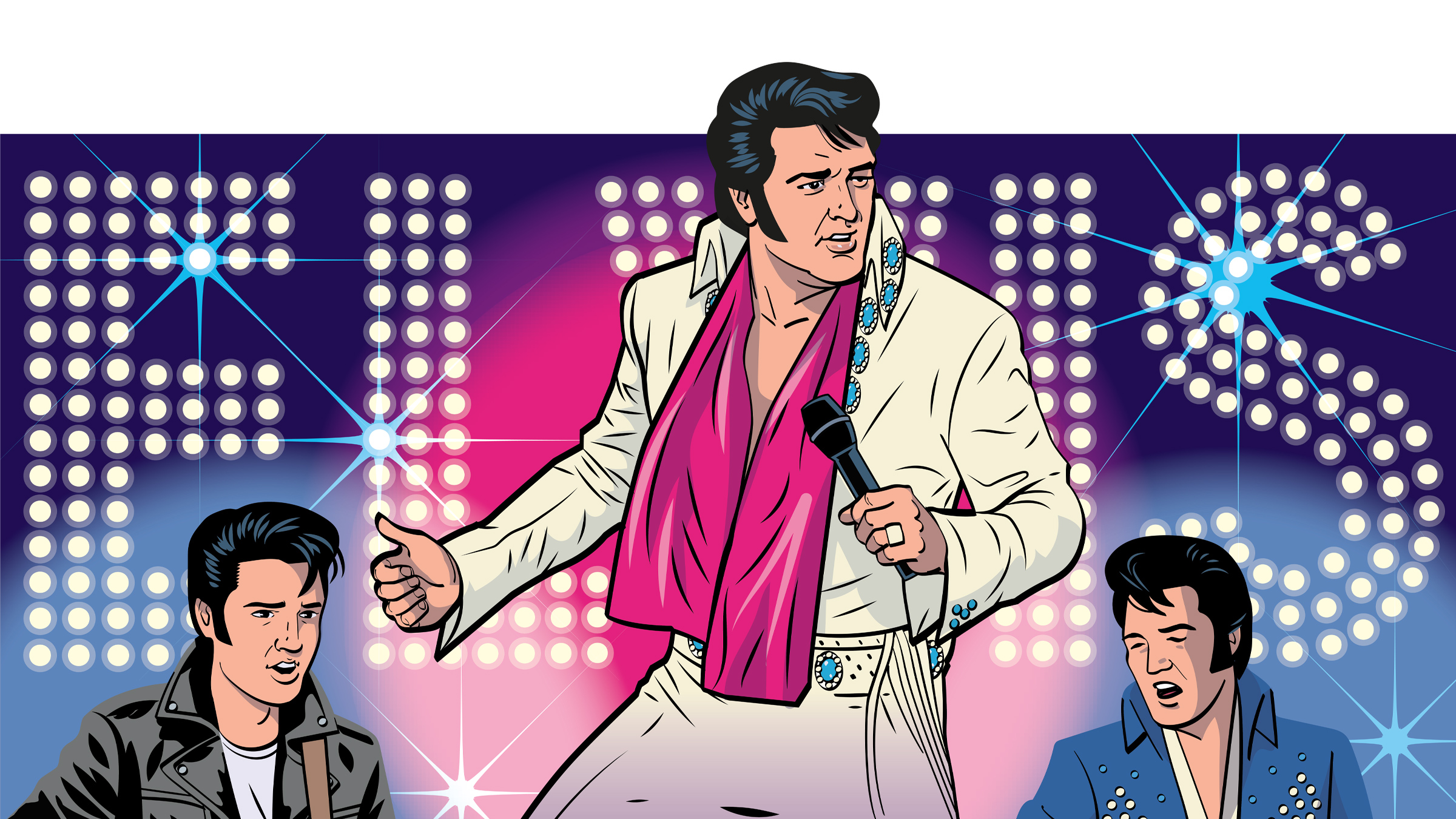
As a cultural anthropologist, Lili Rodriguez ’76 has spent a lifetime studying why people do what they do. That instinct followed her to a Las Vegas chapel in 2023, where she and her longtime partner were married by a young, handsome Elvis.
“This guy was in his early 40s. Elvis had been dead for more than four decades,” Rodriguez says. “I’m sitting there wondering, why would anybody his age want to make a living this way?”
The question became an obsession — and eventually, a book.
Published last fall and written in collaboration with Marian Keijzer Steennis, Echoes of Elvis: Elvis Tribute Artists and the Fans Who Love Them traces a two-year deep dive into the world of Elvis tribute artists (not “impersonators,” Rodriguez notes — a distinction that reflects their focus on preserving Presley’s music and legacy). To report it, she interviewed more than 50 performers, 45 fans, and dozens of musicians, photographers, and others connected to the scene, weaving their stories into a nuanced portrait of the subculture she initially struggled to understand.

No matter [your age], when Elvis touches your face, you’re a teenager again.
For Rodriguez, the subject was an unlikely one. “I didn’t grow up an Elvis fan,” she says. Raised in New York, she came of age in the late ’60s listening to the Beatles and the Doors. An anthropologist with a long career in consumer research, Rodriguez says Elvis reappeared on her radar in 2022, when the Baz Luhrmann Elvis biopic — and soon after, her Las Vegas wedding — sparked a deeper curiosity.
“It’s the first topic that’s gripped me enough to make me want to understand the phenomenon.”
She started her research with “All Shook Up,” a long-running Elvis tribute show in Las Vegas, then traveled to a three-day Elvis festival in Scottsdale, Ariz. What she expected — a tame crowd of Baby Boomers reliving the past — wasn’t what she found. Nearly all the performers were young, some in their 20s and 30s, born long after Elvis’ death. The fans were surprisingly diverse, too, and packed theaters and convention centers with the same frenzied energy that defined Elvis’ concerts at his peak. At one show early in her research, Rodriguez recalls the “electric” moment the performer appeared on stage. Women rushed forward, screaming, crying, straining for a moment of contact. “I’m sitting in the audience going, ‘You know that’s not Elvis, right?’” Rodriguez says. “But it didn’t matter.”
The deeper she went, the more Rodriguez came to understand that these performers weren’t parodying Elvis, but were deeply committed, highly skilled musicians, dancers, and singers. Many discovered Elvis as children, often through a parent or grandparent, and describe the experience in near-mythic terms. One young performer told Rodriguez that hearing “Blue Suede Shoes” for the first time felt like being “struck by lightning.”
Off stage, many tribute artists study Presley obsessively and can track the evolution of his look — sideburns, jumpsuits, jewelry — with meticulous precision. At one event, Rodriguez recalls, a performer watched another take the stage and immediately spotted a flaw: this Elvis was wearing the wrong gold ring for the era he was portraying. “They’re like walking encyclopedias,” Rodriguez says.
She notes that mastery of Presley’s catalog and persona is only part of the craft; the ability to interact with audiences is just as essential. At concerts, performers often move through the crowd, serenading audience members, holding women’s hands, touching their faces, and kissing their cheeks.
“I began to understand how that connection is a huge part of the appeal,” she says. “No matter [your age], when Elvis touches your face, you’re a teenager again.”
Indeed, many of the tribute artists Rodriguez interviewed also perform in nursing homes and hospice centers, offering comfort as much as entertainment. The work is rarely lucrative (costumes alone can cost thousands of dollars), but for many, it becomes central to who they are. “It’s not a job for them — it’s a passion,” she says.
At the same time, Rodriguez found that people project onto Elvis what they want to see. Because he died at 42, his image never had to contend with aging or decline, like other iconic artists of the era.
“He never got old, so in a way, he’s become a symbol of a moment in time,” she says. “He represents a more innocent America that doesn’t exist anymore and those good family values.”
Perhaps that’s why, Rodriguez posits, the community has a strong evangelical Christian overlap, with some framing Elvis through a spiritual lens. Performers often start their shows by invoking “the greatest entertainer who ever lived” while gesturing skyward, as if addressing him directly.
For Rodriguez, that mythology helps explain his endurance. Nearly 50 years after his death, Elvis remains globally recognizable; in her reporting, Rodriguez interviewed performers and fans from Denmark, Norway, Scotland, Mexico, and Australia. “They worship Elvis in the same way Americans do,” she says.
Since the book’s release last year, Rodriguez continues to frequent Elvis conventions and festivals, holding book signings and reconnecting with the performers and fans she’s come to know well — no longer just studying the phenomenon but, occasionally, falling under Elvis’ spell herself.
“You see somebody turn a certain way on stage,” she says, “and for a second, you see it. You see Elvis.”