

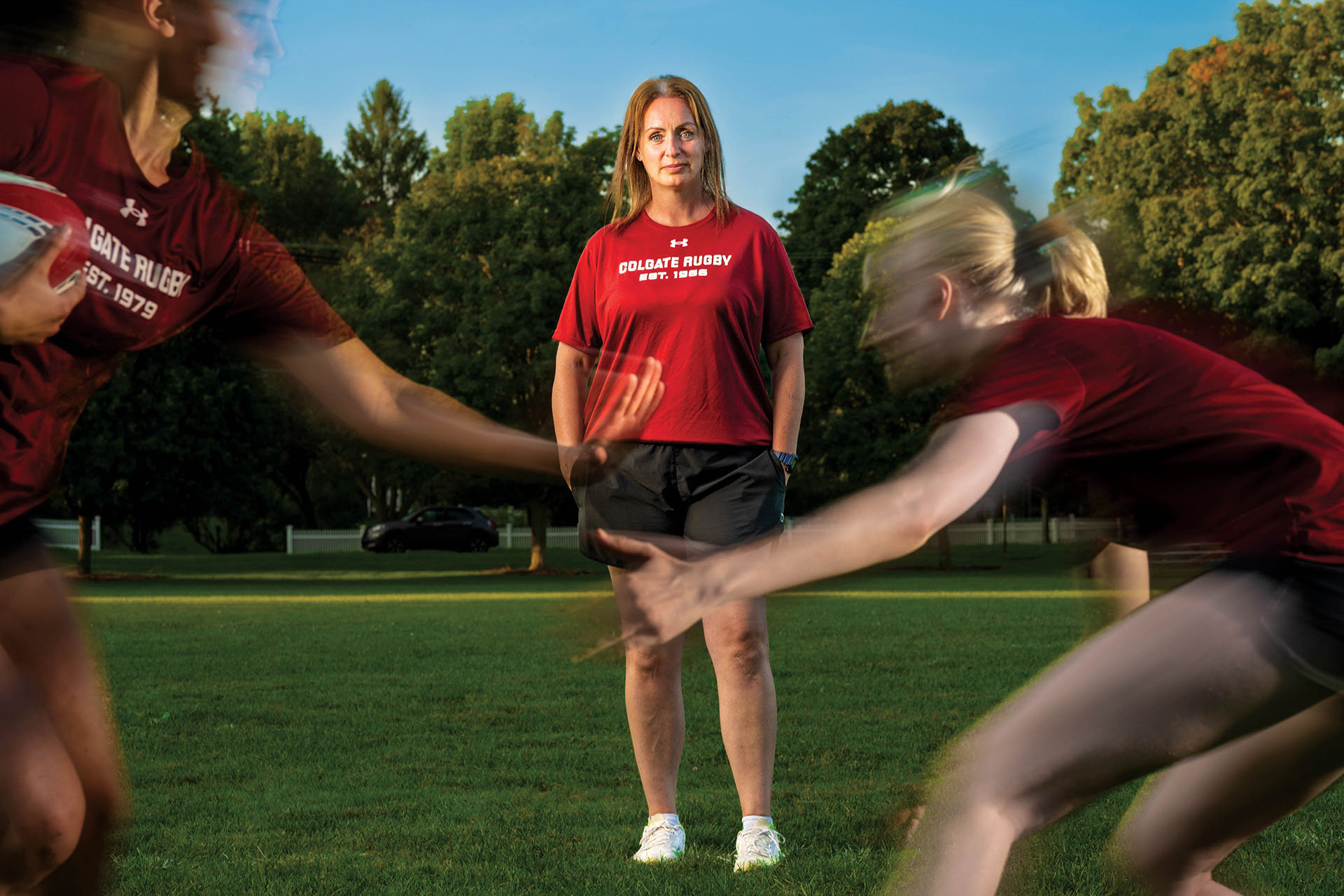
After holding rugby leadership roles in Scotland, England, and Italy, Elaine Vassie came to the U.S. — and plans to stay — because she believes she can make a difference here. “If you’re coaching high level in nations where rugby’s developed,” she says, “maybe you’re tweaking things, as opposed to, ‘How do we help someone fall in love with the game?’”
Colgate Magazine spoke to Vassie at the start of the season to learn more about her and where she plans to take the program.
Previous U.S.-based experience: Vassie came to Colgate from the Texas Rugby Union All Stars, where she served as defense coach while running education workshops. Previously, she spent three seasons as the general manager of Major League Rugby’s Dallas Jackals, a former pro team based in Arlington. In addition, she’s a former head coach and director of the Dallas Harlequins, a DI men’s team.
Breaking the mold: Vassie was the first female assistant general manager in Major League Rugby in the U.S.; previously, she was the first female coach and director in the Men’s National League One in England when she took over Manchester Rugby Club.
Helping students grow: “Our students are people first and then they’re our students and then they’re athletes who choose to play rugby,” Vassie says. She aims to offer support to players both on and off the pitch. “How do we give students good life experiences that they can translate to whatever their lives will be?” For one, she’s been working with Career Services to integrate its programming into the rugby schedule. Students are “here to grow as whole people, not just rugby players.”
The gold standard: “We’ve changed a lot on the medical side. Dr. Ellen Larson ’94 has been phenomenal; we’re running a pilot with [Student Health Services] on in-person concussion assessments, which is the gold standard from a world rugby perspective. We’ve also sourced a new athletic training partnership with Oneida Health so we have them present at training sessions and game days to enhance the level of care.”
She knows what it’s like to suffer from a concussion: At age 19, Vassie was in a car crash that left her with headaches for months and cognitive issues for years. “People weren’t talking about concussions like they are now,” she says in a Rugby Journal profile. “You’d have a scan and get sent home with a leaflet.” It derailed Vassie’s schooling and sports (she was a multisport athlete: netball, soccer, swimming, tennis, trampolining) until she was “feeling normal again.” A friend invited her to play rugby in her early 20s — which is late by England’s standards but helps her understand Colgate students who are beginning to learn the sport.
Equal turf: Although the rugby program is divided into men’s and women’s teams, Vassie and her coaching staff “have a real drive” to make it a rugby community. “The laws of the game are the same for the men’s and women’s teams,” she says. And because both teams have members who haven’t played before coming to Colgate, the coaching staff is intentional in using the same language and terms, as well as sharing clips of games and other resources. “That gets us toward the shared mental model,” she says. “The philosophy, the shapes, the pattern, all of that is the same.”
She loves rugby because it’s a mix of brain and brawn: “There’s a tactical understanding, technical challenges, and lots of different components. You don’t have just one job to do — you’ve got a lot of jobs.”
Team dynamics: “One of the things that’s special about rugby is once you’ve taken the field with someone, your relationship changes. There’s a different level of reliance within rugby because of the physical component of the game and the speed that it’s played at in terms of fluidity.” Because of that dynamic, she says, “You should have a group that you can, 20 years down the line, still pick up the phone and have a conversation with, and that’s because of the experience you had on the field when you were here.”