

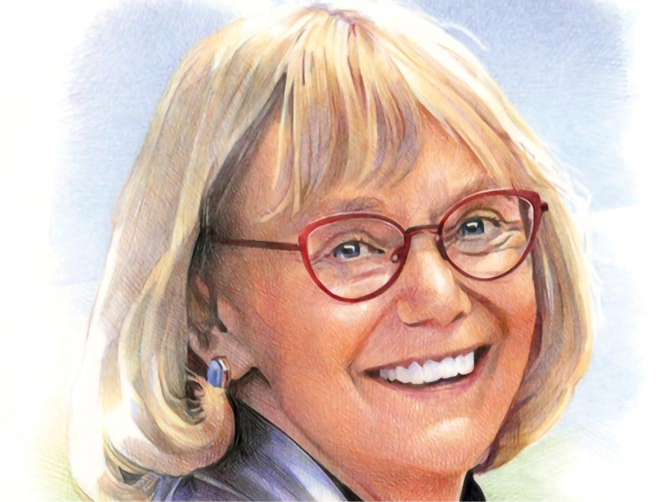
Advice From Former Colgate University President Rebecca S. Chopp
When former Colgate University President Rebecca S. Chopp was diagnosed with Alzheimer’s disease five years ago, the first neurologist she saw gave a grim prognosis: She wouldn’t even be able to button her shirt in a few years. But, as the liberal arts has taught her, if you don’t like the answer you get, “ask the question again; ask it deeper,” she told an audience gathered in Colgate Memorial Chapel in April. When she asked a second neurologist for an opinion, that doctor said, “There’s so much more living you can do.”
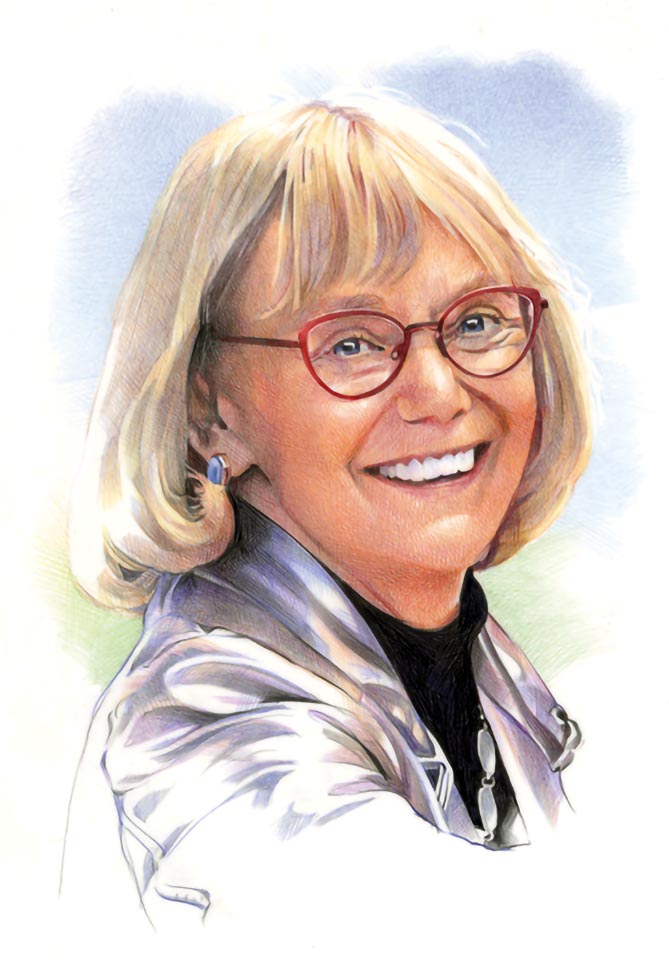
Embracing this credo of living life to the fullest, Chopp has written the book Still Me: Accepting Alzheimer’s Without Losing Yourself and has become an Alzheimer’s activist and educator. She has delivered a TED Talk on the subject and in the spring came to Colgate to participate in a panel discussion with Ellen Percy Kraly, professor of geography and environmental studies emerita, and Doug Johnson, the William R. Kenan Jr. Professor of psychological and brain sciences.
“It was at Colgate where I began to realize how the arts, science, and athletics come together in the phrase we always use, ‘the spirit that is Colgate’ — and it’s about being a full person, a whole person, and how all of this can combine into making a life worth living,” Chopp said.
After serving as Colgate’s 15th president, she became president of Swarthmore College and then chancellor of the University of Denver. Chopp was in the prime of her life when she was diagnosed, she said at the Colgate event. After working through her despair, she decided to “live with joy,” as that second neurologist told her she could do, and start researching how to live well. She turned that “prescription” into gifts she shares with others:
“Build your body to prolong your brain. I wrote this book, and here’s how I did it. I have a little Pomsky (a mix between a Pomeranian and a Husky), and he’s very active. So we walked extremely fast for about an hour to an hour and a half every morning. That got all those chemicals in my brain to allow me to concentrate, to go home and write that book. Exercise is extremely important. If you don’t do it, start. And if you do [exercise], increase it.”
“Creativity, with the 100,000 billion neurons in the brain, allows a kind of flexibility. It forms new pathways, and it also reduces anxiety. So create, doodle, dance; music is fabulous. Any kind of artistic activity. I learned to paint.”
“Sleep is really important. When I [worked at Colgate] and throughout my life, I slept about four hours a night…. [Now] I sleep about nine to 10 hours a day, which is amazing.”
“Every morsel you eat is brain boosting or brain destroying. Adopt a Mediterranean diet. I gave up all processed foods.”
“Abide in awe. Call it spirituality. Call it religion. Whatever you need… Awe is that feeling of being connected to transcendence.”
The panel discussion with Chopp kicked off the University’s Arts, Creativity, and Innovation Weekend.