In Little Hall: making an old printing process new again
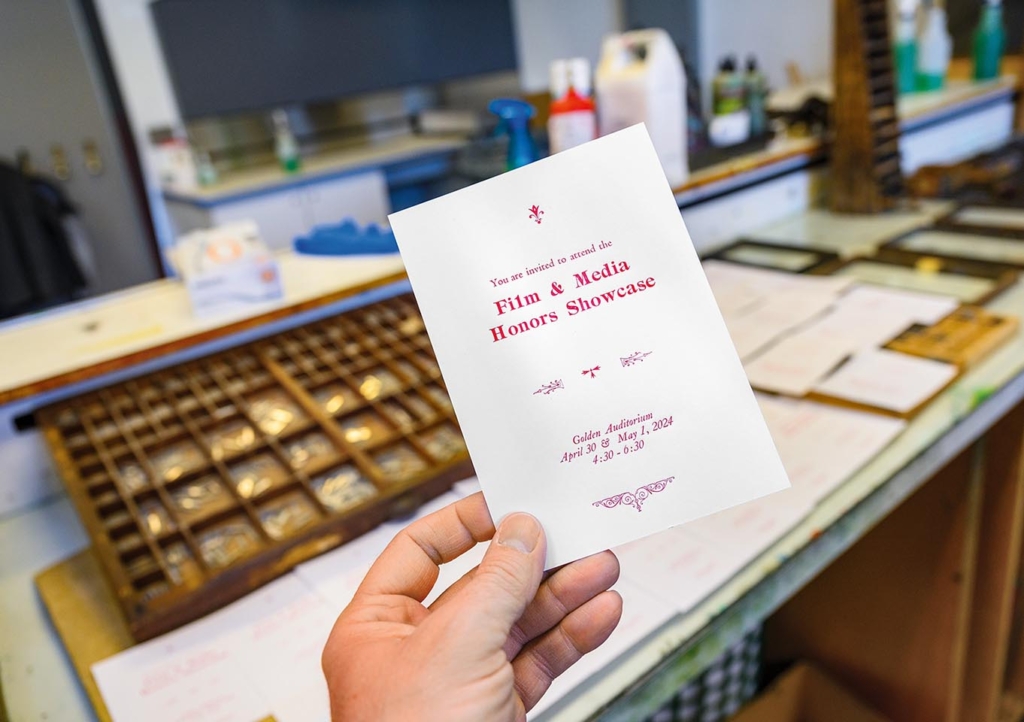
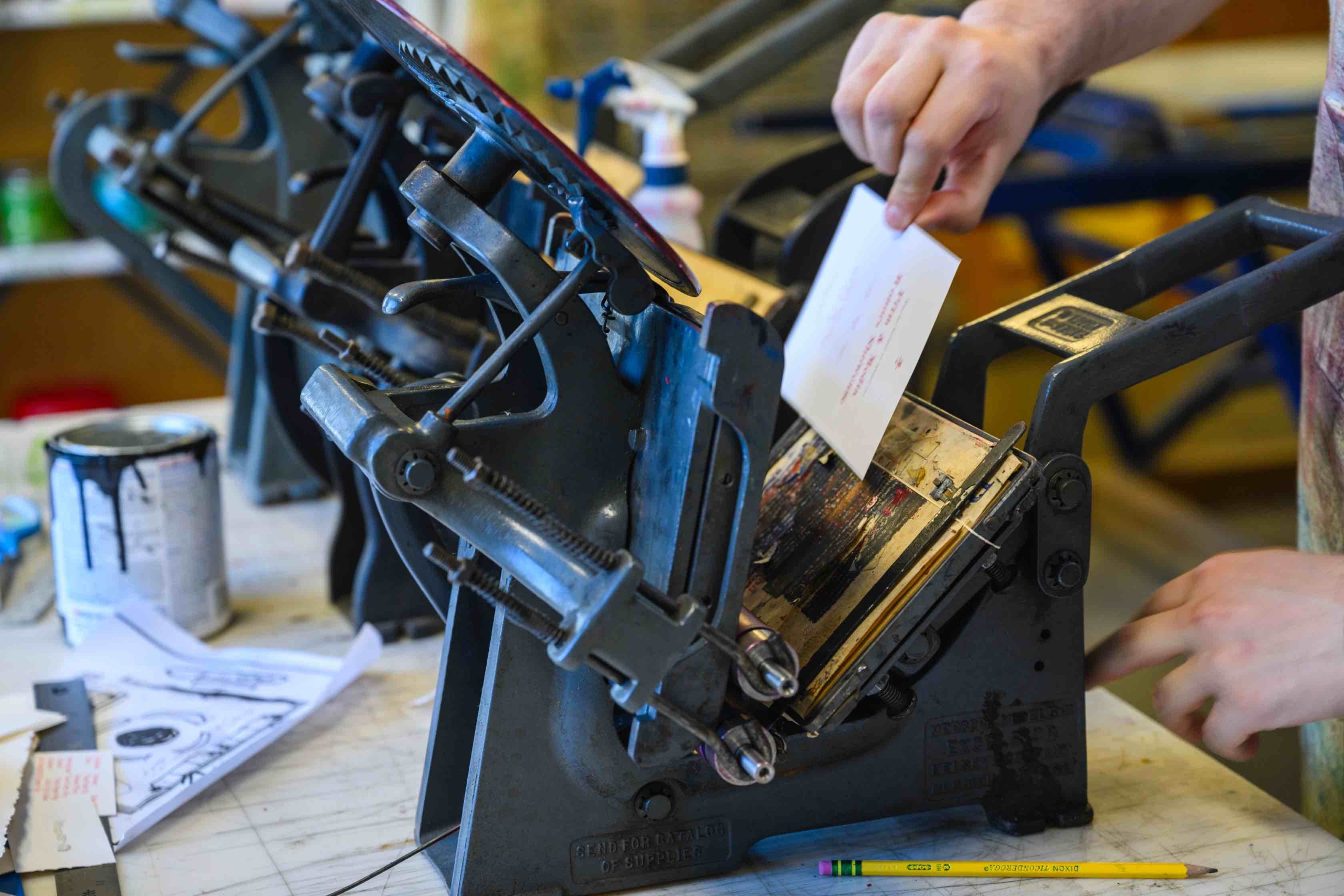
Three small printing presses, dating back to the early and mid-1900s, have been restored to working order in 205 Little Hall. Two of them, along with 11 full type cases and a number of partial type cases, were used for the Colgate News. A third was donated to the University by the family of a former Little Hall custodian.
The equipment had “been gathering dust until they were transformed into something operable” by Kieran Blunnie ’24, says Lynn Schwarzer, professor of art and film & media studies. She’s most excited because they can now be used in her printmaking class, where she teaches processes like lithography, intaglio, and papermaking.
Blunnie, a film & media studies and political science major from Darien, Conn., arrived at Colgate already knowing the art of letterpress. He began learning the craft when he was 12 years old at Camp Kieve in Maine, to which he has returned every summer to refine his skills and, in recent years, teach it to other campers. “He has a natural inclination to it, and we’re really lucky,” Schwarzer says.
This year, as Blunnie was preparing to make his capstone film about letterpress, he asked Schwarzer if he could have access to the printmaking studio and the presses. She made a deal with him: He could have a key if he would make the equipment functional again.
His work started in January: “It became a matter of identifying what was broken,” he explains, “ordering new parts, making sure those parts worked, cleaning and oiling, and then organizing all the pieces.”
Two of these proof presses are 5″ by 8″ and the other is 6″ x 10″. “They’re not for laying out a full newspaper type,” explains Schwarzer. “It is enough to do business cards, invitations, and artwork that is of a scale.”
Both Schwarzer and Blunnie agree that there’s something special about the letterpress process, which was replaced by computerization in the mid- 20th century. “There are tiny bits of fluctuation and little characteristics that can appear, which don’t appear when you just press print and 30 things come out,” Schwarzer says.
“There’s beauty in putting everything together by hand,” Blunnie adds.
“The process itself is meditative,” Schwarzer says. “There’s a rhythm to it: You put the paper in, you make sure it’s inked up, you press it, and then you do the next one and the next one.”
In recent years, letterpress has had a resurgence, she notes. “It’s a little like vinyl; the appreciation for the manual setting of this as opposed to the digital.”