

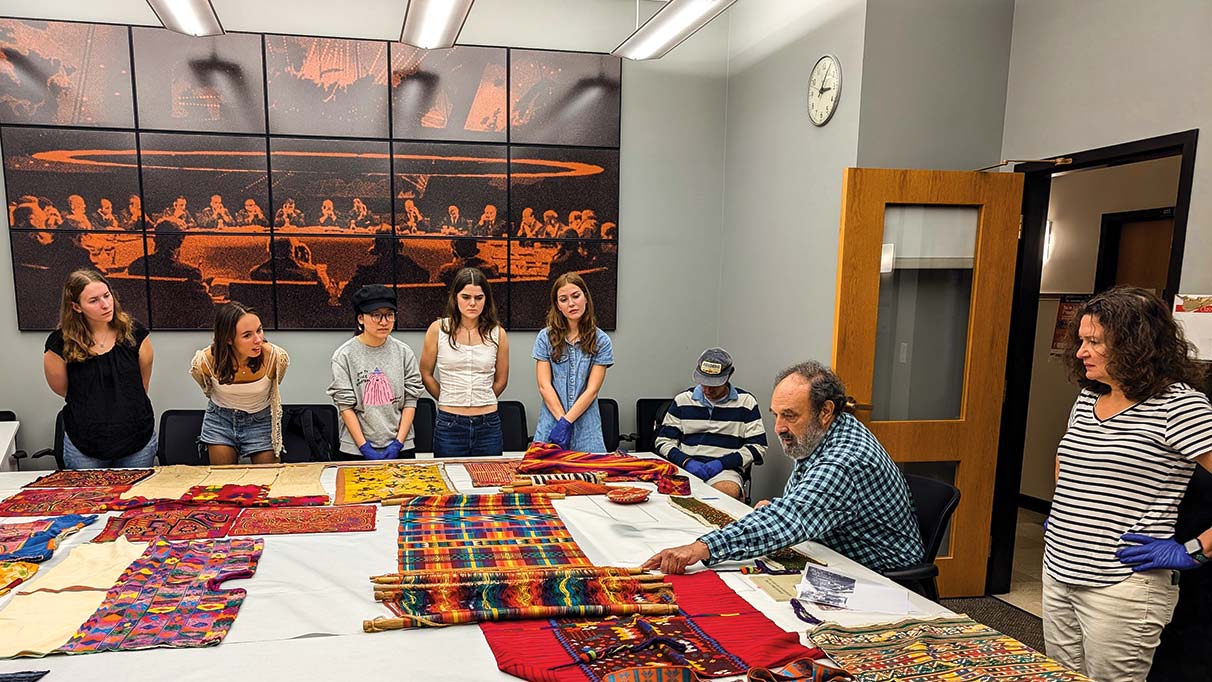
In the Longyear Museum of Anthropology, a vibrant narrative of color and history has found a permanent home. For Robert Aberlin ’66, his donation of a significant Latin American textile collection is a full-circle moment. The dyed fibers and intricate weavings represent a professional and personal journey that began for Aberlin in a Hamilton classroom more than 60 years ago.
His trajectory is a classic liberal arts success story: a spark of curiosity, ignited in him when he was an undergraduate, eventually defined a global career. Aberlin’s path was set in motion by a specific encounter with Latin American literature and history, guided by the late Associate Professor of Romance Languages and Literatures Emeritus Jorge Manuel Chavarri.
Aberlin arrived at Colgate in 1962, a time of immense global shift. While navigating his studies, he found himself drawn to the Spanish language and the complexities of the landscape in Central and South America. It was Chavarri who first introduced him to the literary giants and historical nuances of the region.
This academic foundation deepened during Aberlin’s junior year, when he traveled through Colombia and Chile on an off-campus study program. He recalls the stark contrast of his environments — gaining fluency in Colombia and witnessing the poverty of the Chilean people — while he was a volunteer worker. These experiences were the building blocks of an expanding worldview.
“Life isn’t about finding yourself,” Aberlin reflects. “It’s about creating yourself.”
Armed with the cultural competency and linguistic skills forged at Colgate, he joined Chase Manhattan Bank, climbing the ranks to eventually manage a massive Latin American and international portfolio.
His career followed a map of the region he had grown to love. Aberlin held various high-level positions, including deputy country manager in both Argentina and Costa Rica. His life abroad was marked by historic moments, such as navigating the tensions of the Falklands War with his wife, Mary Beth, and their children, Phoebe and Noah.
After retiring from the world of banking, Aberlin’s leadership continued as he served as the CFO of Poly Prep Country Day School in Brooklyn for two decades.
Despite his global travels, Aberlin’s ties to Hamilton never frayed. He was instrumental in producing the documentary Broken Brotherhood, which tells the story of Colgate graduates who served in Vietnam. This project led to the establishment of a Vietnam Memorial Scholarship Fund, honoring 20 alumni who died in service during the Vietnam War, including one of Aberlin’s roommates and three lacrosse teammates. Aberlin now serves on the Alumni Council, is a member of the Presidents’ Circle, and he received the Wm. Brian Little Award during this year’s reunion weekend, which also marked his 60th Reunion.
“Alumni like Robert are the cornerstone of Colgate philanthropy,” says Kim Harris, vice president of advancement. “His dedication to this institution — whether through financial support, the donation of precious artifacts, or the gift of his time — shows there are many ways to give back to Colgate so that future generations of students can experience the same place to ‘create themselves’ as Robert did.”
However, it is his donation to the Longyear Museum of Anthropology that offers the most tactile connection to his undergraduate days. The textiles he collected throughout his career — more than 20 pieces from Guatemala, Panama, Peru, and Argentina and representative of the very cultures he studied under Chavarri — now serve as primary source material for today’s students.
The textiles stand as a testament to a career built on international understanding, proving that a single course can stretch across a continent and a lifetime.
The Aberlin textile collection is now available to explore online through the University Museums’ database, eMuseum.