

For Kendra Brim ’11, the end of her college basketball career felt like the beginning of a long, uneasy pause — the space between what had been and what came next.
After years defined by discipline, competition, and the charged thrum of life as a Division I student-athlete, graduation marked the loss of the identity she carried onto the court, leaving Brim unsure of who she was beyond it. In that transition, she grappled with the question many former collegiate athletes recognize: Who am I when the uniform comes off for the last time?
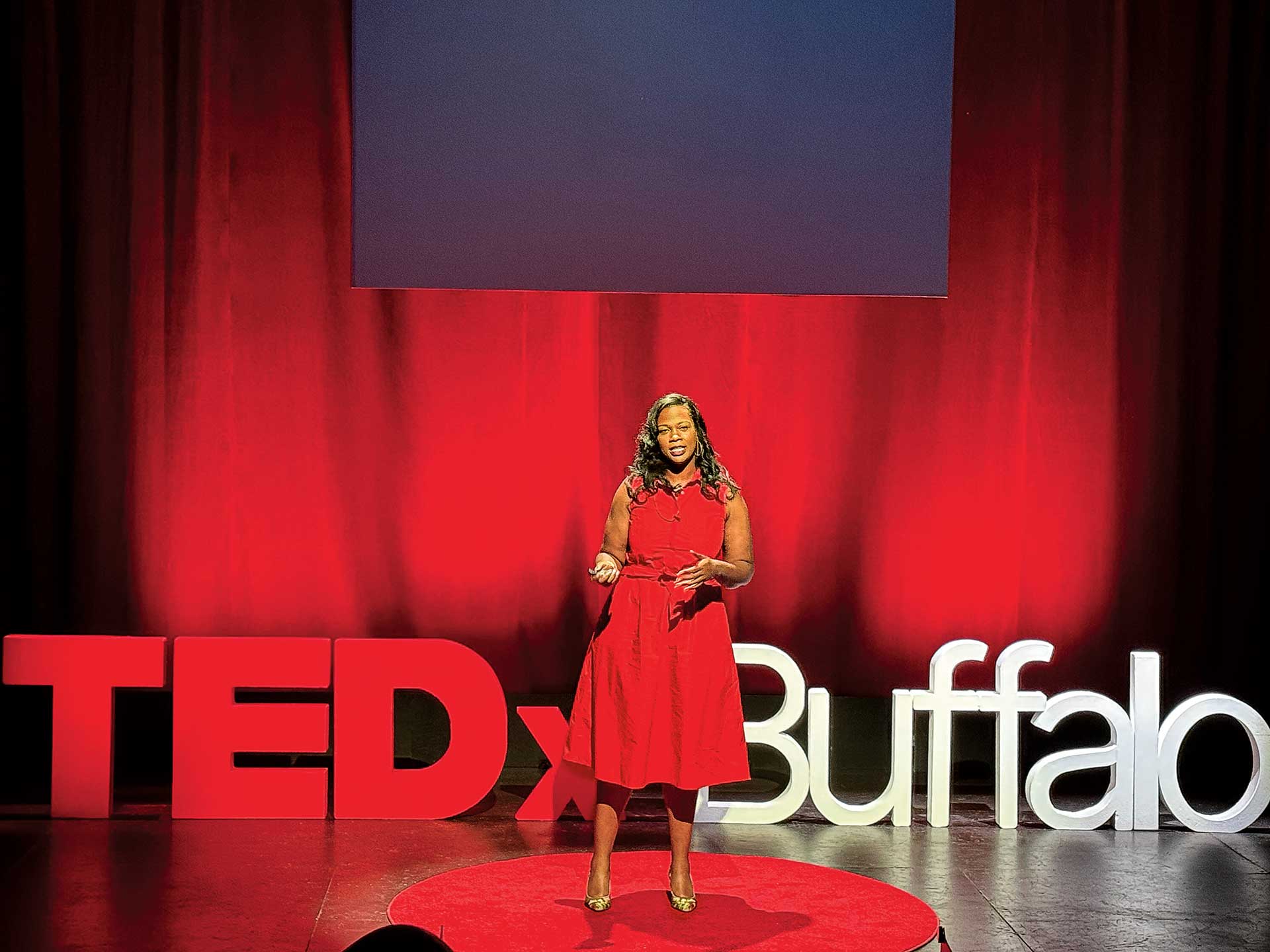
Now an author and the founder of K. Savannah Consulting, Brim works with organizations to foster collaboration in diverse workplaces. She’s also the founder of coaching and mentoring program Out of Bounds, where Brim draws on her own experience to help others navigate life’s in-between stages. In a November 2025 talk at TEDxBuffalo, adapted here, Brim asked listeners to reconsider what it means to go “out of bounds” — not as a mistake, she says, but as a first step in reclaiming your true identity.
I lost 120 pounds. That’s something many people can’t say, but I can. And although I am proud of that accomplishment, I recognized I should have never reached that point in the first place.
You see, I was a Division I basketball player. I knew what it meant to be at the pinnacle of physical fitness, push past my limits, run miles in record times, lift heavy weights, and win close games. I lived and breathed mental grit — it was my life for more than 15 years. But in 2011, when the lights went dim, all of that grit disappeared.
I graduated college at 20 years old. Basketball prepared me for the physical battles of life, but nothing prepared me for the emotional and mental toll I would experience in the absence of adrenaline.
I slipped into the monotony of 9 to 5, thinking that was the right next step. I chased a picture-perfect life: a husband, a family, a home with kids running around the backyard enclosed in a white picket fence. And that failed. I clung to external goals, but nothing gave me the high I had once known. Instead, I faded into the background. I found comfort in food to numb the emptiness inside. And I gained 120 pounds.
That day not only marked the end of my basketball career, it also marked the end of an identity. I was no longer the athlete — I was just me.
But this talk is not about weight. It’s about what we carry to be a certain way. It’s about the pressure of expectations, old dreams, and trying to figure out who we’re meant to be. It’s about the feelings that stay hidden, but hit hard.
Let me take you back to my last day on the court. The echo of basketballs bouncing, sneakers slicing through the hardwood, the smell of sweat and resin in the air, and my coach barking one last set of plays from the sideline. My jersey clung to my skin in effort, adrenaline, and legacy — the growth, discipline, and identity created from the moment I first picked up a basketball. The buzzer sounded, and just like that, it was over. The arena faded, the roar quieted, and the rhythm of my life — the constant pulse of competition and comradery — flatlined. I didn’t realize it at the time, but that day not only marked the end of my basketball career, it also marked the end of an identity. I was no longer the athlete — I was just me. And I didn’t know who me was anymore.
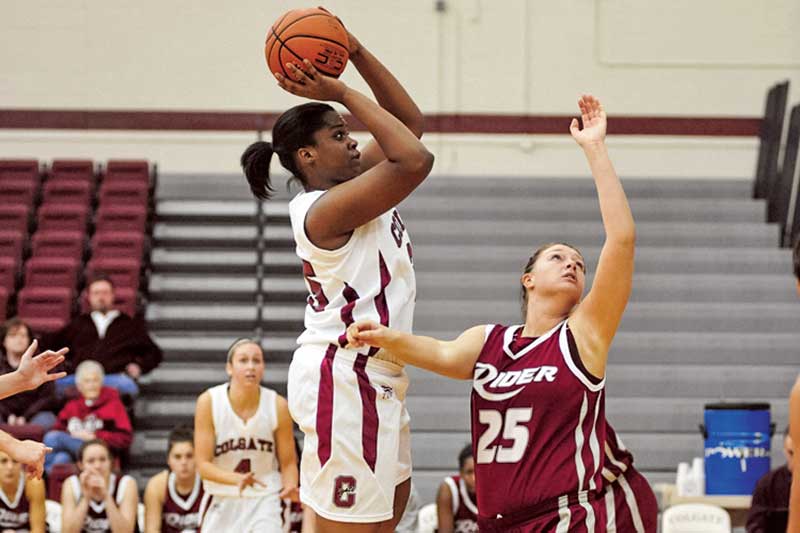
A 5’11” forward, Brim ended her collegiate career in 2011 with a total of 325 points.
The wake-up call came years later, when I was standing in a store’s dressing room under those brutally honest lights, trying to force a dress over my body — not just because of its size, but because of how disconnected I felt from the person in the mirror. I couldn’t hear the arena, couldn’t feel the fire, couldn’t smell the sweat.
I felt so heavy — mentally, emotionally, and physically. I hadn’t just changed, I had lost myself in the transition. I lost my confidence. I lost my discipline. I lost my voice. I lost my joy. And I lost the belief that I could be anything other than who I once was.
We don’t often talk about the in-between: the time when one chapter closes and the next one begins. We talk about wins and losses, but we rarely talk about the pause in between the buzzer and the next tip-off. That’s when life gets real.
I didn’t wake up one day and say, “I’ll lose 120 pounds and start a business.” It started with tiny, unglamorous decisions. Go for a walk. Drink water. Say no to the voice that says you’re not done. It’s like returning to the gym after an injury — weak, wobbly, and unsure, but doing it anyway.
Here are three truths I learned about reclaiming who you are.
- You are not your last success.
Basketball was my first love. But loving something and living in the shadows are two different things. You can love something that shaped you without being trapped by it. At some point, I had to stop identifying myself by a chapter I had already closed. - Small wins matter more than big ones.
We live in a culture obsessed with before-and-after photos. But transition happens in the middle. It happens when you show up for yourself, give yourself grace, and keep going. - Letting go is hard, but necessary.
I had to mourn the person I thought I would become at an early age — the wife, the mother, the athlete — in order to fully embrace the person I was meant to be.
The phrase “out of bounds” used to sting. In basketball it signals a misstep. You made a mistake, you messed up. The play ends and the ball goes to the other team. When I stepped out of bounds, I didn’t just step out physically, but also existentially. I wasn’t out of play, I was out of purpose. But one thing I realized is that “out of bounds” is not the end. It’s just a reset. It’s where strategy gets reimagined. It’s where you recenter yourself, take a deep breath, and get ready for your next play. Not because the whistle forces you to, but because you are ready.
I wasn’t alone in needing that space. Let’s talk about what happens to athletes, specifically women, after college. Only 1.2% of NCAA women’s basketball players go on to play professionally in the WNBA or overseas. That means 98.8% of women feel a sudden shift in identity or routine right after college.
A Boston University study found that many athletes face “identity foreclosure,” where their sense of self is so tied to being an athlete that once it ends, they don’t know who they are anymore. The NCAA’s own mental health survey found that 47% of female athletes reported feeling overwhelmed, and 35% said they felt mentally exhausted on a regular basis. These stats are not just about athletics; they are about the mental toll behind the game.
While my story started with athletics, Out of Bounds is so much more than basketball. I’ve worked with student-athletes who are searching for a road map, helping them avoid the same pitfalls I faced when I graduated and was unprepared for what came next. I’ve worked with adults in transition; those who are laid off or burnt out or quietly questioning whether the life they built still suits the person they’ve become. Through mentoring, coaching, and one-on-one sessions, the same three core questions always arise, regardless of age or background: Who am I now? What comes next? How do I move forward when everything I know no longer applies?
I created Out of Bounds to be a guided transformational space to reflect without judgment. It’s a space to reclaim your voice, even if it’s shaky. It’s a space to redefine success on your own terms — not based off of someone else’s scoreboard. And it’s a space to redefine your identity based on truth and not rooted in titles or résumés.
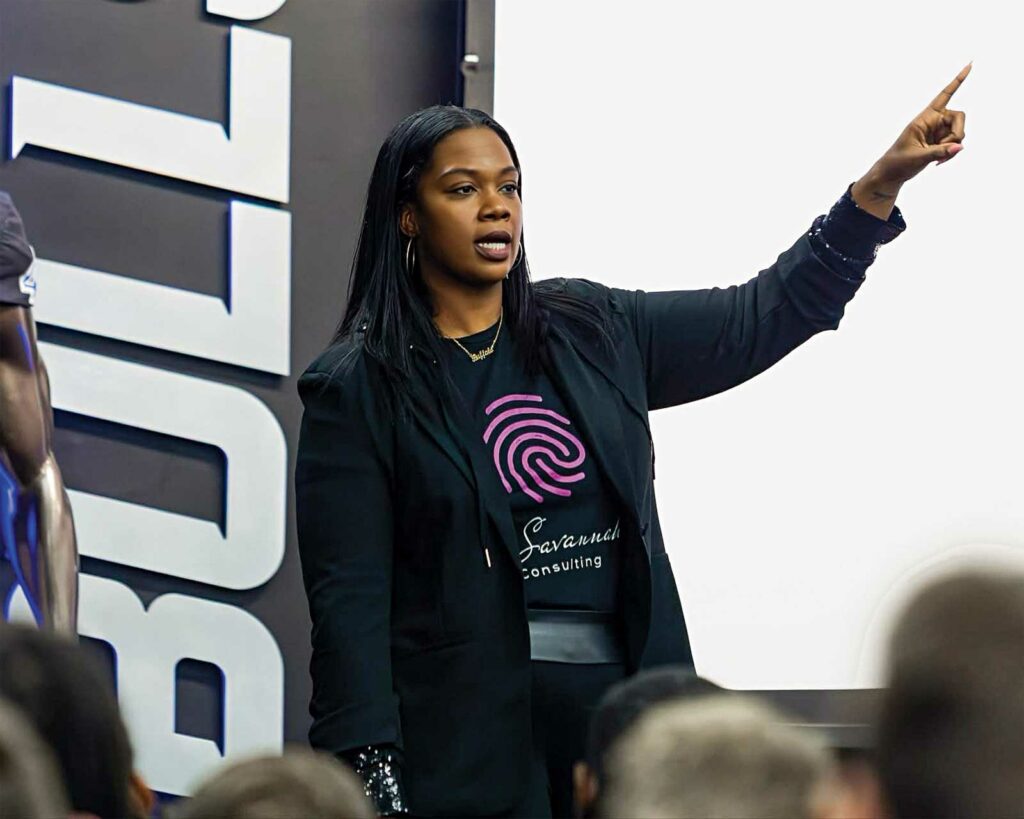
Brim speaks at leadership and corporate workshops, specializing in inclusivity.
Many times when we think of transformation — whether it’s mental, physical, or emotional — we often think that it has to happen in isolation. But the truth is, it doesn’t. Sure, I had to dig deep, but it was the people around me who helped me through the experience. It was my mentors who shared their stories; it was my friends and family who lifted me up when I was down; and it was the people who were experiencing the same things I was. Transformation does not happen in isolation. It happens in community.
At my gym, we often say, “be where your feet are planted.” That means show up for yourself, even if you’re unsure, because there’s beauty in the process — not just at the finish line.
So no, this talk is not about weight. It’s about releasing setbacks, disappointments, and failures. It’s about redefining success, and it’s about realizing, maybe for the first time, that stepping out of bounds is not the end of the game. It’s just a new quarter.