

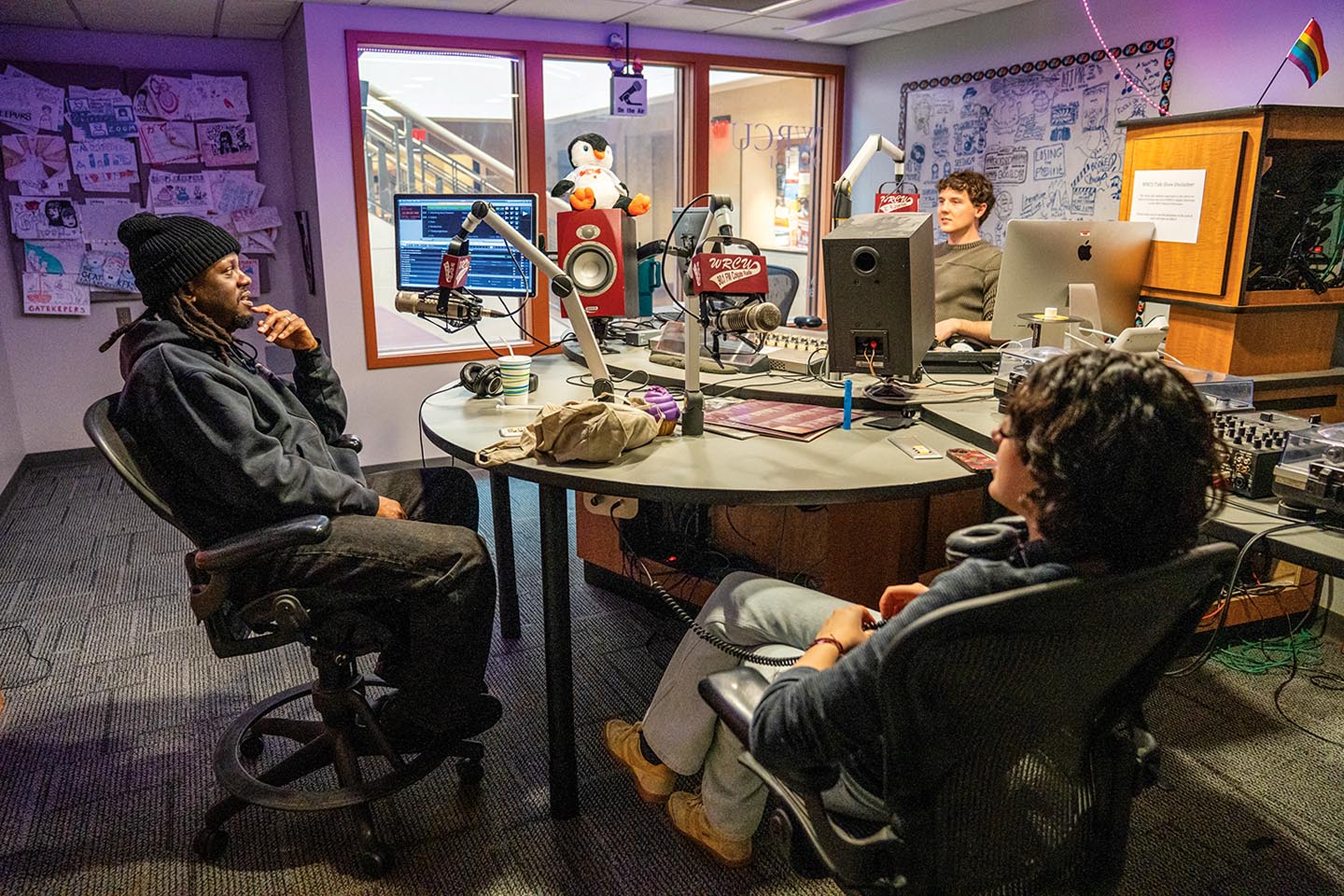
Music producer, DJ, and multimedia storyteller Bobby Carter visited Colgate in March as the Clifford Family Innovator in Residence. Carter is the host and producer of NPR Music’s Tiny Desk Concerts, the iconic web series that features performances from both well-known and emerging artists behind an office desk at NPR’s headquarters in Washington, D.C.
Carter is the third visionary to serve as the Clifford Family Innovator in Residence. Supported by a permanent endowment from Trustee Emeritus Chris Clifford ’67, H’11, P’93 and Carrie Clifford ’93, the residency is one of the cornerstones of the Middle Campus Initiative for the Arts, Creativity, and Innovation (ACI), which engages students and faculty in the work of artists, designers, entrepreneurs, and creatives from various fields.
From March 3–6, Carter immersed himself in the Colgate community, engaging with students, faculty, and staff through a variety of interactive events, including formal discussions with students and faculty, radio and podcast appearances, a criterion record pull, and a musical performance as his DJ persona, DJ Cuzzin B, alongside Assistant Professor of Film and Media Studies and Africana and Latin America Studies Aaron Dial as his DJ persona, Phade Ali.
Throughout the residency, Carter shared stories from his personal and professional life in order to inspire and encourage students to follow their passions. A gifted storyteller, Carter provided examples from notable Tiny Desk performances to reinforce the lessons he imparted: authenticity, intimacy, connection, discovery, and individuality.
On Authenticity
Carter credits much of the success of NPR’s Tiny Desk Concerts to authenticity, noting that the stripped-down format of the show forces a level of honesty from artists that resonates deeply with audiences.
“Less is more in our space,” said Carter. “The audience wants something that’s real, authentic, and made with love.” The most impactful performances are often the most minimalist ones, he explained.
On Intimacy
The power of the close-quarters format of Tiny Desk fosters a vulnerable connection between artists and the audience, in a space that holds no more than 200 people. The audience gets an up-close view of global superstars who typically perform in stadiums and arenas. “The best of the best get really nervous, which is endearing to watch because you get to see these artists as human beings and not just these massive superstars,” Carter said.
On Connection
During the COVID-19 pandemic, Carter had to rely on artists to send in video for Tiny Desk (Home) Concerts. This time period was crucial in understanding how meaningful the show was for people, providing the audience with a sense of community and connection to live music when it was otherwise unavailable. As audiences found community in the comment sections of the online concerts, Carter discovered something powerful about Tiny Desk: “What we were doing meant more to people than I ever realized,” he said. Many people were introduced to the platform during that time, and Tiny Desk’s following exploded.
Now, as Tiny Desk expands to Japan, Korea, and Brazil, the team is exploring what common threads connect audiences globally and how they can maintain quality control across production teams.
On Discovery
Carter recalled his upbringing in St. Louis, Mo., when his passion for music was ignited, influenced by his musician uncle’s diverse musical taste and an experience watching a DJ control a crowd at a roller skating rink. “I watched just how the DJ had the whole room in the palm of his hand,” he said. “That was my introduction to how music can just take your body, mind, and spirit.” He also talked about his teen years spent DJ’ing and working in a Sam Goody music store during the 1990s. These experiences provided him with a foundational education in appreciating all genres of music, informing his curatorial approach at Tiny Desk.
“When you look at a month’s worth of shows on YouTube, it’s just a DJ’s playlist,” Carter said. “I’m going to give you a little bit of what you love. I’m going to give you a little bit of what you never heard of, but I know you’re going to love.”
He sees Tiny Desk as a platform for diversity, showcasing a wide range of cultures and genres that reflect the world. Tiny Desk is celebrated for its cultural impact bringing NPR into spaces like the NAACP Image Awards, where the organization traditionally had no presence. “Tiny Desk was NPR’s happy accident,” Carter said. “They didn’t expect us to affect culturally the way we do.”
On Individuality
Carter — who joined the NPR Music team in 2007 and produced his first Tiny Desk concert in 2014 — was a catalyst for the platform’s growth, as he helped open the door to a wider range of genres and he hopes to pave the way for the next generation to follow. His advice to Colgate students was to lean into that individuality in whatever passion they choose to pursue. “Muster up the courage to be exactly who you are, no matter how uncomfortable that may make other people,” Carter said. “My superpower is my unique perspective. So tap into that special thing about you and bring that in every single room.”