

My mother ended up at the refugee camp after my maternal grandfather, a member of the intelligentsia who was the minister of finance in the city of Harar, died in prison during the civil war. Soon after, many of my mother’s siblings died, too, of illness and other tragic circumstances. My mother and her remaining siblings were forced to fend for themselves. Everyone went separate ways; my mother fled to Yemen in the hopes of finding better work opportunities so she could earn money to send home and one day return.
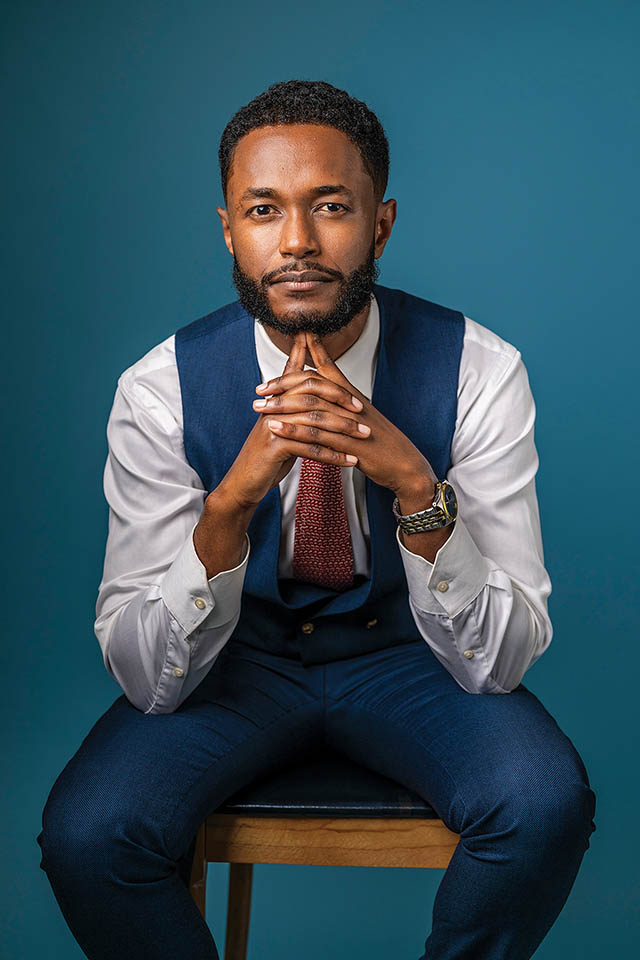
To Whom Much
Is Given,
Much Is Expected
A deep calling compels Solomon Tesfaye ’15 to give voice to his journey as a refugee — celebrating both the hardships and the joy.
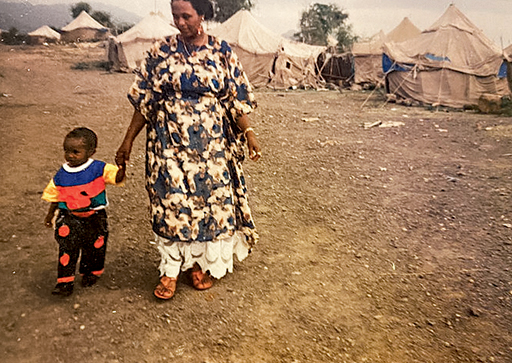
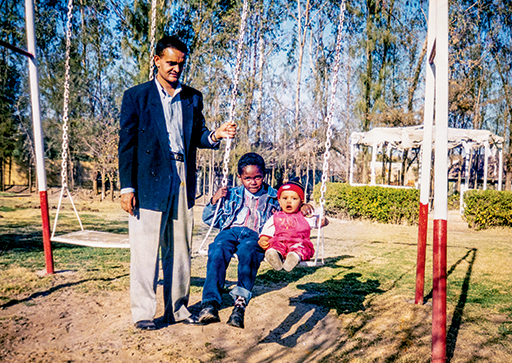
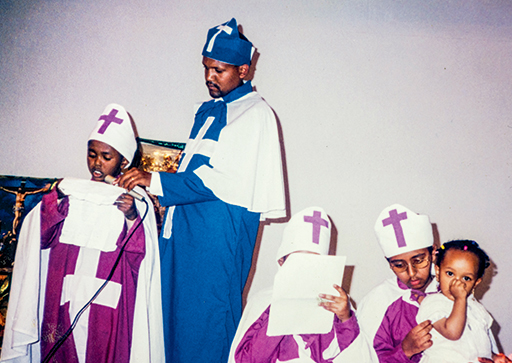
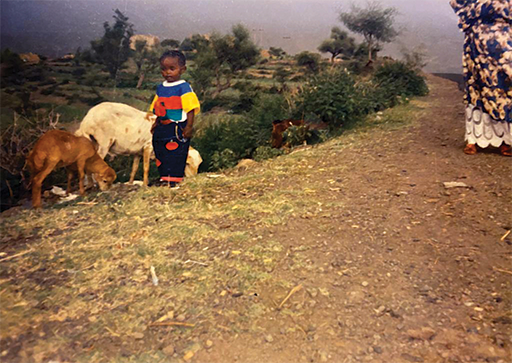
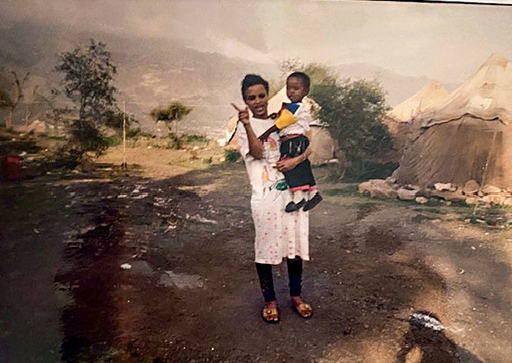
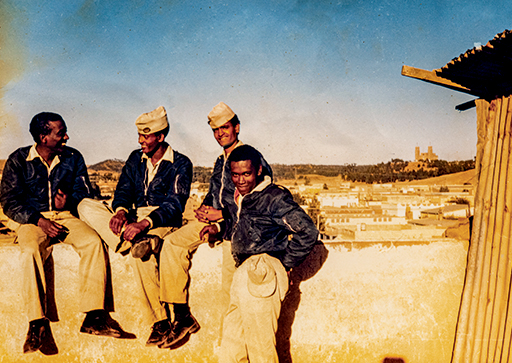
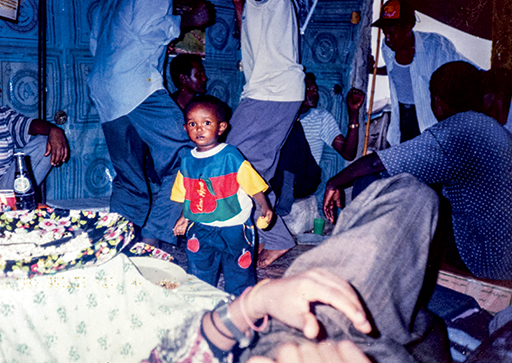
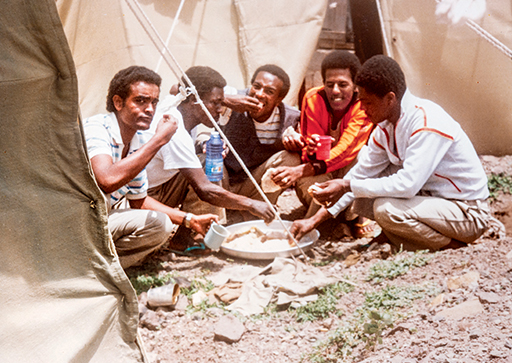
L to R: Tesfaye on a stroll with his mother, Zelalem, in the refugee camp; Tesfaye with his father, Gezahgne, and his sister, Feben, at a playground in Sana’a, Yemen; Tesfaye reading a speech at church in Sana’a
By Solomon Tesfaye ’15, as told to Aleta Mayne
Photos by Mark DiOrio
I was born into displacement.
Everyone else, including my parents, had memories of home, of a country and a flag they could call their own, of relatives and an identity that wasn’t defined by displacement and deprivation. The camp was the only thing I knew.
I was the only child there. The other refugees had chosen not to bring children into that life, but my parents believed my birth was God’s will. Because I was the only child, the entire camp became my guardians — Somali refugees, navy men from Ethiopia, aunties and uncles who weren’t blood but who kept me alive.
There were no real walls, no schools; only tattered tents and a building to distribute rations. Yet to me, it was a world: there were herds of goats in the pastures, countless people who loved me as if I were their own and took me from one end of the mountain to the next; there was a church, and music and parties to celebrate my birthday and the passing of time.
Everything I know about resilience began in that place.
My parents met at the camp, having found themselves there for a different yet similar reasons. Both escaped Ethiopia during the civil war in the 1990s.
“To me, it was
a world: there
were herds
of goats in
the pastures,
countless
people who
loved me as
if I were their
own and took
me from one
end of the
mountain to
the next; there
was a church,
and music
and parties to
celebrate my
birthday and
the passing
of time.”
Listen to Solomon read his story.
My father was in the Ethiopian navy, but when the Derg (military junta) overthrew the government, my father and his shipmates were told: “Leave, or you will be executed.” So they, too, fled to Yemen. The Yemeni government was gracious enough to welcome them and set up the camp.
I tell my story because it deserves to be told. Not to hold myself up as an inspirational figure, but because I believe I was called to share it. My hope is that the story itself — and the characters who carried me from a Yemeni refugee camp to Colgate — can inspire others.
By every statistic, I wasn’t supposed to survive past my 1st birthday. The odds of making it from that camp to a graduation were, rounded to a whole number, zero. Yet I lived — past one year, past five, past decades (I won’t share how many so as not to date myself, but you get the point). Each milestone has been a miracle. Every year, a gift.
And to whom much is given, much is expected.
Chasing Goats
My earliest memories are of taking walks with my parents in the camp. Because it was high in the mountains, nomads would go near the camp to feed their goats in the pastures. I liked chasing the goats, and I remember one particular goat (I don’t know where he is these days, but he and I didn’t really get along). He used to chase me around, and one time he kicked me hard with his hind legs when I was trying to grab his tail. As he chased me and I stumbled and cried, my uncles and aunties in the camp would point and laugh like they were watching a comedy special.
I call them aunties and uncles in the traditional Ethiopian way, but we weren’t related. (I didn’t meet any of my distant relatives until 2017, during my first visit to Ethiopia.) The people I consider to be my aunties and uncles are my mother’s friends and the soldiers who were in the navy with my father. They helped raise me.
When I was 5 years old, my parents decided we should leave, in large part because they thought, “This boy needs to go to school, meet other children, and have some semblance of a normal life.” Up until that point, my learning was like homeschooling but not in the structured sense. My parents and the people in the camp taught me Amharic and a bit of Arabic; my uncles taught me how to play chess, as well as a bit of math and science from whatever they remembered.
Of course, it wasn’t easy to establish a new life. My parents had to save up for several years, putting aside money from my father’s odd jobs in nearby cities and the injera (flatbread) my mother sold around camp. We found an apartment for us and a couple of family friends — six people in a two-bedroom apartment, because no one could afford their own place — in the capital city of Sana’a.
My uncles and aunties warned me that the Yemeni townspeople discriminated against us as refugees and that this was an Islamic country, so I should be prepared to be discriminated against for my Christian faith too. They said, “This isn’t the camp, so when you’re in school or out in the neighborhood, outside of our protection, you have to be careful.” We also had to practice our faith in private; I wasn’t allowed to tell others that we went to church or where it was because of police raids.
I first went to the public school in Sana’a, which included religious education and studying the Quran. Even though I’m a Christian, Quran was one of my favorite subjects. I was very good at memorizing entire chapters of it and had perfect scores on my exams. I was even encouraged by my teachers (word had spread around the school) to participate in Quran memorization competitions around the Middle East. I remember my teacher asking me to stand in front of the class while she reprimanded the other students, saying, “How is this Christian boy better than you at your own religion? This is a shame.” Obviously I wasn’t a very popular kid because of that.
I loved learning the Quran and growing up in an interfaith context because I saw a lot of commonalities between my own Christian faith and Islam. But all the anger, all the hate, all the violence between Christians and Muslims confused me. I remember thinking in church once about how we have the same values as Muslims, the same idols and similar proverbs as the Quran. My own name is found in both (Suleyman), just a different pronunciation. I asked my parents, “Why do the Muslim boys hate me? They also believe in one God like us, they also have a Moses and a David in their stories … so how can that be?”
Defending Our Rights
I was a strong student and my mother received good feedback from my teachers, so she wanted to enroll me in private school. She had a secretarial job at a hospital, and a doctor she worked for told her about a Canadian international school in Sana’a where I could apply for a scholarship. I started going there when I was 11, for my last two years in Yemen.
Because it was an international school, it was a liberal contrast to my previous school where girls and boys were divided and sat opposite each other, and all the girls were forced to wear a niqab, or face veil. The international school, by virtue of the fact that most of the student body was non-Arab and not Muslim, was more accepting and a better fit for me.
In my neighborhood, however, I still faced much abuse. The word they used to describe me and my family means “slaves” in Arabic, referring to the menial labor jobs that were the only employment opportunities available for refugees. I remember hiding my cross under my shirt whenever I walked home alone.
My mother likes to joke that she got to know all of our neighbors because of me. I used to get in so many fights with all the older boys that she had to knock on our neighbors’ doors to say, “Can you ask your son not to beat up my son anymore?”
The abuse wasn’t only pointed toward me, but also my uncles. We would go to a store and people would spit on them. The policemen were abusive and corrupt. They hassled members of our community, demanding bribe money to be left alone.
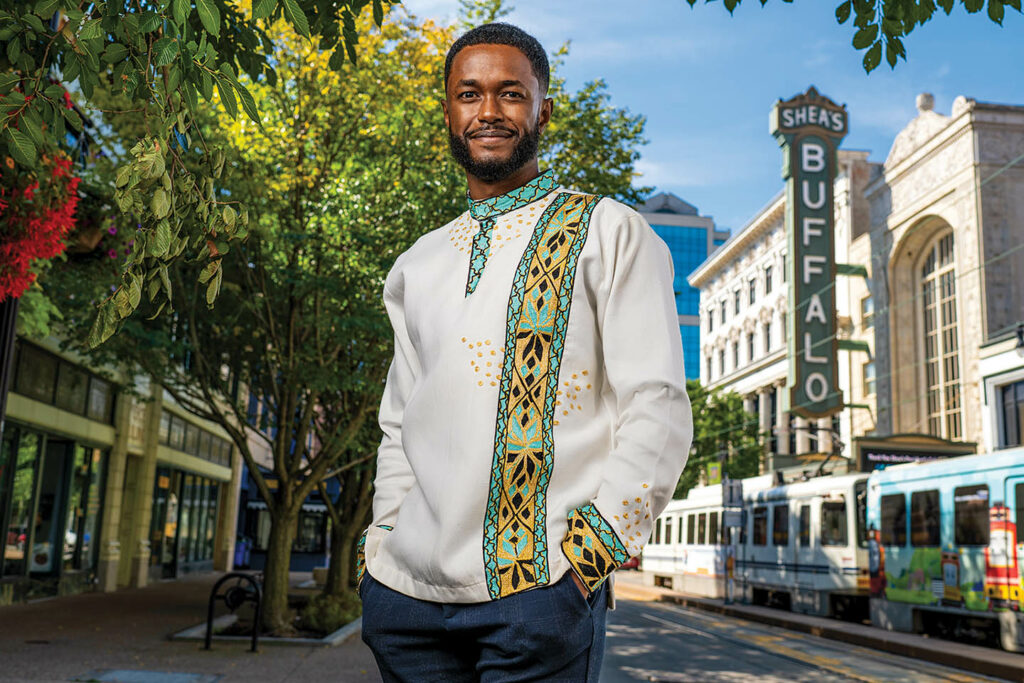
My dad and uncles had difficulty finding work because they weren’t officially recognized by the government and couldn’t apply for a lot of jobs. They also couldn’t own any property, and we had no rights. I recall my teacher asking me, “What do you want to do when you grow up?” I said, “I think I want to be a doctor.” She replied, “You’ll need to go to university for that, but you can’t go to university here. You’re a refugee.” It was a big shock for me, realizing that being a refugee meant being deprived of many things, including a right to education in this country.
To protest the ways in which refugees were being treated, my father and uncles joined hundreds in a sit-in in front of the UN High Commissioner for Refugees (UNHCR) building. They were arrested and imprisoned for several months, even though it was a peaceful protest.
My mother is an entrepreneur, and she’d opened up a restaurant at the Ethiopian Community Center. We struggled when my dad was in prison, but not as much as we would have before the restaurant. Other community members came to assist; they supported those who were affected, and that eased the burden a bit.
After school I would help out at the restaurant. On the weekends, my mother and I visited my father and uncles in jail, bringing them food. As a child, it was traumatic for me to see the people I love most in that setting and to see so many bodies held in captivity that way.
The protesters’ efforts eventually paid off because it gave the situation visibility, and UNHCR and the Yemeni government started granting refugees asylum.
Adjusting to Change
I was 13 when our asylum cases were finally granted; refugees were able to go to different countries based on their applications. On one of the forms, we were given choices of cities where we could move. My mother told my father to leave it blank because she wanted to go wherever God would take us.
I’m not sure if it was God’s choice (in fact I’m sure it wasn’t, because why would God not choose London or Melbourne?), but alas, we landed in Buffalo, N.Y. There, Catholic Charities gave us an apartment, language classes, and a second chance.
I started at a public school, which surprisingly had a lot of international immigrant students: Somalis, Iraqis, Vietnamese, Burmese. The school placed me in an ESL class, even though I’d already learned English from my time at the Canadian International School. Also, I loved American TV; I used to watch The Fresh Prince of Bel Air and 24 with my mother. I even had a Walkman with a tape of 50 Cent’s Get Rich or Die Tryin’ album. So thanks to 50, Will Smith, and Jack Bauer’s varied use of the language, my English was pretty good. I remember telling my mom, “They’re teaching us how to spell words like ‘apple’ in school. It’s childish and disrespectful.”
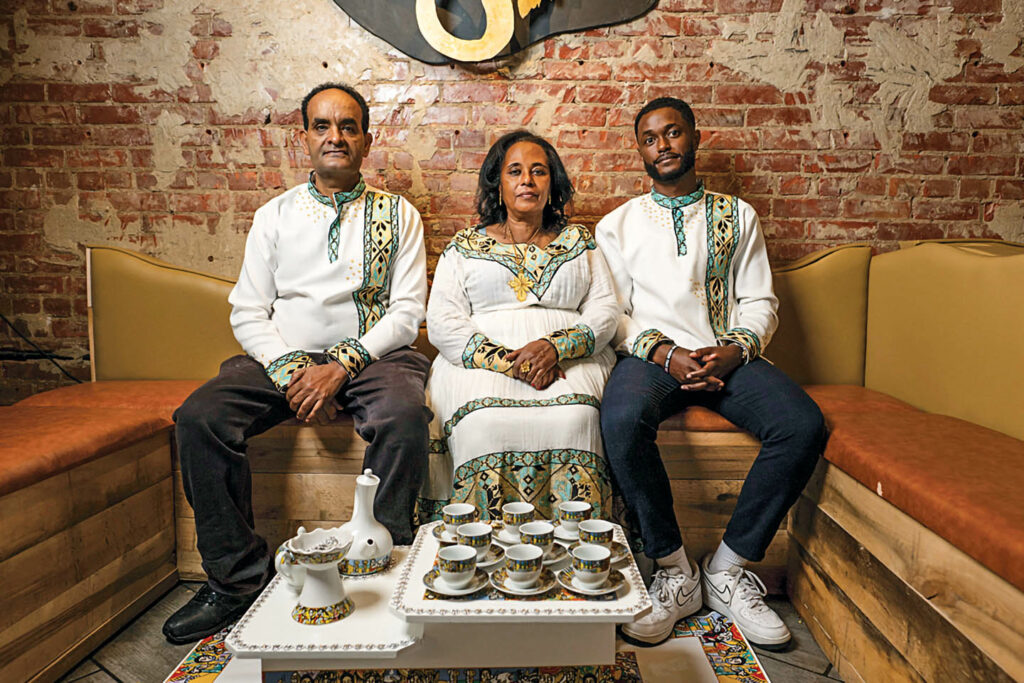
My mother’s friend Auntie Almaz introduced me to a benefactor who made it possible for me to earn a scholarship to a private school in Buffalo called The Park School, and my educational path trajectory was forever changed. This benefactor set up a conversation with the administration, I took an entrance exam, and I was interviewed by some of the teachers. One of them asked me about geopolitics, but the great thing about being a refugee is that I’m well versed in geopolitics by disposition rather than intellectual curiosity — my life is defined by it. He was impressed by my knowledge and advocated for me to be enrolled. My public school teachers wrote amazing recommendation letters, so I was accepted and received a full scholarship (thanks to the benefactor who sponsored my scholarship).
“It was a big shock for me, realizing that being a refugee meant being deprived of many things.”
When our time in the apartment set up by Catholic Charities expired, it was too expensive for us to stay, so we moved to the projects on the west side of Buffalo. The school was in the northeast section of the city, and we didn’t have a car at the time, so I had to learn how to navigate public transportation. I’d catch the 5:30 a.m. bus, ride 25 minutes to the train station, take a train 25 minutes to the last stop, take another bus for 15 minutes, and then walk 10 minutes to the school. Sitting in homeroom one day, one of my classmates said to me, “Dude, I’m so exhausted. I just woke up 30 minutes ago.” I’m like, “I’ve been up since 5 a.m.” I thought it was so unfair, but my indignation fed my resilience and perseverance. It gave me the motivation to do even better in school.
The Park School was an amazing educational opportunity, but it was difficult at first. Private school was a bigger adjustment than America itself. The students spoke differently than the kids in public school, they wrote essays differently than I’d been taught before, and there was a lot more critical thinking. I didn’t do very well in the beginning, but I learned to adjust quickly (a superpower that comes from being a refugee), and I was taking AP courses to set me up for college applications — including AP English, having been in ESL just a couple of years back.
Mentors and Opportunities at Colgate
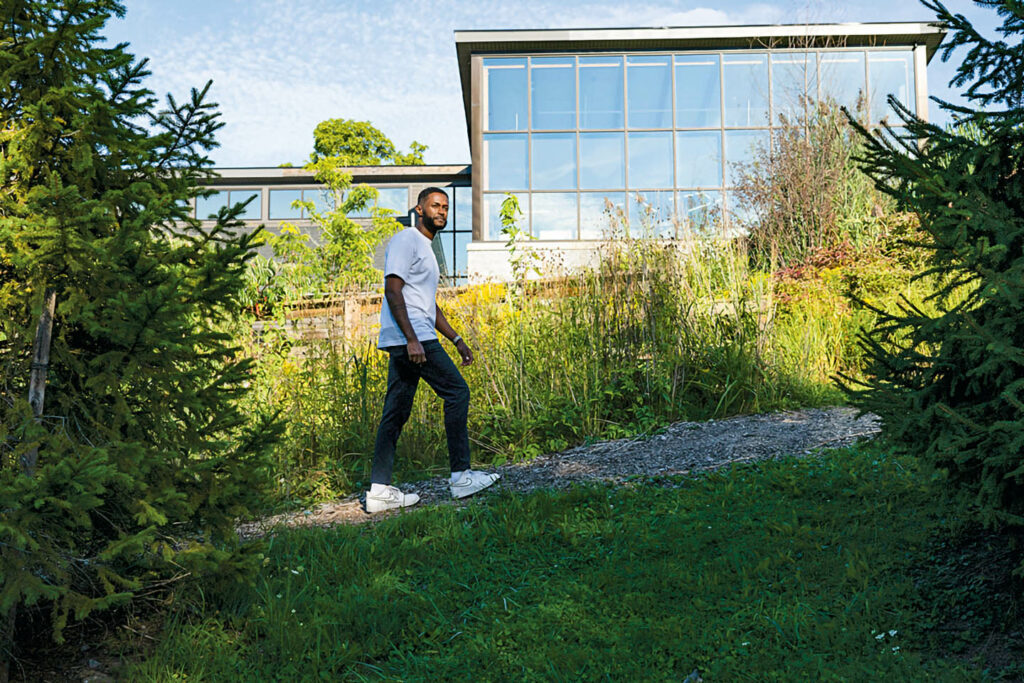
Knowing my financial situation, my guidance counselor suggested I apply to Colgate, telling me, “It has great scholarships.” I applied, was accepted, and I did get a scholarship. We could only afford one college visit, so that was the one. When my mother and I went for prospective student weekend, she said, “It’s perfect.” She was happy that there were minimal distractions relative to the schools in major cities.
I was part of the Office of Undergraduate Studies (OUS) Scholars Program, and I took Intro to Neuroscience with Professor Jun Yoshino that summer. I love neuroscience because I have a huge interest in understanding people and how our minds work. It’s also a way for me to understand my history as a refugee. Why did these things happen? Why do people treat each other this way? What leads to our actions and motivations? Professor Yoshino’s class really opened my eyes, explaining it from a molecular and behavioral standpoint.
My thesis adviser was Professor Spencer Kelly, who became an academic father figure and a role model of the kind of man I would like to be. My research was about how our nonverbal communication is an expression of implicit bias. It was a testament to the really cool research students can do at Colgate with brilliant professors.
I also minored in Islamic studies to keep in touch with my Middle Eastern heritage as well as my Arabic language and knowledge. I took Arabic classes with Professor Nady Abdal-Ghaffar, an amazing teacher who loved to yell at me as soon as he saw me walk into class, because he knew I probably didn’t do the homework. He’s Egyptian, so we connected. My classmates would say, “What did you do to make him this mad at you?” I’d explain that it was cultural: “This is normal dialogue. He actually likes me.”
My work-study was at Case Library, and I had to file a lot of books (too many) over the three years that I worked there. Maybe that’s subconsciously where my interest in literature came from, because I was surrounded by books all the time. I worked a lot of shifts to earn money, and that’s also where I studied.
Colgate let me travel and explore the world in ways that I otherwise wouldn’t have had the opportunity to. I did a semester in Cardiff, Wales, with Professor Scott Kraly. I went to Egypt with Professor Nady for a winter exchange program. And I did a State Department program in Oman, studying Arabic and Middle Eastern history.
It was such a blessing to go to Colgate because, without that experience, my life wouldn’t be what it is today, and I wouldn’t have had the opportunities that I had.
A Nerd’s Disney World
After graduation I had a bit of an existential crisis. My original goal was to become a neurosurgeon. But the endless years of training — and the burden of debt that came with it — terrified me. Having grown up in extreme poverty, I knew too well that this amount of debt could strangle a life before it could even begin. I found my way into the consulting space because it allowed me to use the research skills I learned at Colgate. It was demanding work, requiring me to dedicate long hours and sometimes sleep on my office floor, but I can honestly say it helped me grow personally and professionally in ways I could have never imagined.
Soon after, I realized that rather than working to increase the profit margins of a Fortune 100 company, I wanted to do social impact work. I liked the work I did, but I wanted to do it for something that was meaningful to me.
As an extension of my behavioral neuroscience degree, I became interested in behavioral economics and public policy. I applied to Harvard, Cornell, and Princeton — although I was hesitant to apply because I didn’t think I could get in. I remember expressing my uncertainty to a colleague, telling him, “Everyone who was admitted the previous year has perfect scores. They speak at least four languages.” He joked, “Well, you speak three and a half, so you’re close.” The belief that my Colgate mentors instilled in me helped a lot too. Professor Kelly wrote one of my recommendation letters, and I was almost embarrassed reading it, because he thought much more highly of me than I did.
I was accepted to every school I applied to, and Princeton offered me a full scholarship as well as a stipend. It felt like a statement — that they wanted to invest in me and my education. God gave me that opportunity, and I took it.
“Each draft carried the weight of memory and trauma, but also the joy and laughter that defined our survival. The book became a mirror. It showed me not just what we endured, but also how much we built in the in-between spaces — between nations and political identities, between faiths, between identities.”
Attending Princeton for graduate school was the best choice I could have made. I was able to have dinner with Daniel Kahneman, Nobel Prize–winning author of one of my favorite books, Thinking, Fast and Slow; he was the reason I applied to Princeton in the first place. I had engaging conversations with other amazing thinkers like Cornel West, who gave me inspirational words in the form of riddles, like “your vocation is in your voice, young man.” (I still don’t know what that means.) I even had debates with Cecilia Rouse, chair of the Council of Economic Advisers under the Biden administration, about topics I’d just learned that semester. It felt like a nerd’s Disney World. I learned a lot; the courses were challenging but also rewarding and exciting.
For my research paper, “Preventing Violent Extremism in the Horn of Africa,” I traveled to London to talk to the Kenyan ambassador and members of the UK’s National Security Council. It was a very rewarding and important piece of research for me as an Ethiopian. I also spent a summer internship working for UNICEF in Ivory Coast.
Writing Through the In-Between
Princeton is also where I met other refugees. When I shared my story, they all gave me the same response: “Your life story sounds like a movie. God didn’t bring you here just to bring you here. You have to share this with others.”
I started to consider the idea of writing a book then, and it felt like a God-given calling. At first I resisted. I’d never written anything beyond research papers and policy briefs, and I had a litany of excuses: English is my third language, I have other career ambitions, I don’t know the industry, I have no road map. But the more I tried to ignore it, the more insistent the pull became.
For the past five years, I’ve been working on a novel tentatively titled In-Between Worlds. It’s a coming-of-age story rooted in my journey, but told through a fictional character — because fiction allows me to both honor my family’s truth and reach for something universal. The process has been anything but easy. I interviewed my parents and camp survivors, dug up stories my parents tried to forget, and relived moments I, myself, had buried. Each draft carried the weight of memory and trauma, but also the joy and laughter that defined our survival.
The book became a mirror. It showed me not just what we endured, but also how much we built in the in-between spaces — between nations and political identities, between faiths, between identities.
I hold on stubbornly to that vision. Through pandemics, through personal losses, through the rejection letters that stack up for any new writer, I’ve refused to let go. In- Between Worlds deserves its readership. Refugee children deserve to see more than despair reflected back at them. And policymakers deserve to be reminded that their decisions shape individual lives like mine.
Most importantly, the world deserves to see the joy in our stories. Too often refugee narratives are flattened into vignettes of destitution. My life was never just about tragedy. It was also the ecstasy of playing soccer in the rain, the indignation of uncles arguing over politics, the fierce laughter of my mother, the comedy of chasing goats in a mountain pasture. It was hardship and beauty braided together.
“My life was never just about tragedy. It was also the ecstasy of playing soccer in the rain, the indignation of uncles arguing over politics, the fierce laughter of my mother, the comedy of chasing goats in a mountain pasture. It was hardship and beauty braided together.”
That is what I want the novel — and one day, God willing, a film or show — to capture.
Through my recent PEN America Emerging Voices fellowship, mentors helped me refine the work and prepare it for publication. I’ve workshopped In-Between Worlds at the Colgate Writers’ Conference, Sewanee, and Tin House. I’ve studied the craft relentlessly. Now I’m praying for the doors to open — for the right publisher, the right producer, the right partner who believes this story matters enough that they also want to see it through.
To whom much is given, much is expected. This story was given to me. And I intend to carry it as far as it can go.
— Solomon Tesfaye ’15 was recently given a Spotify x JED Impact award for unpublished stories featuring exceptional depictions of mental health. Professionally, Tesfaye works in management consulting, overseeing a portfolio of projects for the Consumer Financial Protection Bureau and the Environmental Protection Agency on enterprise risk management and operational efficiency. For more info or to get in touch, visit elsoloo.com.
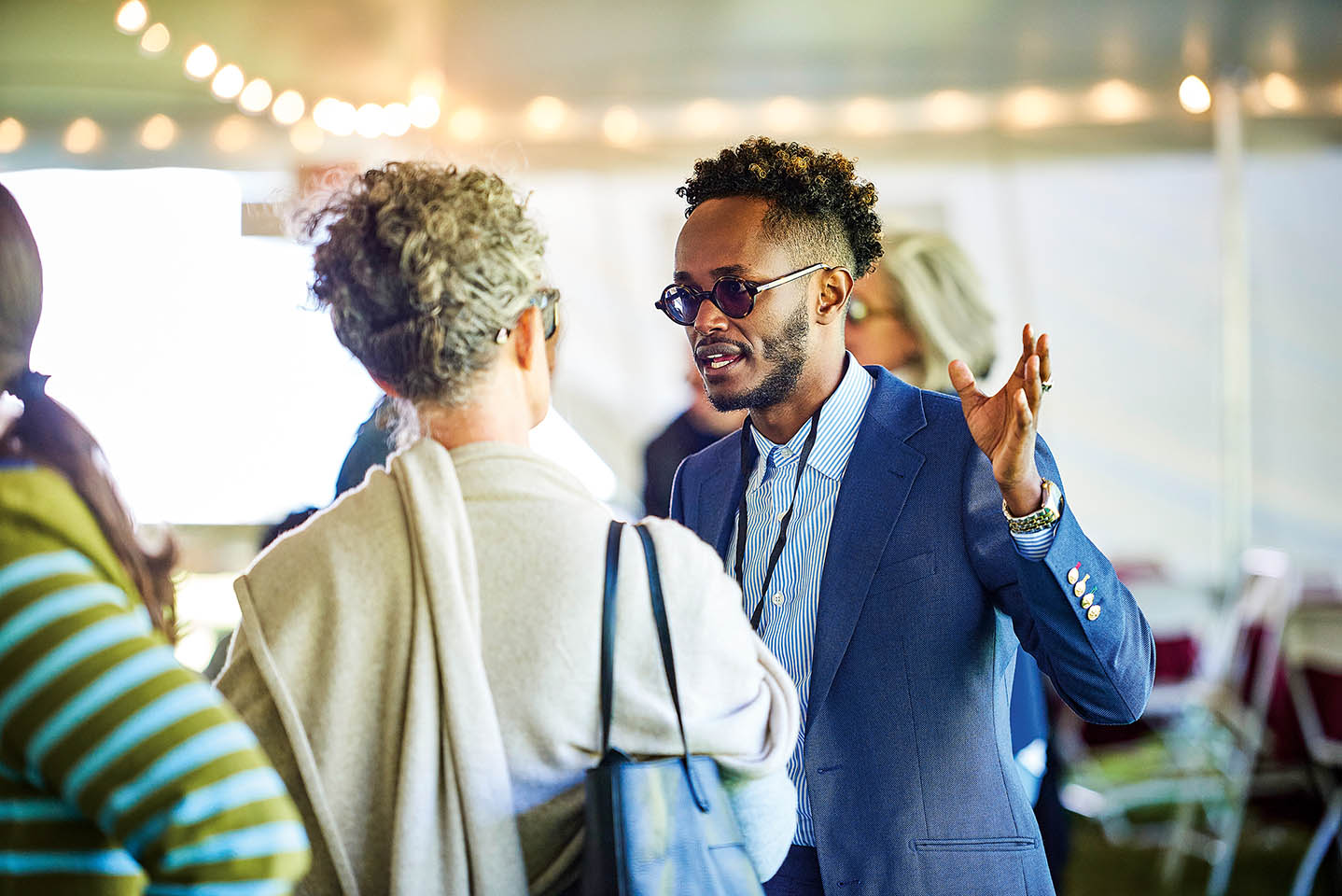
Tesfaye workshopped his novel at the Colgate Writers Conference. To learn more about this year's conference — taking place June 7–13 — visit colgate.edu/cwc, where you can apply and sign up for the mailing list. Applications are open through March 1. The 2026 Colgate Writers Conference will feature Colgate faculty members Peter Balakian and Kyle Bass, alongside other distinguished faculty. Genres include poetry, fiction, creative nonfiction, and YA.