

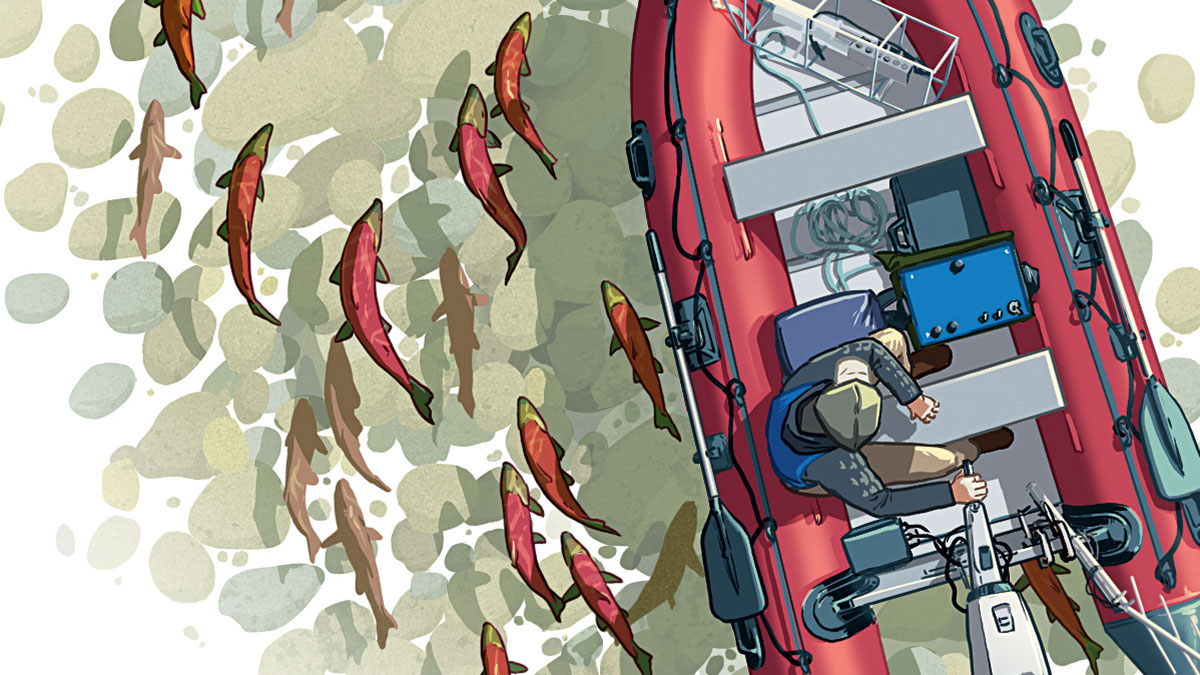
The Copper River watershed in South central Alaska is a massive, free-flowing river system where a million salmon make the annual upriver journey to spawn. As climate change affects river and ocean conditions over time, Pete Rand ’87 is helping communities understand how salmon and the many people who depend on them can adapt and thrive. Rand is a research ecologist who studies cold-water fish with the Prince William Sound Science Center (PWSSC).
“As a kid, I had a natural curiosity about all things aquatic,” Rand says. “Then Colgate started me on a lifelong trajectory of increasing my knowledge. I pursued graduate studies and a career in fisheries and aquatic sciences, which led me to Cordova, Alaska.”
Cordova sits in the delta of the Copper River, on the eastern edge of Prince William Sound. “It’s a working town directly tied to fishing,” Rand explains. “Salmon is a major commercial and subsistence resource. Understanding and managing salmon populations is vital for economic, cultural, and food security reasons.”
Based in Cordova, the nonprofit PWSSC was created in response to the 1989 Exxon Valdez oil spill. “Understanding long-term impacts of oil spills on marine life is still an important aspect of our mission to increase knowledge about marine and freshwater systems through research and education,” Rand says.
To shape its research, PWSSC works closely with a wide variety of stakeholders. Rand’s research projects in the sound and in local rivers involve fishery managers, commercial and sport fishermen, Native Alaskan communities, and state and federal agencies that manage the Copper River watershed.
“The Copper River system drains an area about the size of West Virginia. It’s pristine in many ways. There are no dams,” Rand says. “Many rivers and landscapes in the Lower 48 have been modified by development and dams, but these rivers are in a wilder state. It’s almost like walking back in time 100-plus years in comparison.” The system produces salmon well known among seafood markets, especially on the West Coast. “Copper River salmon is marketed as some of the first available to markets each year and fetches a high price for quality,” Rand says.
However, he notes, adult salmon returning to the river from the ocean have been getting smaller over time. “We’ve seen a high frequency of unusually high ocean surface water temperatures; we think that’s affecting their metabolism and ability to find prey. Smaller salmon have lower fat reserves, which they rely on for energy to swim hundreds of miles to their spawning grounds.”
What long-term implications could this downward trend in body size have on migration success? That’s what Rand is trying to find out: “My fieldwork is part of a multiyear collaboration between the Native Village of Eyak, Ahtna Intertribal Resource Commission, Alaska Department of Fish and Game, and PWSSC, looking for relationships between fish size, river conditions, and the likelihood of these fish reaching their spawning grounds to complete their life cycle.”
Even as their size dwindles, Copper River salmon may also have to fight against increasingly stronger river flows to reach their destinations. “A heat wave in 2019 perhaps gave us a glimpse of the future,” Rand says. “Heat waves may contribute to droughts in other states, but here, we saw accelerated glacier melt and extremely high river flow rates that impeded and even trapped fish during their migration.”
Starting in 2019, the project team collected fish in the lower river, measured them, and inserted radio tags that each emitted a unique code. Rand and his colleagues tracked thousands of tagged fish using a network of receivers set up along the riverbanks.
This September he also surveyed the population that reached Klutina Lake, where approximately half of Copper River salmon spawn.
After analyzing the project’s multiyear data, he’ll help PWSSC convene scientists, Native Village elders, and other key stakeholders for the next step.
“Creating opportunities to share knowledge is incredibly important,” Rand says. “Together, we’ll advance our shared understanding of how historical changes in river and ocean conditions have affected salmon populations, then apply those insights and the new data to predict impacts over the next 100 years.
“Salmon are naturally resilient and adaptable,” he continues. “Because we’re working together now, we can determine ways to adapt fishery management practices to conserve salmon — so communities relying on these fish can be resilient too.”