

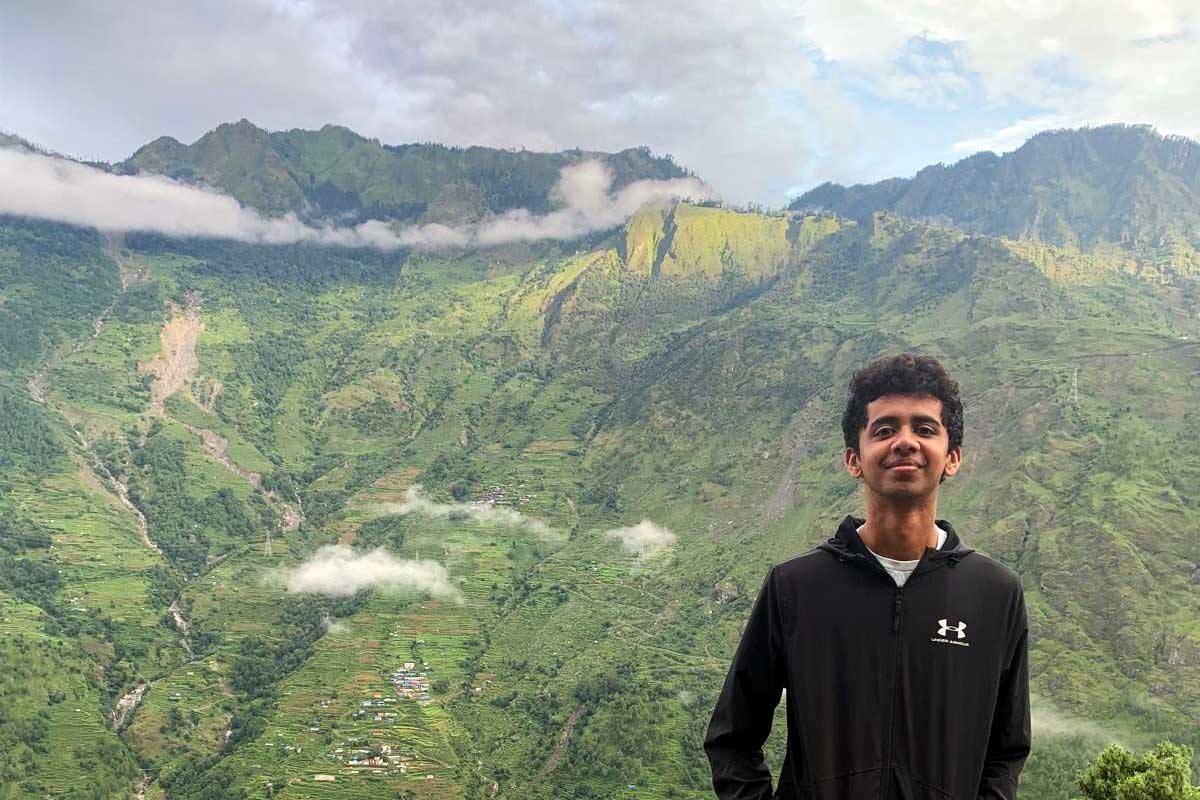
After graduation, Vishnu Anandraj ’25 began his yearlong Watson Fellowship abroad, researching the impact of development projects — such as dams, mining, transmission lines, and highways. He aims to learn how communities are displaced and otherwise affected by the economic, cultural, and environmental impacts of these projects.
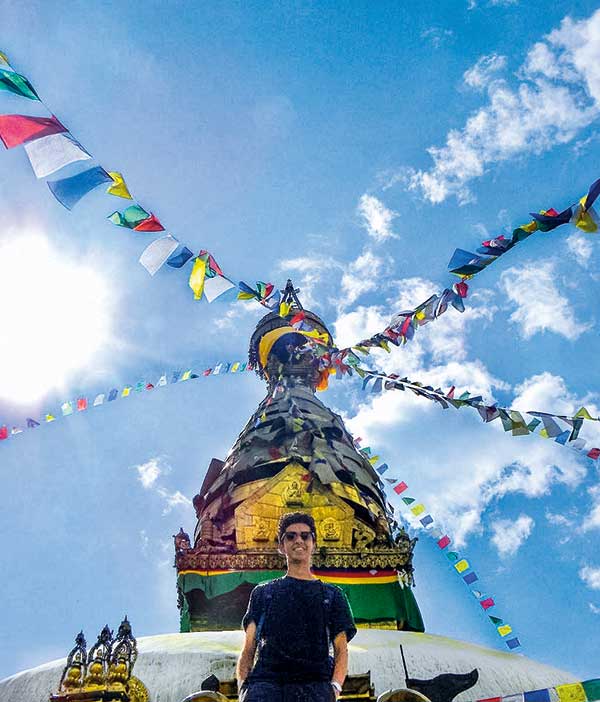
Anandraj at Swayambhunath, a Buddhist religious complex in Kathmandu
Anandraj arrived in Nepal in August and will continue his travels in Ghana, Peru, and Thailand. At each location, he will meet with urban planners, conservationists, and Indigenous groups to learn how they are understanding and addressing displacement impacts.
Hailing from Plainsboro, N.J., Anandraj majored in economics and minored in both political science and creative writing. He also interned with Colgate’s Office of Sustainability and plans to pursue a related career. “The challenges climate change poses for economic development globally are fascinating to me,” he says, “so I would love to keep exploring that interest beyond my Watson.”
While on his fellowship journey, Anandraj is writing a weekly blog: subscribe to “After the Blueprint” on Substack.
The following is an edited version of his first few posts.
On the morning of Sept. 10, 2025, Mangal Bazaar is quiet. Every store in sight has drawn down its roller shutters. The streets are empty, save the occasional motorcycle rolling away to its particular place of refuge. Even the stray dogs have disappeared. My only interruption from this eerie silence was, when searching for an open grocery store, I encountered a crowd encircling piles of smoke. The smoke rose from a local minister’s car, the fire spitting out of its warping windows. For the first time, I had witnessed with my own eyes a totem of Nepal’s unfolding disarray.
Mangal Bazaar, like most of Kathmandu, Lalitpur, and Bhaktapur, is (at the time of this writing) under curfew. This, the government’s attempt to regain control of the valley after the Sept. 8 protests, dubbed the “Gen Z Rallies.” Young people organized these rallies in major cities across Nepal, such as Pokhara, Chitwan, and Butwal, but it was Kathmandu that made international news, with headlines like: “At least nineteen killed in ‘gen Z’ protests against Nepal’s social media ban” (the Guardian).
Although it is tempting to impose such a neat narrative on the social turmoil of a faraway country, these types of headlines ignore the complex political context. Nepal rests in a precarious position between the geographies and economic doctrines of India and China, while also being influenced by more Western, market-based ideas. The country has only been a democracy for a decade, which has failed to bring the economic improvements and social mobilization many hoped it would upon its inception.
Why the promises of democracy in Nepal remain unredeemed is beyond my limited qualifications and understanding of the country. The particular feature of this government that drew so much backlash, though, seems clear enough: Corruption both big and small is making the country slip further and further away from its citizens, into the grasp of an entrenched elite.
Motivated by these impulses, Nepali youth took to the streets. After the army killed 19 of them on that day, the country has been sent spiraling. The cards have already been shuffled: The prime minister has resigned, a transitory government is forming, and new elections seem imminent. In the meantime, the Parliament and the Supreme Court are on fire. The military has been deployed, roaming the streets to quell anarchy that has erupted out of a wild rage far, far different from the more grounded desires of Nepal’s next generation for a government that truly serves them.
When I first arrived in Nepal on Aug. 1, 2025, I sensed none of these impulses in the air. The most daunting fire I encountered in my first week emerged within my own mouth, from a lunch I was decidedly unprepared for.
Bricks, Gods, and Neighbors
At this point in the meal, the few remaining drops of Coca-Cola are merely insulting, not even offering the hope of respite.
“Even for me, it’s spicy,” my Airbnb host Niroj tells me. His dark eyes widen, he flexes his jaw, and he massages his combed beard as if to soothe his face. For a moment, I believe him, but his Coke bottle is more than halfway full, and I can tell he is once again simply being gracious with his hapless American guest. I eat one last laphing (a Tibetan spicy noodle dish), rejoice in its flavor, wince at the scorching of my mouth, and try to salvage some dignity by leaving the Coke untouched.
We leave the restaurant and continue our tour of Patan, Nepal, where I’m staying. “In the [Kathmandu] valley, there is a saying,” Niroj tells me. “Here, there are more temples than homes, more gods than people.”
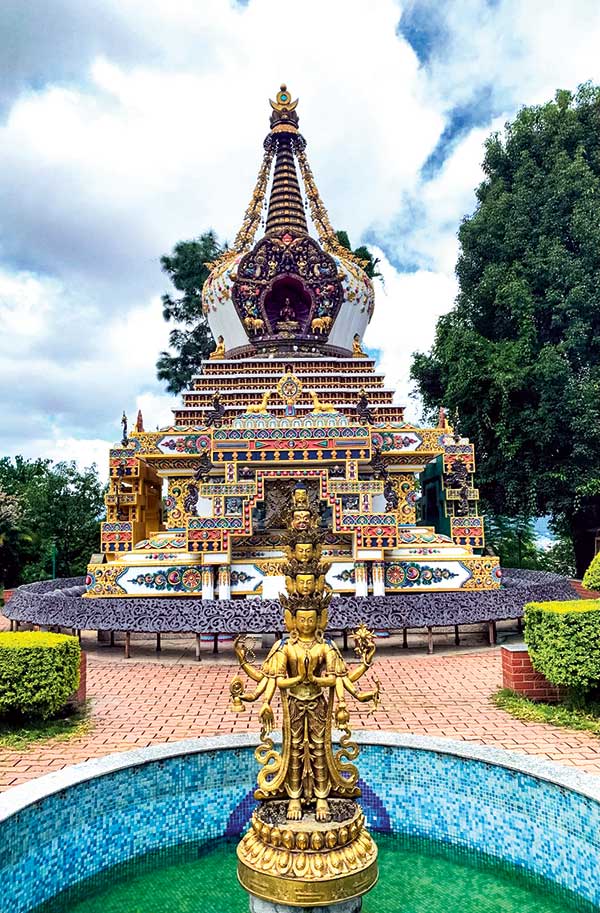
Patan certainly has its share of remarkable temples: sloped roofs stacked like stairways into the heavens, each tier traced with intricate engravings of elephants, deities, and dancers, with gates at the base revealing the god of each shrine. Yet worship is not reserved for elaborate monuments. Venture to the most unassuming places — between a print shop and a law office, for instance — and you may well find a temple.
The omnipresence of temples in Patan is usurped by only one thing: bricks. Virtually every building, from local banks and cafés to Thangka paint shops and pashmina stores, is made of brick. The style has been influenced by more than aesthetics. “In the Kathmandu Valley, there is an earthquake every 100 years,” Niroj explains. “[There was one in] 1834, 1934, then …” he pauses, “well, 80 or so years, 2015.” Incidentally, bricks are meant to last for approximately 100 years, and more importantly, their ruins are easily reconfigured into new, usable bricks. “People think Patan is a UNESCO World Heritage Site because of the temples,” Niroj says. “Really, it’s because our ancestors are so smart. They built our city so intelligently.”
The proposed path would cut right through Khokana and the neighboring town of Bungamati, slicing the rice paddies with asphalt, severing the sacred ceremonial route to Sikali, and paving over cremation sites.
Too intelligently, it seemed, for me. During my first day, while in a jet lag– induced purgatory between consciousness and sleep, I took many a wrong turn. The crooked streets twisted without apology, and again and again I stumbled from traffic-packed roads into serene, vast courtyards, where families were hanging laundry, cleaning their doorsteps, and wondering why some dazed foreigner had thrust himself into their afternoon. Niroj soon dispelled me of the notion that these were elaborate mazes built to trap clueless westerners like myself. In fact, courtyards are another integral component of Patan’s design. “They provide community,” he says, “away from the busy streets.” Open social spaces where people of all ages could mingle safely and easily meant that community was physically built and maintained within the city. “During the earthquakes, they also provide refuge,” Niroj continues. He recounts how, in 2015, you could find entire neighborhoods packed into these spaces, cooking, sleeping, waiting.
Over the course of our tour, I learned that Patan — from its public water spouts and ponds to its plentiful shrines — is a city meticulously crafted to safeguard disaster. What will survive the devastation of Mother Nature? Patan’s answer seems to be bricks, gods, and the ties between your neighbors.
The Concrete Tide
In between getting lost, finding my way, and seeing just a glimpse of the Kathmandu Valley, I have been making some valuable contacts. Activists, academics, and NGOs have all lent their time to try to help me understand development-induced displacement in Nepal. Highways and transmission lines are just some of the ways development initiatives are causing resettlement for the Newari Indigenous communities that inhabit Patan and its surrounding areas.
The Indigenous activists I am working with recommended I visit Khokana, the oldest Newari settlement in the valley, which houses within its tight city center and vast agricultural lands thousands of years of history.


Left and middle: Bhaktapur Durbar Square. Right: A Thakali meal, one of the staples of Nepali
food, which includes rice, dal, and chicken curry.
I arrive on Gai Jantra, a festival celebrated throughout the Kathmandu Valley to honor those who have passed away in the preceding year. All of Khokana is here, whether they are playing in the marching band, hanging leisurely from their windows, or peering from their shop doors. I spend my first hour there following the procession. Our walk through the city halts and surges, punctuated by various stops. At one, a group of men wearing bright red drink milk poured from a golden kettle. At another, a man roughly my age suddenly leaps as incense singes his fingers. Toward the end, I briefly drift away from the main crowd to witness two men dive into a pukhu, an enclosed, square-shaped, man-made pond.
When the drums fade, I find Krishna, one of my Newari activist contacts. He takes me through the city, explaining the importance of shrines and common areas. Gutis, adjoining houses that form three sides of a square, are located throughout Khokana as community centers. “For every celebration, people congregate at the gutis,” he tells me. Similar to Patan, I realize, Khokana is intentionally crafted to facilitate community.
Krishna and I move out of the main city and come upon a vast field of rice paddies. Like folds of a quilt, they stretch in layers for as far as the eye can see, blanketing the valley in jade. Krishna points to a temple on a hill: “That is Sikali,” he explains. During the religious festival called Dashain, the townspeople don masks and carry the goddess Rudrayani on a wooden chariot from Khokana to Sikali, marking a crucial part of their five-day celebration. He also points to a place called Ku Dey. “This is where our ancestors first settled,” he says, “before jungle animals and the elements forced them to resettle where Khokana’s main city is today.”
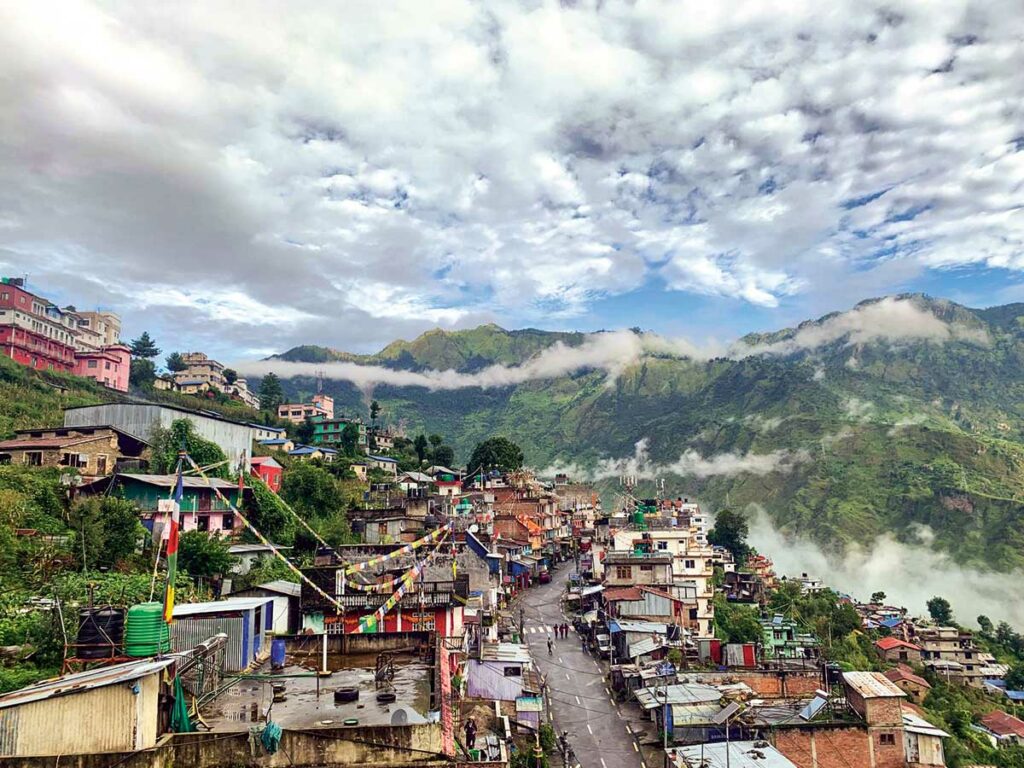
Dhunche, in the Rasuwa district
Krishna points these out because both Ku Dey and Sikali are sites of impending destruction. The government of Nepal is planning a Fast Track Expressway to connect Kathmandu with the rural southern Terai region. The proposed path would cut right through Khokana and the neighboring town of Bungamati, slicing the rice paddies with asphalt, severing the sacred ceremonial route to Sikali, and paving over cremation sites. Families would lose their farmland, and the broader community would be rid of the sacred spaces that are foundational to their identity.
What is most worrying to activists like Krishna is that the project opens a Pandora’s box of development initiatives in this part of the Kathmandu Valley. There is a plan to build adjoining roads to the Fast Track, transmission lines, and infrastructure on the banks of the Bagmati River, which passes through much of the valley. The Fast Track is seen as the entry point. A relatively small slice of land, which for centuries has sustained farmers with productive agriculture and communities with rich heritage, is now being asked to bear the brunt of a concrete tide indifferent to whatever and whoever it will drown.
“The government does not care about this culture,” Krishna laments, indicating a misalignment that defines much of this displacement conflict. In the balance sheets of the Nepali government, it seems the heritage sites of Khokana are unavoidable, bankable losses on the path to a much more important, significant kind of progress. Walking through Khokana on Gai Jatra, though, the obvious question is: progress for whom?
From the city’s architecture to the sheer volume of people at the festival, one realizes that these ceremonies constitute an essential part of the daily, lived experience of the communities here. To sever their people from these traditions is to, in some fundamental way, destroy an active part of their livelihood.
There is more for me to learn about the Fast Track, which I plan to do through my continued work with activists in the field and through assisting their drafting of petitions and reports. Meanwhile, the Nepali Army has set up a camp in Sikali to oversee construction, and a Korean company has agreed to finance the project. Yet all around the Kathmandu Valley, Newari communities are mobilizing to resist them, providing counterproposals and urging the government to preserve the rich cultural heritage of Khokana.
In addition to working on my project, I’ve had time to explore more of Kathmandu. Krishna even made me an authentic Newari meal. To share a home-cooked meal while traveling is to be briefly and truly embraced by another place and people, and that makes it a real privilege. There are few, if any, greater honors.
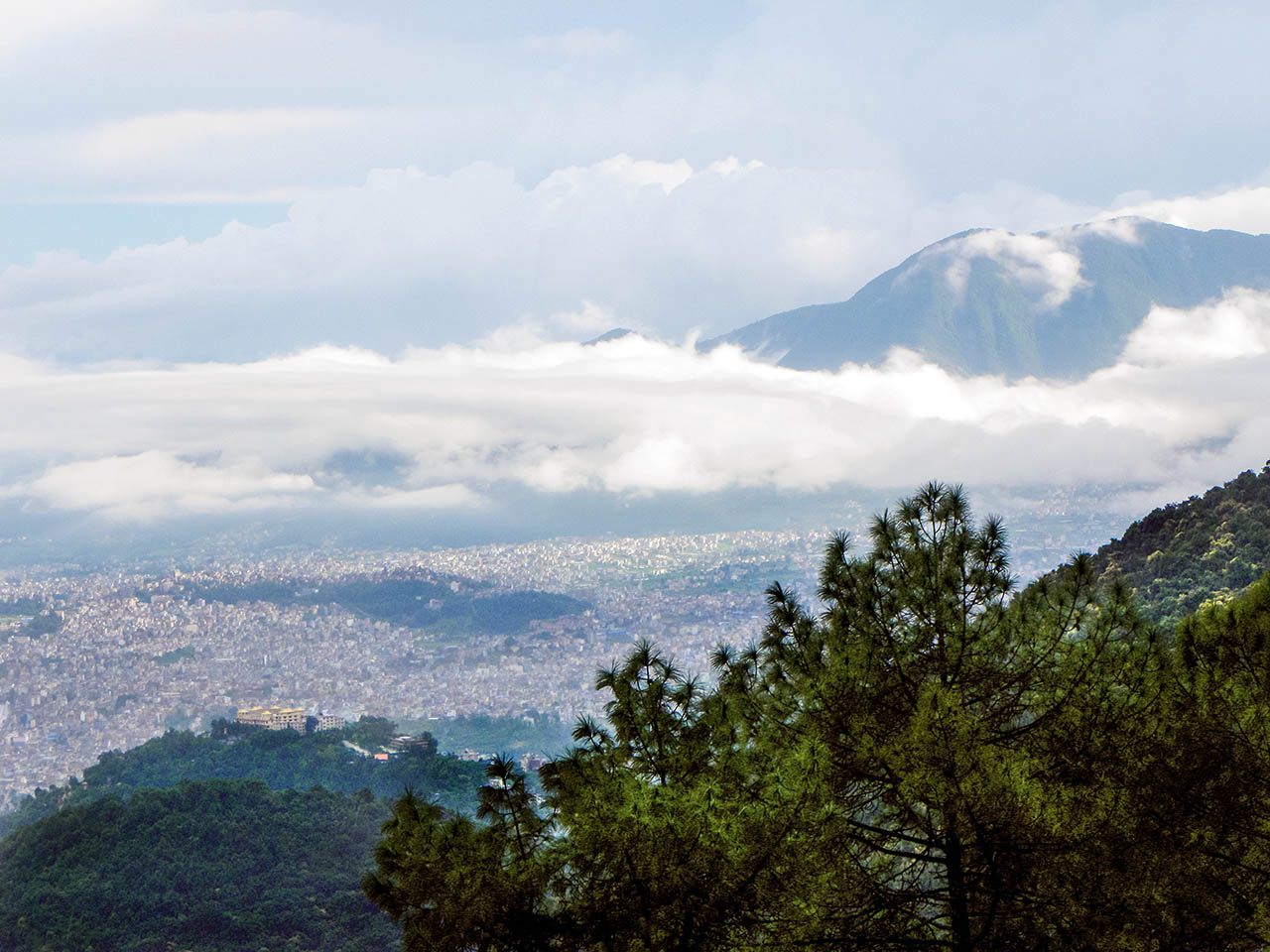
Shivapuri National Park
This is the first time I have traveled alone — taken a flight to a destination without any close friends or family to await me. It’s a bit of a strange sensation to sit in restaurants full of chatter and not be a part of it, or witness groups of friends and families striding the same streets and feel distinctly separate. Moving through the world alone, safely and on my own terms, is a privilege just as much as it is an oddity, though. I am growing to enjoy the gentle peace of wandering a foreign country with nothing but my Kindle, my camera, and my thoughts.
The people I am meeting have been remarkably gracious and charitable with their time. Whether it’s Niroj and his family, taxi drivers, or my fellowship contacts, so many meet me with curiosity about who I am and a willingness to talk, share, and lend some local insight. The thing I am enjoying the most is being able to mirror that curiosity with my own. To be lost, asking too many questions, and still — always — welcome.