

I always believed that the ability to tell stories that stick in your mind comes from an early exposure to great storytellers.
Information, for my Nebraska grandparents (born long before cars and planes existed), was the local weather reports or family updates. Even as a child, I knew stories were different: They were told and retold in the best oral tradition and in an endless cycle of time, people, places, and even songs.
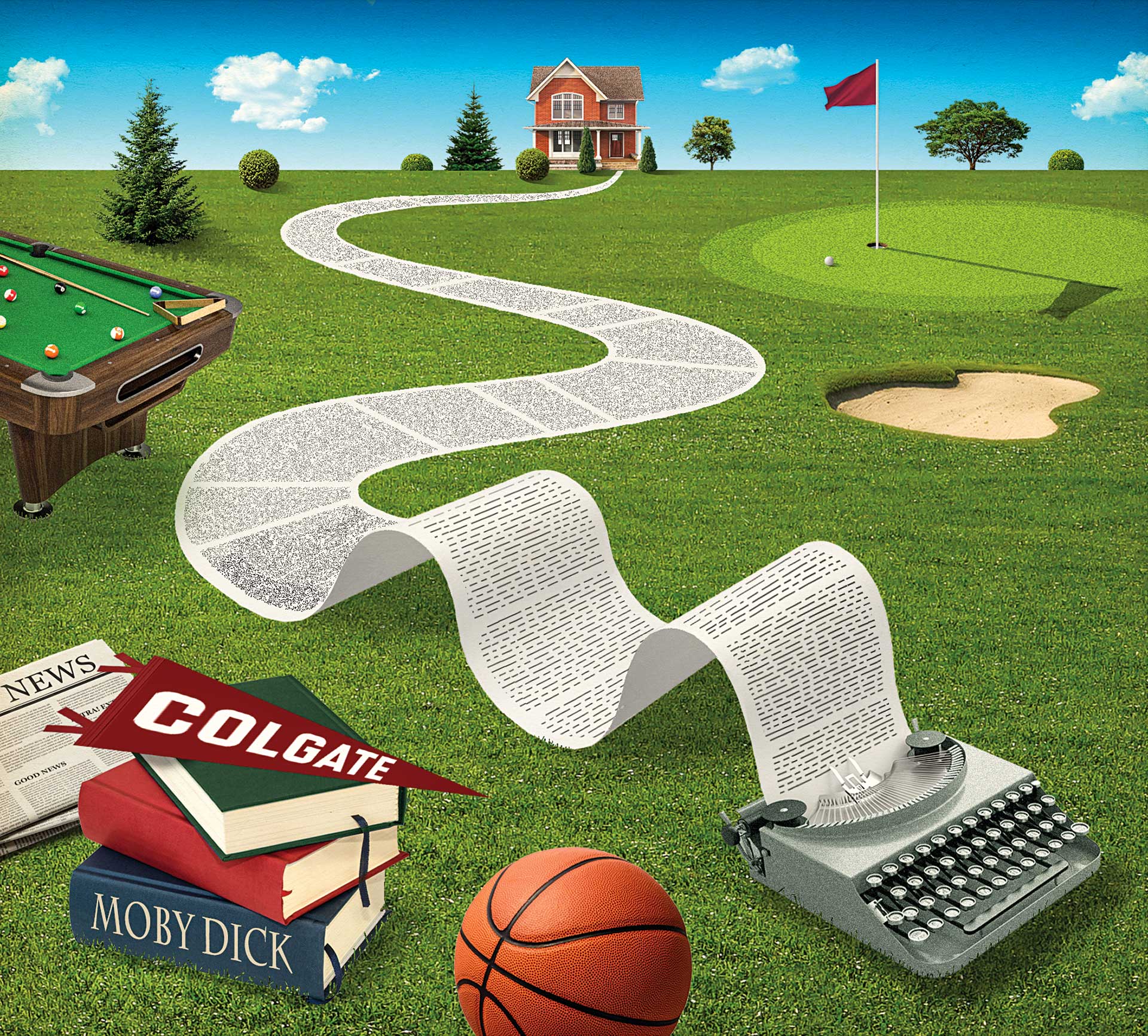
I never wrote any of these stories down until recently, but dozens have survived in my mind.
My grandfather Herman Cattau, a charming German immigrant and incorrigible trickster who died in 1973 at age 87, would break into this mournful song unprompted and usually in Plattdeutsch (low German):
Out in this cold world alone,
Walking about on the street,
Asking a penny for bread,
Nothing but sorrow I meet,
I am nobody’s darling,
And nobody cares for me.
My grandmother Anna hated the song and took it personally. After hearing the song all my life, I asked Herman why he liked it:
“It’s to teach parents to be kind to their children.”
The German critic Walter Benjamin, in The Storyteller, writes: “The value of information does not survive the moment in which it was new. It lives only at that moment … a story is different. It does not expend itself. It preserves and concentrates its strength and is capable of releasing it even after a long time.”
When I was a Colgate freshman in 1968, my dorm room was on the fourth floor of East Hall. That was unremarkable except for a minor problem: I had an artificial leg that weighed 14 pounds and there was no elevator. I did not complain and neither did my parents, who thought it would be good exercise.
If that happened today, a Colgate dean told me, “There’d be seven attorneys on the phone right away.”
For decades, this Colgate story lay dormant like a time capsule, but today the image of running up and down four flights of stairs hauling a metaphorical bowling ball never ceases to get a laugh or a horrified look.
Why? The story didn’t change, but the context did: People today would expect an elevator because of the Americans with Disabilities Act (1990). An ordinary bit of information, released after time, becomes a story.
I was born without a left leg at the knee, left arm at the elbow, and with only one functional finger on my right hand. I had the distinct advantage of low or no expectations, and the date of my birth, Oct. 2, 1950, was also the exact date when Charlie Brown first appeared in a comic strip — a nice touch by the divine storyteller.
My parents moved from Omaha to the Buffalo, N.Y., area in the early ’50s. They bought a home in Williamsville, a suburb known for its excellent schools. Enrolling me anywhere was a long shot. My savvy parents asked to meet the school district’s superintendent, but he insisted they bring me along. I guess the interview went well: I was only 4 years old when I started half-day kindergarten, just a regular pupil — albeit one who flunked tying my shoes, then a prerequisite for first grade.
There’s a poignant scene in Ted Lasso, where Jason Sudeikis’ character unexpectedly beats an arrogant Brit in a game of darts. “Be curious, not judgmental,” says Ted, quoting Walt Whitman and pointing out that he had been underestimated all his life.
I also made a career — and won some pool hall and golf bets — out of often being underestimated.
I’m always stunned that some educated adults still ask if I were a “thalidomide baby,” referring to the morning sickness drug that caused tragic birth defects in the 1950s, mostly in Europe. The drug was never approved for use in the United States.
Often, older kids who should know better, stop to ask: “What happened to you, mister?” It took me decades to come up with a truthful answer that also put a stop to the questioning: “I don’t know.”
Of course, I always give small children a fuller, kinder explanation and toss a ball to them, if one is handy, as an exclamation point. One sharp 3-year-old girl asked for a clarification: “But you weren’t born with the glasses, were you?”
At my 45th Colgate Reunion in 2017, I was having beers with my basketball buddy and former trustee Tom Dempsey ’72 and Mark Murphy ’77, the recently retired president/ CEO of the Green Bay Packers.
Dempsey pointed to me and said: “Dan, the best athlete in our class.”
Like George Washington’s mythical cherry tree story, the quote is demonstrably untrue, but it’s also true enough. George was honest, and I could shoot three-pointers long before Steph Curry was born.
I later sent Murphy an email, half expecting him to think we had been fooling with him. He quickly wrote back: “I remember thinking, ‘Wow, that’s impressive, and Demps is not prone to exaggeration.’”
Beyond sports, my time at Colgate came with a roster full of five-star mentors: professors Jonathan Kistler and Bob Blackmore ’41 in English, Raymond Rockwood in history (who led the London History Study Group), Dean of Students Guy Martin ’57, and University Chaplain Coleman Brown.
After graduating in 1972, I had monthly conversations with Coleman (who died in 2014). The wisdom usually went one way; but once (in 40 years), I finally said something that struck him as insightful and he replied: “Now you’re preaching to me.”
A liberal arts education, I quickly found out, was not about career plans but rather surprises.
For a required course my sophomore year, I signed up for “the short story” taught by Frederick Busch, an author especially admired by the literati. We had to turn in a weekly, 500-word typed critique of a short story by the likes of Ernest Hemingway or William Carlos Williams. It basically was a boot camp about storytelling. (Tying shoes wasn’t my only problem; I didn’t know how to type. My roommate, Marshall Olds ’72, typed my papers and, no doubt, improved them.)
I stayed in touch with Busch after college, and he was always generous with praise. In his quasi-memoir, A Dangerous Profession: A Book About the Writing Life, Busch talked about the kind of stories he liked best: You will remember the death of a parent, the loss of a friend, the terror or illness of a child you tried to protect. It is those moments — they are lived at body temperature; there is nothing cool about them — that define a life.
I was a history major and had a vague notion that I could write based on doing well in Busch’s class, two published letters to the editor, and a lifelong obsession with Moby- Dick. (I started reading Moby-Dick in eighth grade and reread it every summer through my junior year in college.)
My first published letter to the editor was in response to a July 1971 Sports Illustrated piece titled “To the Brink — and Beyond” about a family, the Hills, who lost a father and two sons in trying to conquer Niagara Falls. Immediately, I thought of Ahab’s inscrutable madness and idolatry that, like the Hills, at least made sense to him. I wrote to the magazine comparing the Hills to Ahab, complete with Ahab’s chilling quote: “All visible objects, man, are but as pasteboard masks….”
Later, in reading a Herman Melville biography, I noted that his first journalistic efforts were letters to the editor at a small paper near Albany … just like my letter about Moby-Dick. (I’m still a white whale fanboy: An Uber driver at my local bar once asked for a reading recommendation. Two years later, after battling Moby-Dick to the finish, he remarked: “It’s not about the whale, is it?”)
During my senior year, I spent the fall term with the London History Study Group. I had enough credits to graduate early, so I traveled in Spain for three months. I came back to Colgate in May 1972, two days before graduation, and with no post-college plans.
English professor Bob Blackmore asked about my future. “I’m going to Nebraska to visit my grandparents, and I might try to get a newspaper job.”
This is the thing I always loved about Colgate: Nobody told me this was crazy. Which it was.
A former Time-Life executive, Blackmore influenced generations of students who went into journalism. He saw my lack of experience as an old-school virtue and suggested that I look for a job “at any paper that interests you” along the way to Nebraska. I laminated two letter-to-the-editor clippings (including Moby), stuck them in my wallet — and drove away.
In case anyone was dumb enough to hire me, I also started teaching myself how to type.
Blissfully unaware of reality, I applied to dozens of papers, mostly in person, including: the Grand Island Independent (Nebraska); the Des Moines Register (Iowa); the Laramie Boomerang (Wyoming); and the Sioux Falls Argus-Leader (South Dakota). One editor told me it was the “weirdest application” he ever received.
Surprisingly, only one editor was curious enough to ask the most obvious question: “How fast can you type?” I told him I could type “half as fast as a two-fingered typist.”
The summer slipped by with no offers, and I was about to start a bank training program. In desperation, I wrote a two-page letter to a kindly editor I had met in Omaha. I briefly described each rejection in dateline fashion.
Grand Island – Applied for farm writer job. Editor tells me that having an uncle who is a farmer is not a qualification.
I ended up at the Omaha World-Herald on a one-month tryout. With only Tuesdays and Wednesdays off, I’d travel 90 miles to Columbus, Neb., hang out with my grandfather, and listen to his stories, again and again. One day, he told my grandmother he was “going to the living room to take a nap,” but added, “I don’t think I’ll be around much longer.”
He never woke up from that eternal nap.
Decades later, I told Carl Keith, the Omaha managing editor, about what it meant to get to know my grandfather — in addition to the lucky career break. “By the way,” I asked him, “why did you ever hire me?” Was it my Nebraska family? The off-the-wall letter? Were you drunk or on drugs?
“No,” he said, “it was Colgate.”

Daniel Cattau ’72 helped develop and edit the Pulitzer Prize– winning biography King: A Life by Jonathan Eig. In researching the book, says Cattau, Coleman Brown’s dissertation on Martin Luther King Jr. provided important insights.