

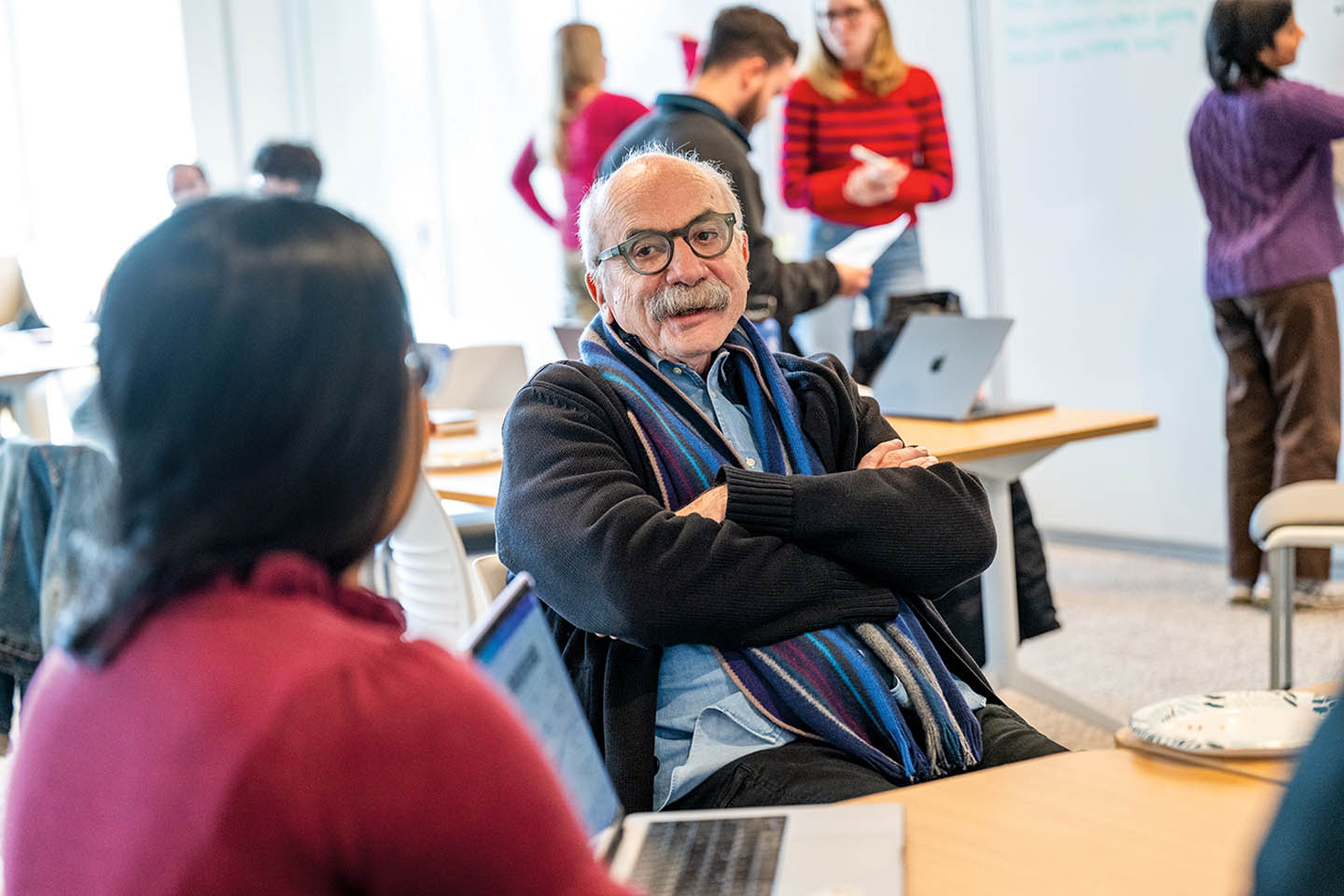
Engineer, designer, and entrepreneur David Kelley visited campus as the Clifford Family Innovator-in-Residence in April. Kelley specializes in design thinking and human-centered design methodology, which he applied during his interactions with students, faculty, and staff.
The Donald W. Whittier Professor in mechanical engineering at Stanford University, Kelley serves as faculty director of Stanford’s interdisciplinary d.school, which is dedicated to helping students develop their creative capacity. He is a co-founder of the Silicon Valley design and consulting firm IDEO and co-author of the book Creative Confidence: Unleashing the Creative Potential Within Us All.
“Creativity is not limited to the arts,” said Associate Professor of Theater Christian DuComb, who is also the associate dean of the faculty for faculty recruitment and development. “David’s residency has given us insight into how we can continue to provide opportunities for collaboration among students and faculty in innovative and interdisciplinary ways.”
As part of his student interactions, Kelley consulted with the innovation fellows from Colgate’s Design for America Studio during a roundtable discussion. The studio develops solutions for problems facing the campus and community. Fellows are currently working on a project that would improve climate education for school-aged children, and Kelley advised them to keep pushing themselves beyond what is comfortable — not to get discouraged during the design process.
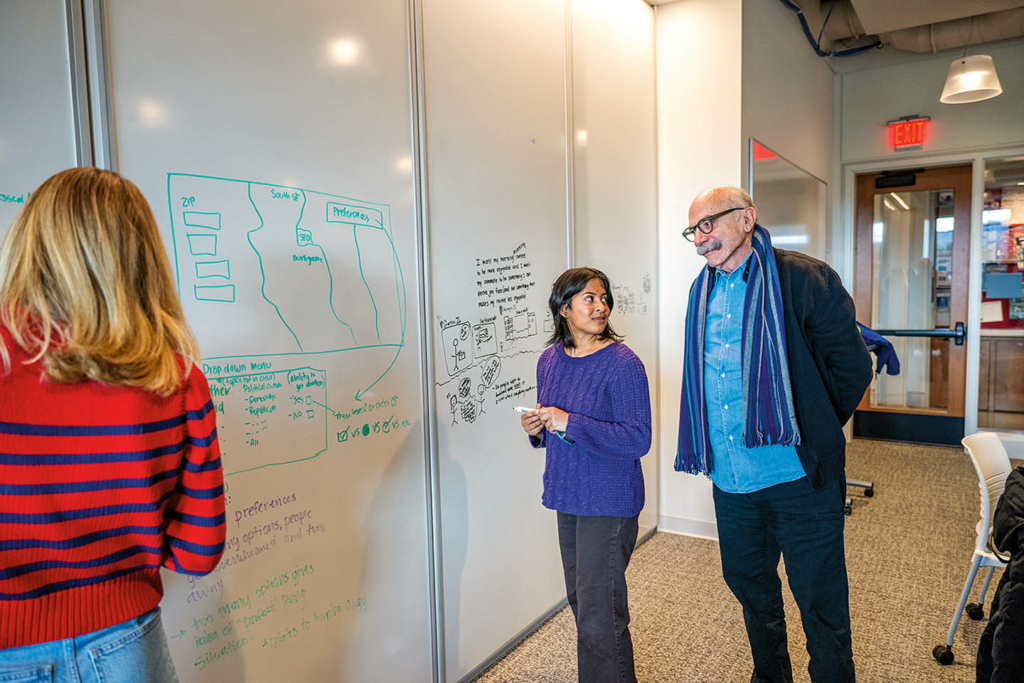
Students participated in an interdisciplinary seminar with Kelley and other faculty members to workshop design-related challenges in creative projects. Faculty mentors included Peter L. and Maria T. Kellner Endowed Chair in the Arts, Creativity, and Innovation DeWitt Godfrey; Assistant Professor of Computer Science Noah Apthorpe; Professor of Earth and Environmental Geosciences and Peace and Conflict Studies Karen Harpp; and Weiner Family Entrepreneur in Residence Reece Wilson. Students shared their projects and received feedback from their mentors and Kelley.
“A design-thinking tenant that really works is storytelling,” Kelley advised the students. “Paint a picture of the future — where your idea is in it, and it’s working. That allows all kinds of people to help you with your idea.”
He also encouraged the students to move toward prototyping to test their concepts. This is part of the design-thinking process. “Prototyping allows you to gather information about your idea, rather than just thinking about it,” he said.
Kelley visited two Department of Computer Science courses on human-computer interaction, toured Bernstein Hall, and visited current University exhibitions. He also met with the ACI Steering Committee to strategize about the next phase of the ACI Initiative.
“Everyone is wildly creative,” Kelley said. “We don’t have to teach students to be creative — we just have to remove the blocks.”
The Clifford Family Innovator-in-Residence program is a cornerstone of the Middle Campus Initiative for Arts, Creativity, and Innovation at Colgate and is funded by a permanent endowment from Trustee Emeritus Chris Clifford ’67, H’11, P’93 and Carrie Clifford ’93.