

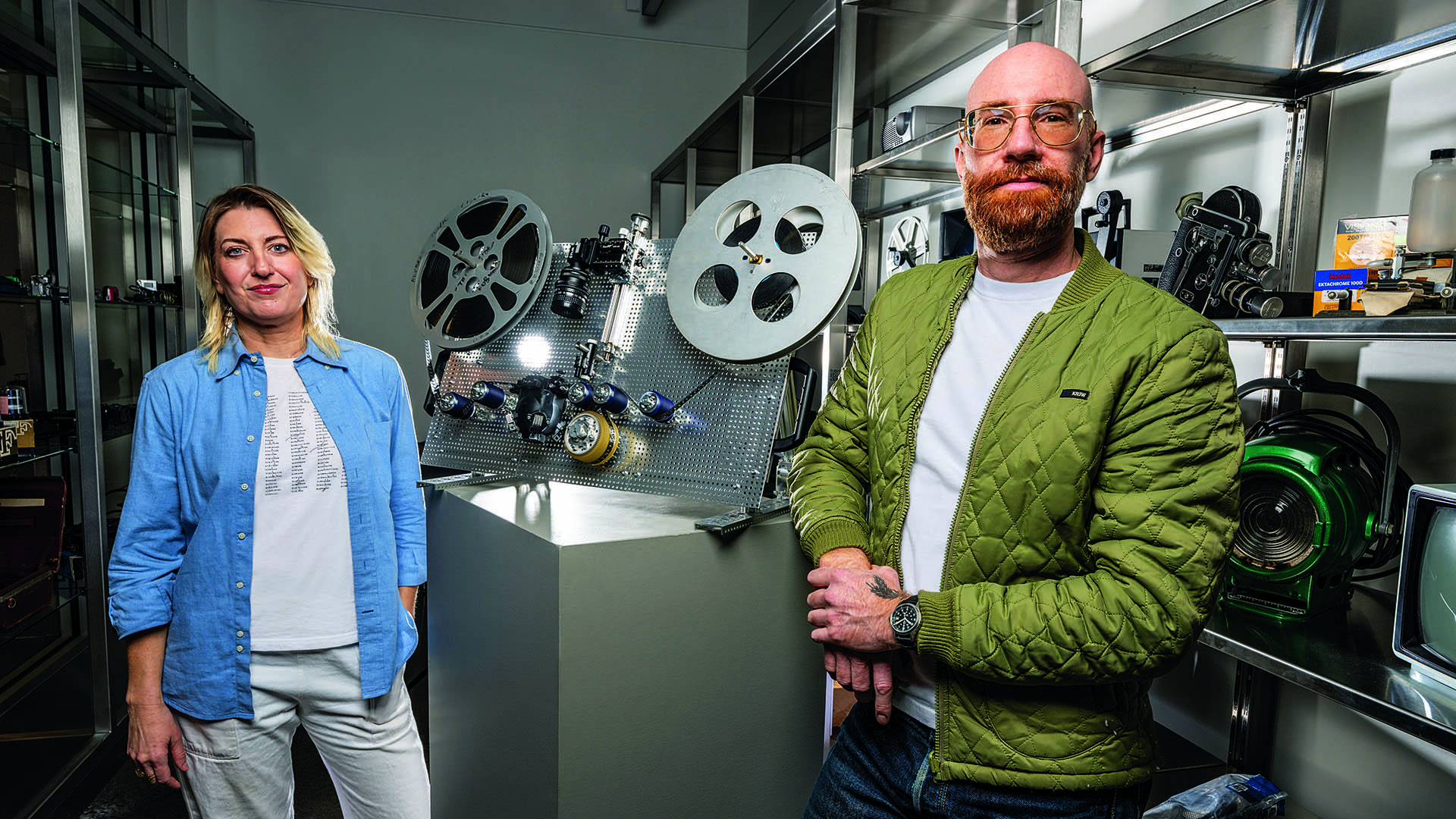
A search for rare Cold War propaganda films launched Professor Brynn Hatton into a community of scholars racing to save aging film stock around the world.
Professor Brynn Hatton first heard about the obscure film archive in the Jordanian capital of Amman in an email posting by technologist Matthew Epler in 2012. He had come across a dusty collection of 16 mm and 35 mm film reels — some 900 in all — in a forgotten room in the country’s Royal Film Commission and asked for help translating the titles. The archive consisted of propaganda films promoting solidarity between the Soviet Union and its allies from the 1960s and ’70s, and Hatton was especially intrigued by the mention of several unidentified Vietnamese films, corresponding to her own area of interest in Vietnam as a cultural idea.
Then a doctoral student in art history at Northwestern, Hatton spent two years raising funds to visit the archive; just 10 days before the trip, however, she was crushed to receive notice that she would no longer be allowed access. She took the trip anyway, the start of a winding journey that would result in a unique interdisciplinary community poised to create unprecedented access to old and deteriorating films around the world.
“I’ve never looked at any of the films properly that are in this archive,” Hatton told an audience last October at Colgate, where she is now Kindler Family Assistant Professor in global contemporary art. “The individual filmic specimens here are not the treasure.”
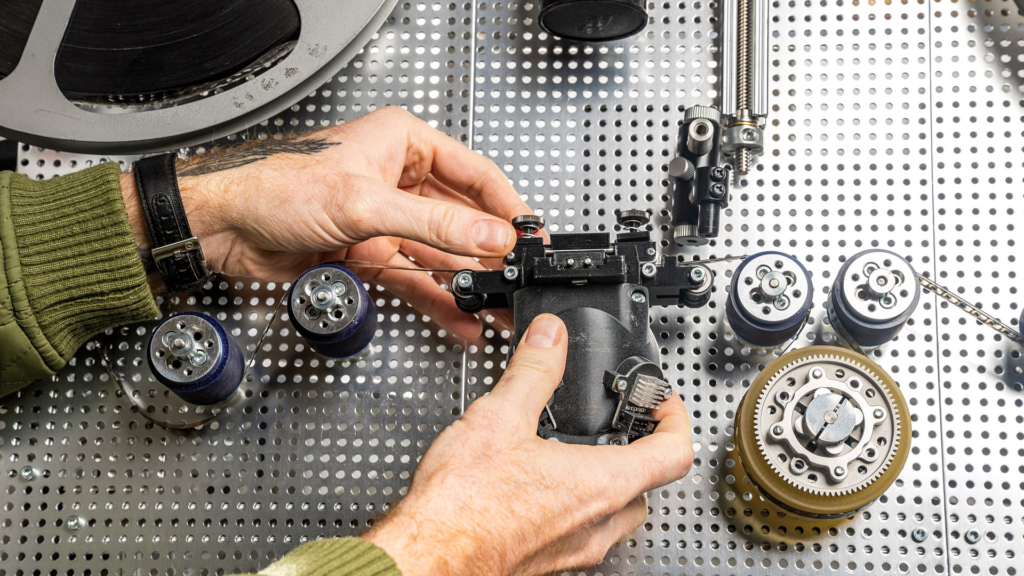
Instead, they served as a catalyst for the creation of a new device — a portable, open-source film projector dubbed the kinograph, which can be 3-D printed by anyone, fit into a standard-size suitcase, and be flown anywhere in the world. A researcher can “digitize a really good print of a 16 mm or 35 mm film on-site, with great sound and image capture,” Hatton told the audience, appearing alongside Epler and several other collaborators. The next day, Epler demonstrated the device at Colgate before giving it to the University for faculty and student use.
The device could be a game changer for film preservation. “Right now, film digitization happens mostly in professional labs and is prohibitively expensive,” Hatton says. At the same time, decaying 16 mm and 35 mm films languish in private archives all over the world, much of it without access to any equipment to play it. In Jordan, members of the collective were unable to find a projector in the entire country capable of screening the films in the royal archive. “These older media formats are disappearing,” she says.
Arriving in Jordan a decade ago, Hatton made the best of her lack of access to the archive by conducting interviews with locals about the films, which were screened by a cultural organization called the Jordan Soviet Friendship Society during the Cold War in an effort to curry favor for communism in the strategically important Middle East. While many of them were standard Soviet propaganda films, some, including two films from Vietnam and several from the Palestinian Liberation Organization, were much rarer. During her time in Jordan, Hatton made contact with Epler and other scholars — including Arab film historian Kay Dickinson, Soviet historian Masha Salazkina, and artist Ala Younis — who all worked in tandem to piece together the significance of the collection.
Just a day before she was to leave the country, Hatton was granted access to the archive for one afternoon and scrambled to catalog some of the films by taking pictures of the negatives. Even so, she realized that the real value of the archive was not the individual films, but the way they were used in Jordan and other countries to win hearts and minds through hundreds of other Soviet friendship organizations across the landscape of the Cold War.
Even as she was conducting that research, Hatton and her new colleagues were creating a “friendship society” of their own, reaching across disciplines to think even more broadly about how to preserve and utilize the networks of decaying film archives across the world. By now, Epler was working on the kinograph as a student at New York University’s Interactive Telecommunications Program, meeting virtually with Hatton and other historians and artists for input as well as with engineers across the world who helped design the equipment. One of Hatton’s first requests when she started as a professor at Colgate in 2019 was for a grant to support the continued development of the device.
In a short article he wrote about the decade-long project, Epler calls the kinograph more than a collaboration, but a community. “This multidisciplinary approach has made kinograph a richer and more robust project than it could have been if driven solely by technologists,” he wrote. From the beginning, the collective was adamant that the kinograph be open source, so that anyone around the world could use it. Libraries, universities, and film societies could preserve their own collections, even as scholars could make the most of their tenuous access to archives to digitize films on-site. Plans to make a kinograph are available for free online, where they can be downloaded, used, and improved upon by anyone with the curiosity to do so.
As Epler, Salazkina, Dickinson, and Younis all assembled for the panel discussion unveiling the kinograph at Colgate, Hatton took pleasure in thinking that the originators of the archive would have approved of the mission of this new “friendship society,” making it possible to further disseminate films around the world — all without regard to profit. “As we collaborate across national and disciplinary boundaries toward diverse individual ends,” she said, “we take cues from the pan-socialist solidarity networks of transnational friendship that brought this film collection into the world.”