

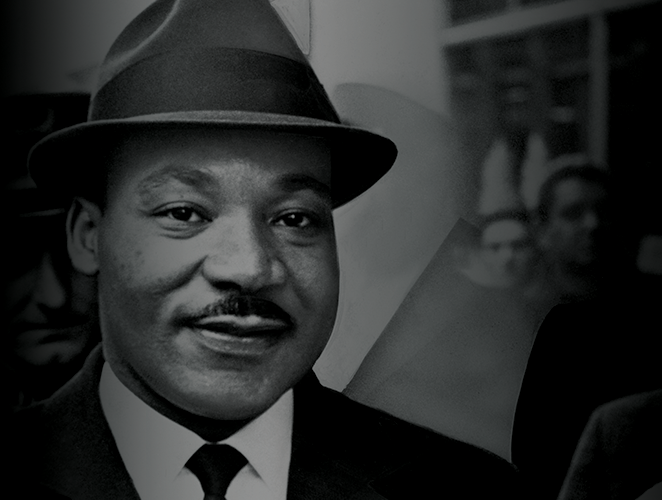
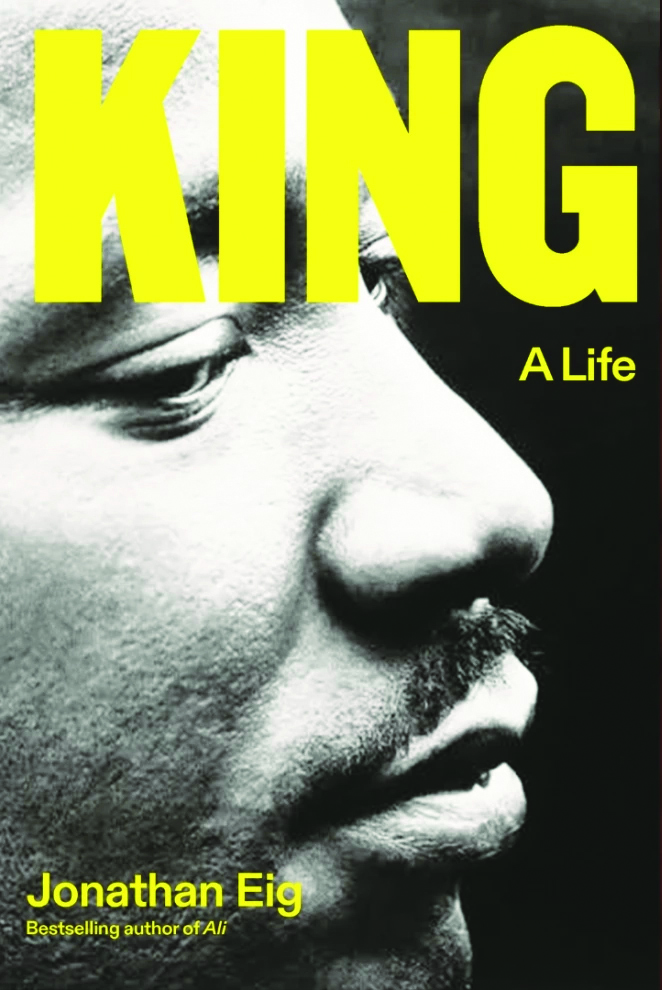
Pulitzer Prize–winning author Jonathan Eig came to Colgate to speak about Martin Luther King Jr., based on the research he conducted for his book King: A Life. Eig’s Feb. 11 lecture was titled Beyond The Dream: Embracing a More Complicated Martin Luther King and focused on King’s legacy of faith-based radicalism.

“I wanted to write a book to help remind us that King was human; he had fears, he had failures, he had flaws,” Eig said of his 2023 biography. “In celebrating King, we have watered him down to the point he wouldn’t recognize himself.”
Eig noted how King’s commitment to activism and radicalism became a constant choice throughout his life, even as he faced harassment in the wake of the boycott, including having his home bombed, his windows shot out, and other attempts at intimidation.
King continued to push back against injustice and the status quo, Eig said, even as, years later, his advisers urged him to step back. Instead of being satisfied with the progress of the Civil Rights Act and the Voting Rights Act, King expanded his mission from civil rights to human rights, income inequality, and guaranteed jobs and income. He called for a fundamental restructuring of America’s capitalistic society. He also began speaking out more aggressively against the Vietnam War, and as this happened, his popularity sank, Eig said.
The FBI began an all-out campaign to destroy him, but King refused to back down, Eig said, noting King’s planning of the Poor People’s Campaign in 1967 to bring thousands of people to Washington, D.C., to disrupt the city and the government. When people talk about the Black Lives Matter protests or the highways being shut down after the murder of George Floyd in Chicago, Eig said people say, “‘Martin Luther King would never do that.’ But that’s exactly what he did, over and over.”
Eig said the “watering down” of King’s radical message is intentional. For proof, Eig cites King’s “I Have a Dream” speech. The way King is taught today, Eig notes, the emphasis is always on the second half of the speech, focused on judging people on the content of their character, not the color of their skin. Educators rarely emphasize the first half, which was, Eig said, “a radical speech about income inequality, police brutality, subtly suggesting that reparations were going to be needed before America could move on from the sin of slavery.”
In writing about King’s life, Eig conducted interviews with those closest to King and dug through troves of archival materials — some recently declassified. Eig worked closely with Dan Cattau ’72, his friend and editor for the book, and Eig reviewed Professor Coleman Brown’s 1979 dissertation, which reinforced the idea of a “radical King.”
A national holiday and streets named after King are appropriate, Eig said, but “not if it forces us to forget what Coleman Brown wrote in his dissertation: that King’s greatness was rooted in radicalism and that radicalism is rooted in his Christian faith. That’s essential to understanding King. If we deprive him of that, we deprive him of everything he fought for.”