

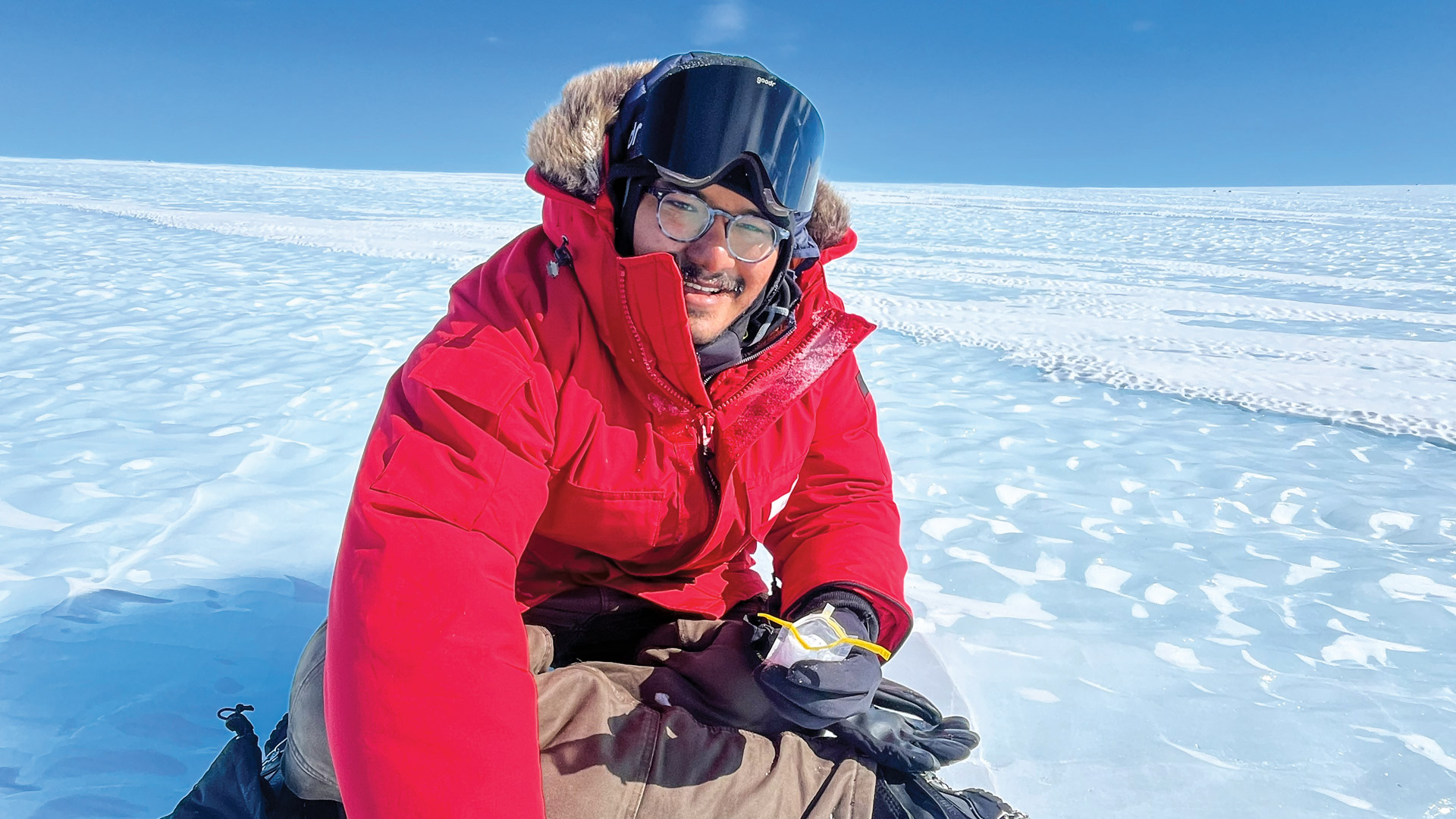
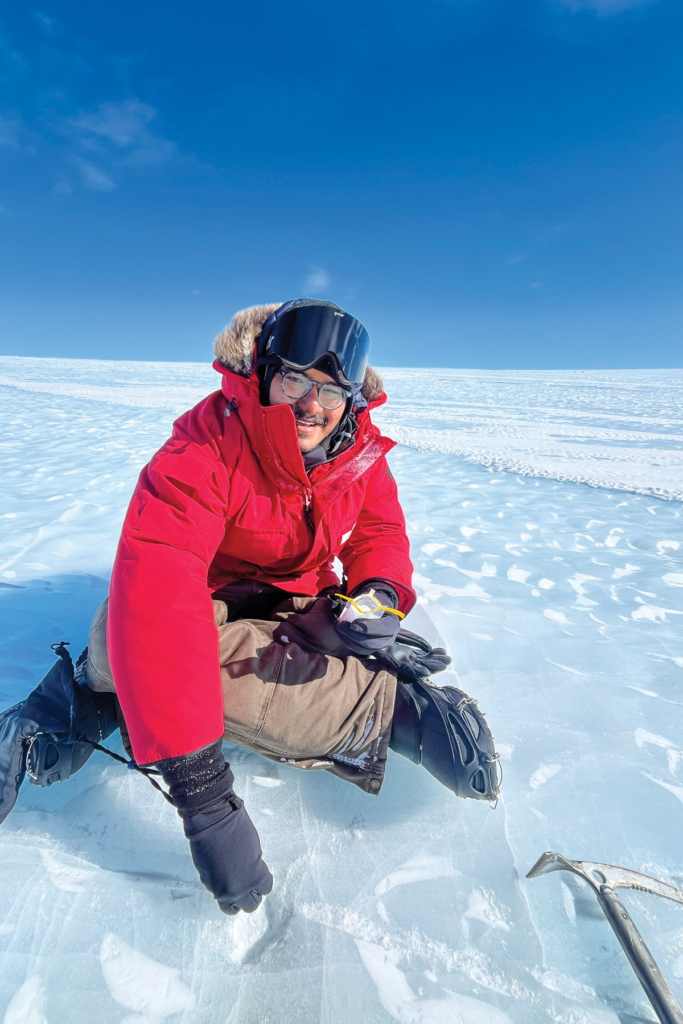
The white canvas tent shakes behind paleoclimatologist Fairuz Ishraque ’22 as he speaks on a Zoom call from the windswept Allan Hills of Antarctica. “The crux of the problem we’re trying to tackle as a team is we know very little about the Earth’s climate history beyond a million years ago,” he explains, dressed in a heavy parka to protect against temperatures as low as -30° Celsius. He and his fellow scientists are rectifying that problem by drilling deep to unlock records of the Earth’s past, frozen in ancient ice. “These records help us understand how climate systems evolved and how they respond to rapid changes,” he says.
The first Bangladeshi scientist to conduct research within the United States Antarctic Program on the continent, Ishraque experienced the devastating impact of climate change firsthand at age 4 when his family’s home was lost to the effects of riverbank erosion, forcing them to relocate to the urban center of Chittagong. An early interest in earth sciences and astronomy led him to Colgate’s astrogeophysics program, where he spent three years studying the geology of Mars with Professor Joe Levy, using satellite images of its boulder-strewn glaciers to understand the red planet’s climate history. “I am constantly using my training from Colgate to better understand the sedimentary processes and flows here,” he says.
His interest in climate science inspired Ishraque to join the lab of paleoclimatologist John Higgins at Princeton, where Ishraque is now a doctoral candidate. Last year, he was one of three recipients of a prestigious UCAR Next Generation Fellowship from the University Corporation for Atmospheric Research, which is helping fund his current research on ice-core science and glaciology. He traveled to Antarctica for the first time last November for a 10-week stint studying in the Allan Hills, a so-called blue ice area where ancient ice is pushed to the surface by the dynamic flows of the ice sheet.
“Anything that goes into the ice sheet eventually comes out at a blue-ice area,” explains Ishraque, who is “helping extract ice cores containing tiny bubbles that preserve bits of the Earth’s atmosphere as old as 6 million years. To analyze the samples, Ishraque uses cryo-laser ablation mass spectrometry, a technique he co-developed with Higgins. “We vaporize tiny sections of the ice with ultraviolet lasers,” he explains. The technique allows them to create a detailed map of the Earth’s climate records over time based on minute samples with minimal destruction of the ice core.
By analyzing the chemical composition of those samples — including traces of salt that can help identify sea level — they hope to gain valuable insight into critical periods such as the mid-Pliocene warming event 3 million years ago. “The pacing of these past warming events are quite similar to our current global warming event,” Ishraque says. “It gives us a good idea of what happens to the atmosphere when such huge changes happen in a short timescale.”
The snowy winters at Colgate helped prepare him for Antarctica’s extreme cold, but “nothing prepares you for the wind here,” Ishraque says. Gusts can reach speeds of 40 knots, requiring drilling operations to be conducted inside tents. He and his fellow researchers spend the day busy with intense physical labor, hauling equipment and 100-pound ice cores; while nights are spent on lawn chairs in a large heated tent trading stories and crossword puzzle books before retiring to small unheated tents to sleep. The inhospitable conditions have hardly chilled Ishraque’s passion for scientific discovery. “I want to continue developing tools and techniques that advance ice-core research,” he says, helping better predict the Earth’s future by melting its distant past.