

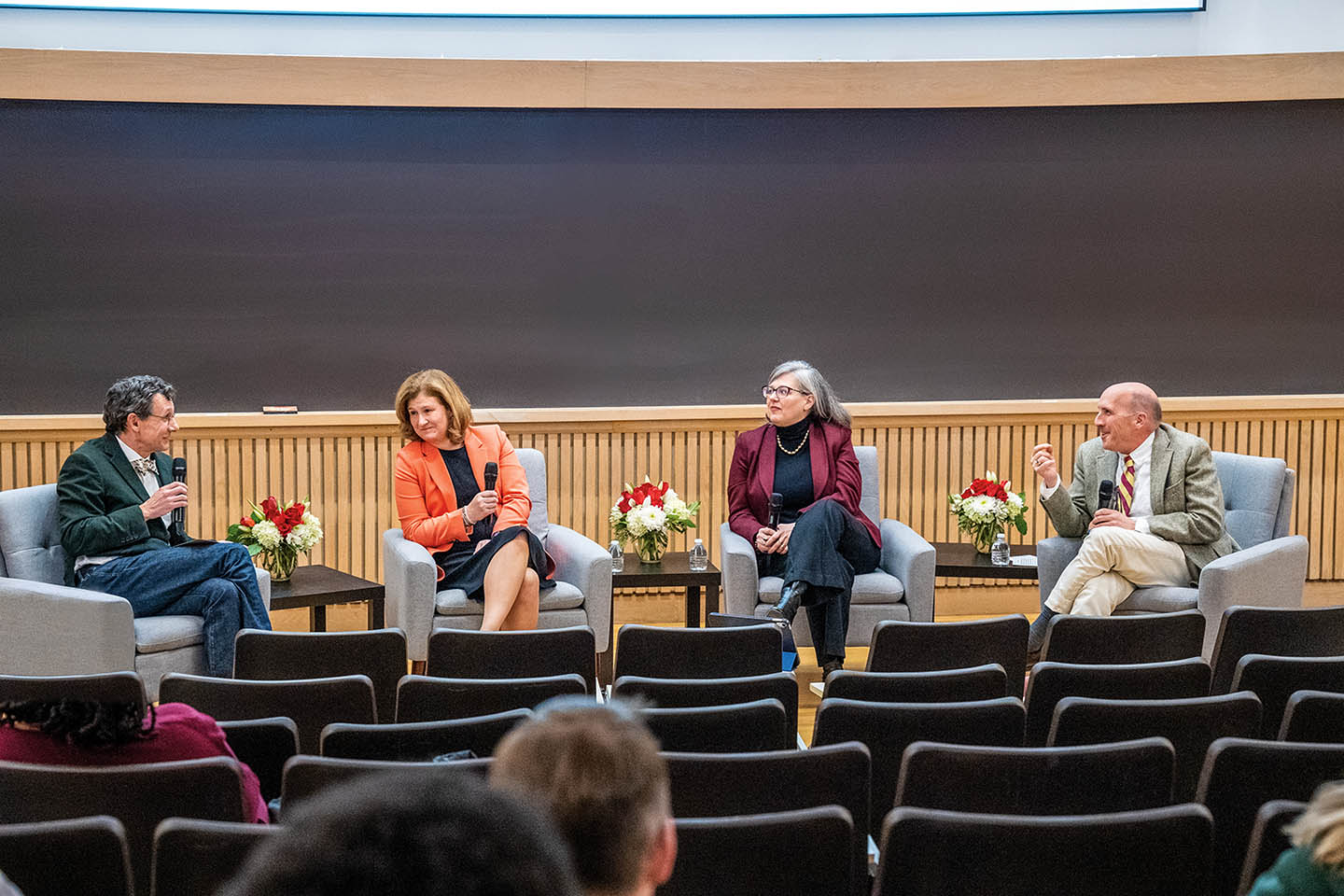
Colgate welcomed three presidents of leading liberal arts colleges on Feb. 25 to discuss the mounting challenges faced by higher education. The panel, part of the spring Presidential Speaker Series, was moderated by President Brian W. Casey and featured Grinnell College President Anne F. Harris, Lafayette College President Nicole Hurd, and Hamilton College President Steven Tepper.
University leaders acknowledged a growing negative perception of higher education in recent years. Colleges and universities, once widely viewed as pathways for social mobility and personal growth, are now seen by some as ideological strongholds. For these presidents, such views are misconceptions as they stressed that campuses remain places of diverse ideas and beliefs. “We are noisy places with lots of ideas,” Tepper said. “We are not cathedrals — we are bazaars.”
While some critics view university curriculums as focused on ideological conformity, the panelists argued that the goal of their curriculums is to explore a wide range of perspectives.
“I think we should ask students how well faculty were able to put ideas in competition with each other,” Tepper said. “If we believe that kind of friction is actually what leads to truth and growth, then we should ask about it. And that’s also the question America’s asking us because they think we aren’t doing it — I think we are.”
So, how can universities challenge this narrative? Harris emphasized the importance of confronting the restrictive legacies of higher education. “We need to fight our own history,” Harris said. “Structurally and historically, we have had this withdrawal from the world that makes us look elitist and disconnected, when in fact, now we’re fully permeable.”
For Tepper, ensuring that every student feels truly welcome and equal on campus is one of the crucial responsibilities of university leadership. “That is what our great project is: How do you actually make pluralism for every single human who comes to our campuses?” he said.
Hurd and Tepper also agreed that critics need to be reminded of the proven benefits of higher education, including increased civic engagement, increased life expectancy, and more. “A part of the way that you handle that attack is you explain what your outcomes are, and our outcomes are something that we should be very proud of,” Hurd said.
These critiques are not just coming from the public. On Feb. 14, the U.S. Department of Education Office for Civil Rights published a “Dear Colleague” letter suggesting that the department intended to interpret the 2023 Supreme Court ruling banning race-based affirmative action in college admissions as extending to all aspects of student life, calling into question the legality of diversity, equity, and inclusion initiatives and the potential withdrawal of federal funding from institutions that don’t remove such programs.
Despite these challenges, Hurd emphasized the importance of remaining hopeful in order to move forward.
“A leader does two things: You tell the truth and you inspire optimism,” Hurd said. “It seems hard because there are days when you don’t feel like being optimistic, but it’s an act of optimism to be an educator.”
Other speakers in the spring 2025 series included New York Times opinion writer Bret Stephens and former Chronicle of Higher Education senior writer Goldie Blumenstyk ’79, UCLA professor Eddie Cole, author John Tomasi, and Johns Hopkins University President Ronald J. Daniels.