

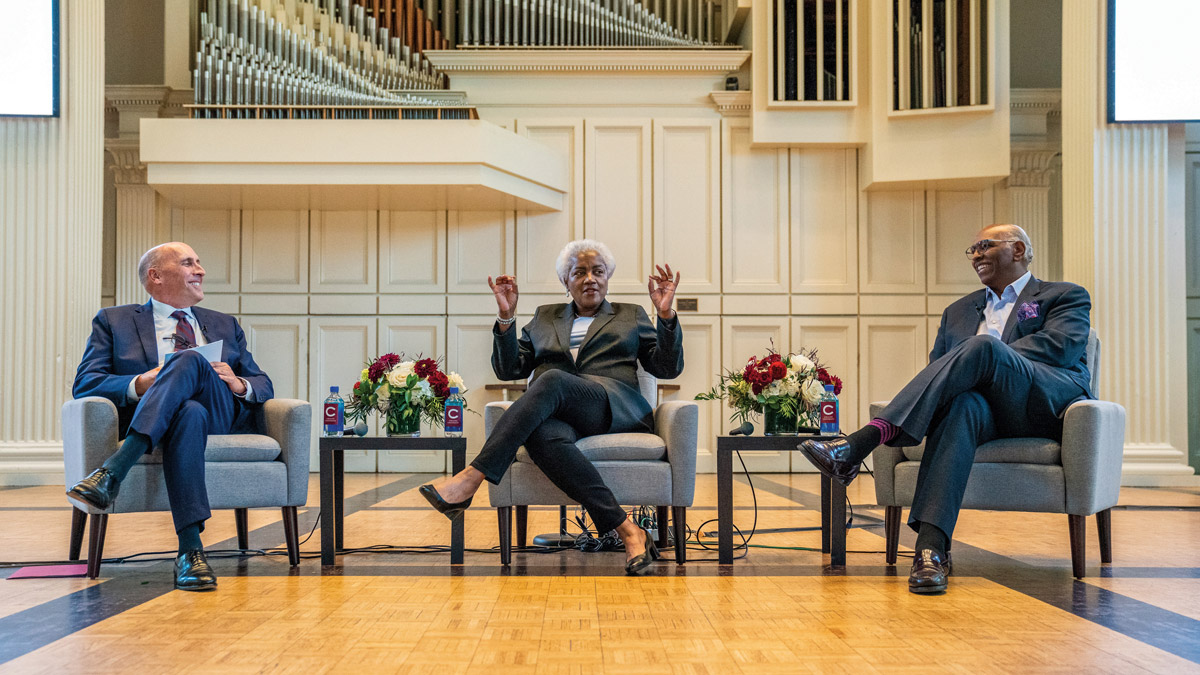
The University’s academic community came together for moments of civic engagement during The Road to the White House: Colgate’s 2024 Election Series in the fall. The series was presented by the Office of the President and the Lampert Institute for Civic and Global Affairs. The three main events featured former Democratic National Committee Chair Donna Brazile and former Republican National Committee Chair Michael Steele; political strategist Karl Rove; and New York Times columnist Maureen Dowd and the chief Washington correspondent for the New York Times, Carl Hulse.
On Sept. 4, a Q&A session with Brazile and Steele, moderated by President Brian W. Casey, gave audience members a look at the election process, the 2024 presidential campaign, and the challenges facing America — all from the perspective of political party leadership.
Brazile and Steele lead the Bipartisan Policy Center’s Election Legitimacy Initiative. They use public education campaigns to help voters understand their rights, identify misinformation, register to vote and cast ballots, and they make sure votes are accurately counted. Brazile emphasized that, in spite of the party politics, voter suppression, and vitriol, “it’s still about us — it’s still about our hopes and dreams. We have to take ownership of our citizenship, and we have to learn how to believe in each other.” In the second installment of the series, Professor of Economics Chad Sparber led a Q&A with Rove, former senior adviser and deputy chief of staff to the George W. Bush Administration. The discussion covered Rove’s role in shaping election strategies for the Bush administration, his analysis of the current election, and his views on the importance of civic engagement on a national scale. Preceding his current work as a weekly op-ed writer for the Wall Street Journal and a political commentator, Rove oversaw the White House offices of Strategic Initiatives, Intergovernmental Affairs, Political Affairs, and Public Liaison under President Bush.
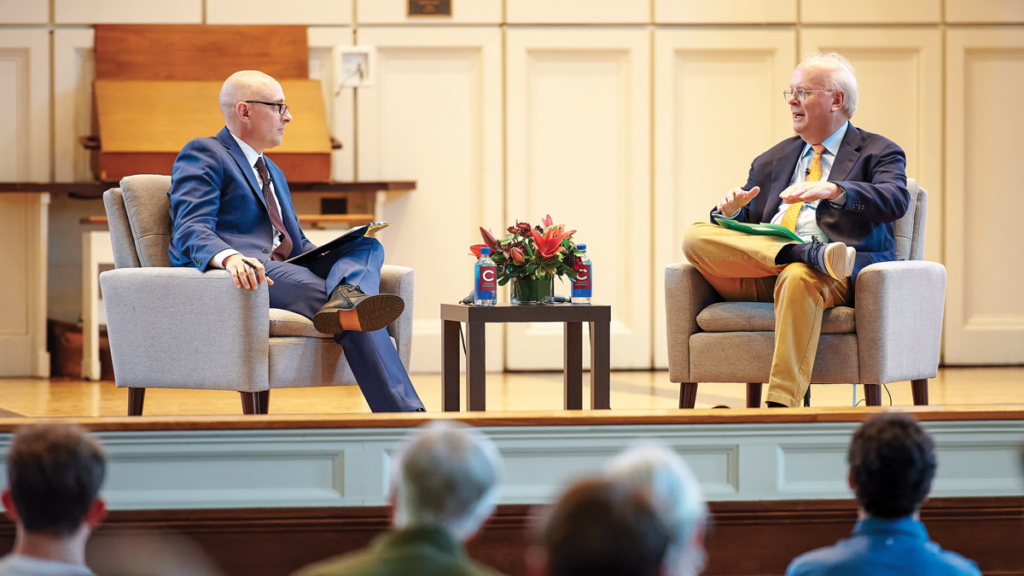
An especially prominent strategy that Rove leveraged in his election campaigns was the process of microtargeting: using methods such as phone calls to gather voter data and customize their advertising messages accordingly. “It’s amazing how much information is out there,” Rove said. “The object was to help us identify people who were worth spending more time, energy, and money on, and trying to get them to vote in support of our interests.”
From there, based on the data collected, Rove identified and targeted low-propensity voters — eligible voters who do not typically participate in elections — and deployed volunteers to influence their voting behavior. “Many Americans, particularly those in middle age, have drifted away from politics, distracted by their busy lives,” he says. “But we need civic engagement from everyone, both young and old.”
The third main event in the series featured the New York Times’ Dowd and Hulse.
The Sept. 24 event provided insight into the election campaign process and a glimpse into the internal workings of the candidates’ parties — as well as the state of American democracy. Taking neutral stances on both parties, the journalists acknowledged the lack of policy present within this election on both sides of the political spectrum, explaining that both parties were campaigning on different goals: Trump to maintain his own popularity by adopting popular policies and Harris to simply defeat Trump. Dowd and Hulse agreed that there would be some “really big consequences” for American democracy after this election. Hulse concluded with a subtle warning to Americans that, “There’s no guarantee to democracy, and I think people need to realize that — you have to keep at it.”