

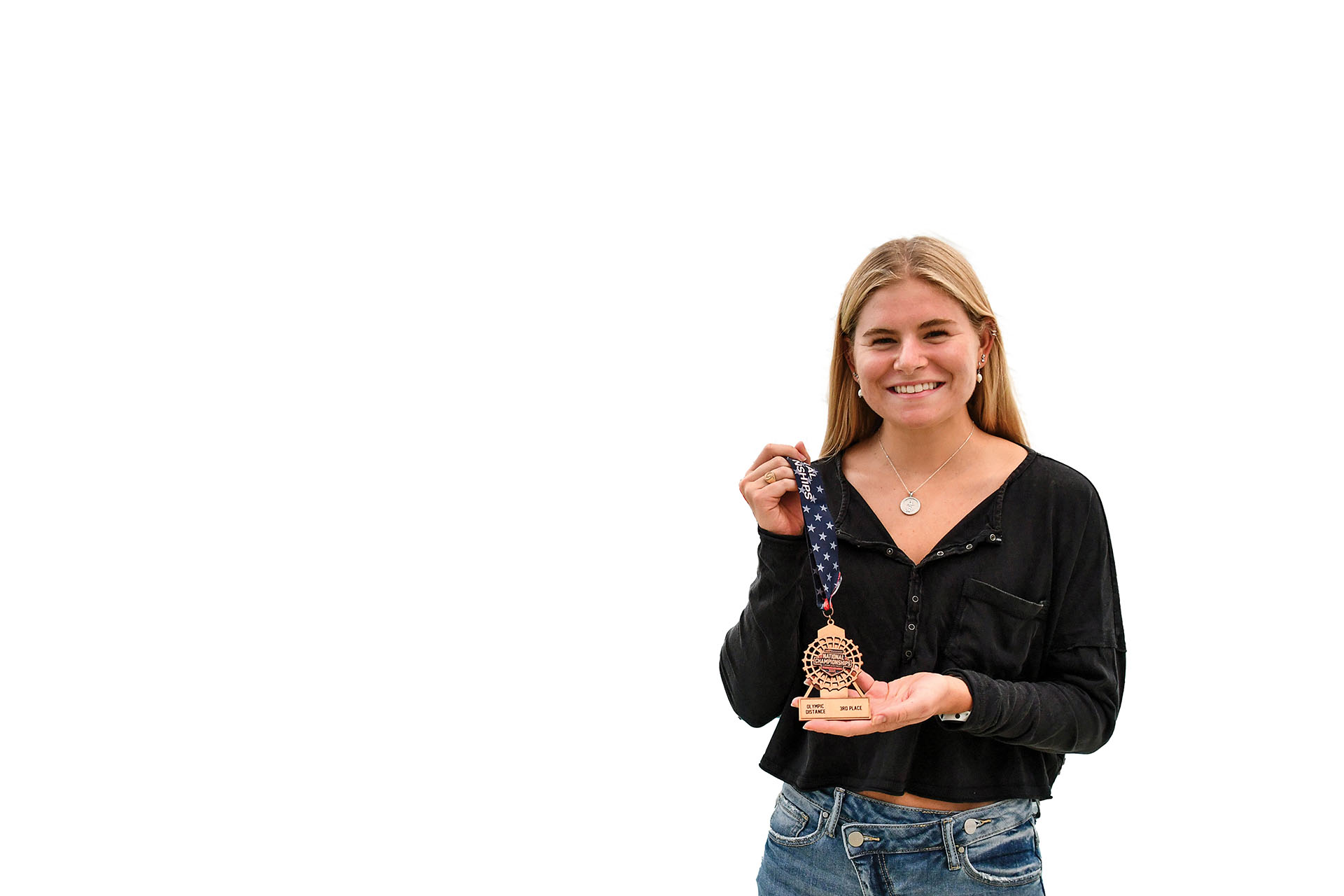
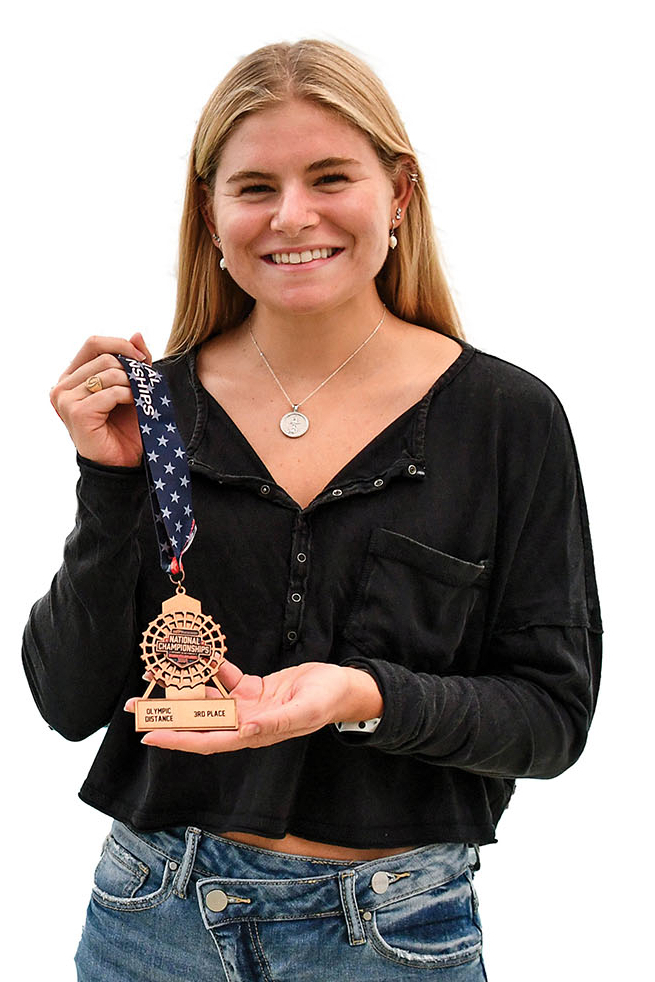
Reilly Brennan ’26, a member of the women’s swimming and diving team, competed in the 2024 USA Triathlon Olympic Distance National Championships in Atlantic City, N.J., in September and captured the bronze in her age group.
Athletes in this grueling competition must complete a 1500-meter swim, 25-mile bike ride, and 10-kilometer run. Brennan completed the race in two hours and 18 minutes.
Recovering from a torn labrum from last year, Brennan says, “It was a long journey getting myself back. I never thought I would have achieved this kind of success.”
The molecular biology major from Devon, Pa., says the race was an enormous physical challenge that felt like a slow burn as she pressed forward. Caloric intake and hydration were crucial. She took five energy gels for nutrition, and she was careful to maintain a steady pace to avoid cramps.
“You have to be very in tune with your pace and your plan,” she says. “It’s much different from a swim race where you go as fast as possible until you finish. In the triathlon, if you go too hard in the beginning, you might not even finish.”
While swimming is her strength, running has always been her weakness. Yet at the national championships, she was especially proud of her performance in the run. “I was able to chip away a lot of time in my run. I was most proud of that part.”
By finishing in the top three in the 20–24 female age group, Brennan has qualified for the world championships, which will take place next year in Australia. Brennan hasn’t decided if she will compete on the world stage. Nevertheless, her preparation for the nationals involved new techniques that allowed her to compete at a top level without injury.
In 2023 Brennan began training with a triathlon team in Lancaster, Pa. The team used a Norwegian training method that involved lactate testing, which is done by taking blood samples of athletes to measure their lactic acid. The tests show whether an athlete is working out at the precise intensity.
“The Norwegian method makes sure you don’t overtrain,” Brennan explains. “Using this testing, you are training at a pace that your body can sustain for long periods. That was huge for me. I didn’t do that testing last summer, but started this summer and it kept me injury free.”
Brennan also credits her triathlon coach and various other people for helping her become a better athlete. Those people include her parents: Her mother was a runner in college and competed on the professional stage, while her father is a cyclist.
Another key figure in her success is swimming and diving Head Coach Ed Pretre, who began training her as a distance swimmer in her first year. “I wasn’t much of a distance swimmer in high school, but when I came here, Ed saw the aerobic [athlete] in me and started putting me in the distance group,” Brennan says. “I don’t think my swimming would be the way it is without doing that the first two years of college.”
“Her hard work, dedication, attention to detail, and overcoming adversity demonstrate her character,” Pretre says. “There is no surprise that she achieved her goal of making worlds next year to compete in Australia for her country. We are so proud of her.”
When Brennan is not swimming or training, she’s working on her diploma. She selected molecular biology as a major because of her love for math and science. Once she arrived at Colgate, she began taking science courses. In the process, she developed an interest in human anatomy, partly because of her injury history and experience in rehab.
“I became interested in what was behind those injuries,” Brennan says. “I wanted to be able to help other people who had the same problems I did.” As a result, she’s interested in a career in physical therapy, orthopedics, or sports medicine.