

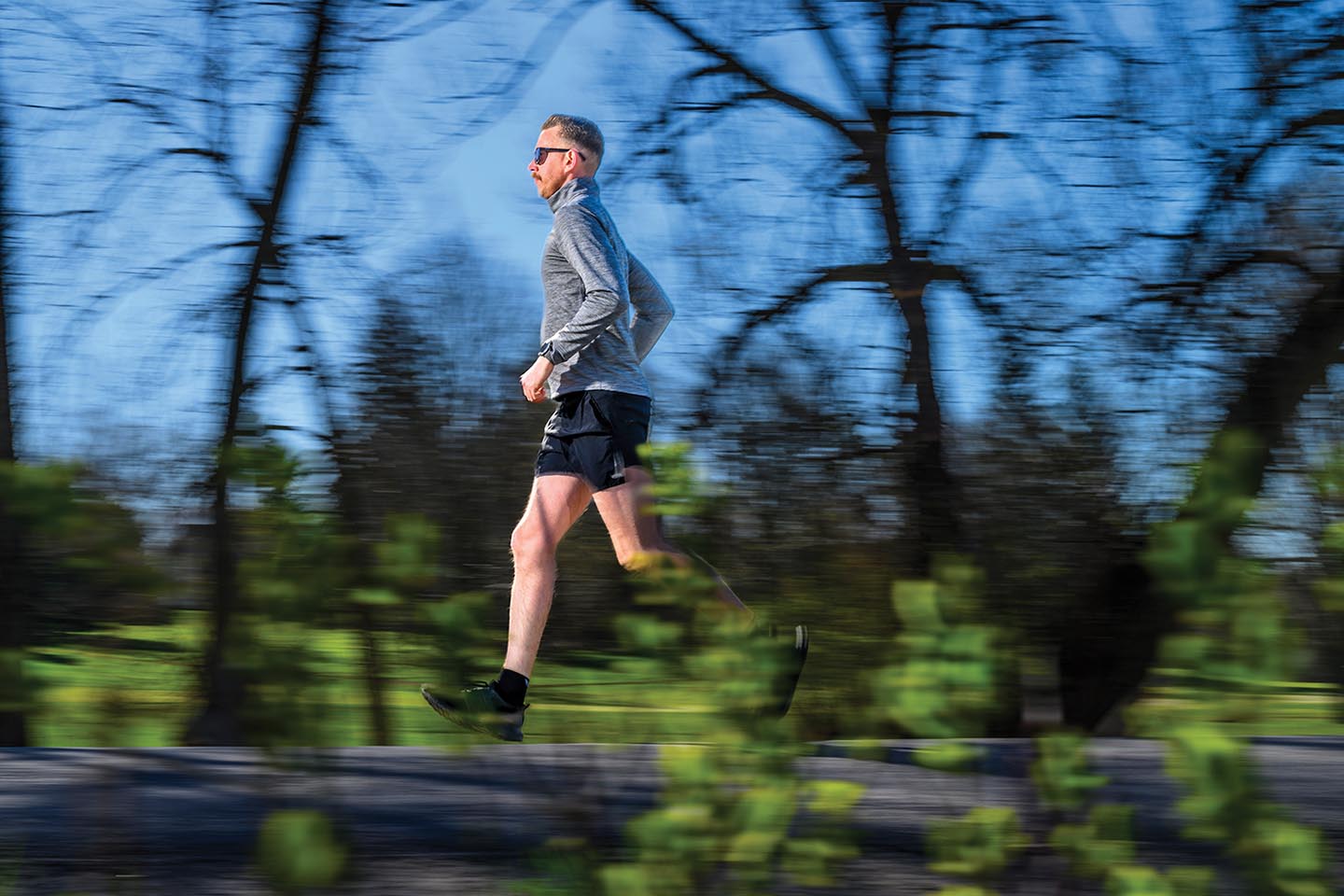
Just before finishing his first year as a Colgate staff member, Lou Kaminski completed a 100-mile race on March 23 along the Prairie Spirit Trail in Ottawa, Kan. This was his second 100-mile race, after completing the first eight years ago. He placed 7th overall and 5th in his division in the March race with a time of 19:32:38, among the 40 runners who finished the race (out of the nearly 60 who started).
As someone who started seriously running in your 30s, what sparked the transition from more casual running to taking on longer and longer races?
I have always been interested in running, but never quite had the confidence in myself to just go for it. I worked at [Johnson and Wales University] in Miami and incorporated a lot of events with students into my running, which sparked an even bigger passion for wellness. I also had a friend who encouraged me to join a running group, and the rest was history. I found my community and made some lifelong friends. It was that group that opened my eyes to distance running and ultramarathons.
What qualities does someone need to be a 100 miler?
For me, distance running, in particular ultramarathons, has always been about testing the mental and physical limits. I say everyone can run, you just have to get out the door and get your feet moving. There is no particular race, gender, age, or body size at these races. I do think you need to have mental grit, patience, and perseverance to get through a race of this distance. I’ve never been one to give up, so I’ve always tapped into those reserves when it gets really tough.
Do you have advice for someone looking to start running more seriously?
What has always worked for me is setting goals for myself, whether that is to make it to the end of the street, the next tree, finishing a 5K, finishing a 5K faster, or just getting out the door. I also think having someone who can hold you accountable is important. I knew for this 100 miler that I had to provide data from my training runs to my coach, and I needed to meet his expectations, but I also knew that if I didn’t get my long runs in, I was going to be in pain on race day. I run in all conditions — rain, sun, sleet, snow, wind. I run when I’m tired, I run when I’m overwhelmed, I push myself to run when I don’t want to, and I find people who can push me even more on the days when I really don’t want to get moving.
How does running play a role in your job at Colgate?
Having my office decorated with race medals and pictures helps me break barriers with students. It humanizes me and almost always allows me an opportunity to talk with a student on a personal level, whether it is running, ultrarunning, or just outdoor adventures. My Weimaraner, Enzo, has also done a lot of running with me, completing several 31-plus-mile races with me. Bringing my dogs into the mix when meeting with students also eases students’ anxiety about being in the conduct office. Running also allows me the ability to disconnect and process things that go on in my life, both work and personal. I don’t run with a phone or music, so it’s just me in my own head, with my own thoughts, mile after mile. I firmly believe that it lets me start each day refreshed.
Kaminski has made connections with colleagues across campus who are also runners, including Associate Professor of Psychology Lauren Philbrook (who was featured in Runner’s World for completing a marathon while pregnant) and Professor of Physics Rebecca Metzler (who, with Philbrook, runs long-distance races and trains nearly every day).