

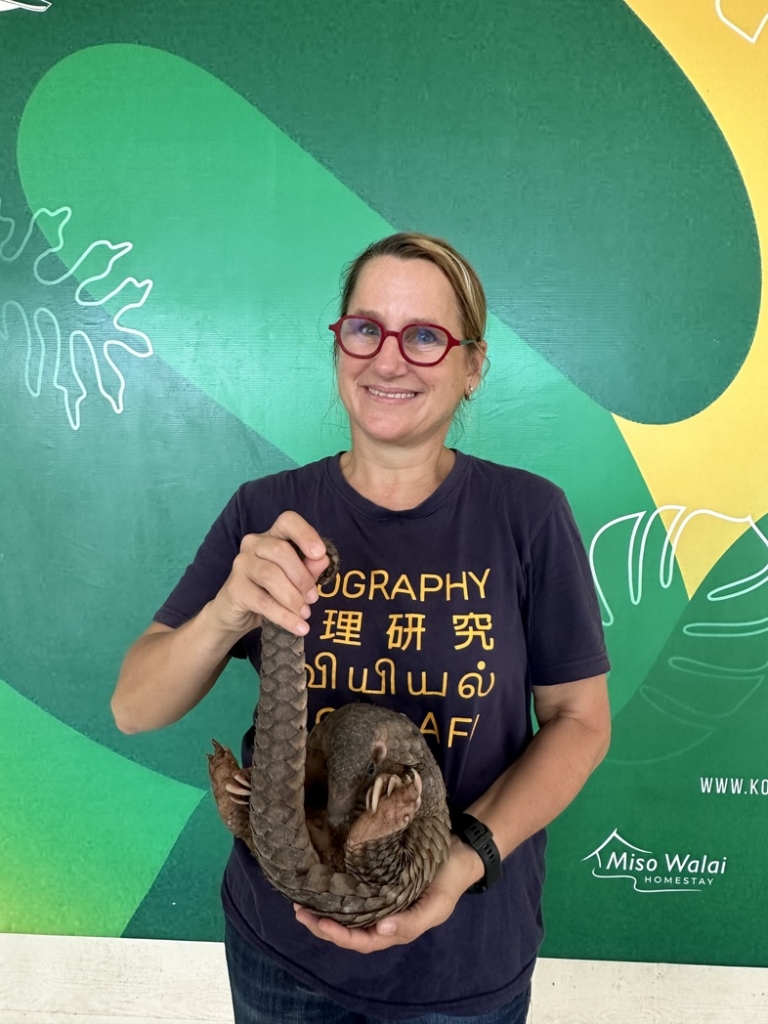
It’s not unusual for National Geographic Explorer Gretchen Coffman ’91 to wake up to an orangutan eating flowers outside her window. “It’s magical: the places I work, the people I meet,” she says. Since 2020, she has lived in Singapore, her home hub for traveling to forests, coral reefs, and communities around Southeast Asia. Coffman grew up in the Southeastern United States, where she backpacked, kayaked, and developed a love for wilderness exploration that has shaped her life. Today, she is an ecologist, conservation scientist, and senior lecturer at the National University of Singapore (NUS) Department of Geography. “My niche discipline of wildlife habitat restoration is interdisciplinary,” explains Coffman, who works with wildlife biologists, hydrologists, engineers, landscape architects, and others. “I weave this team-based approach into my teaching pedagogy of ‘exploration and discovery.’”
Coffman first experienced the wilderness of Southeast Asia after finishing her PhD, when she joined a team of wildlife biologists traveling to Laos. There, she discovered a critically endangered tree species in an area soon to be flooded by a hydroelectric dam. She secured a National Geographic Explorer grant to continue studying, protecting, and restoring that species.
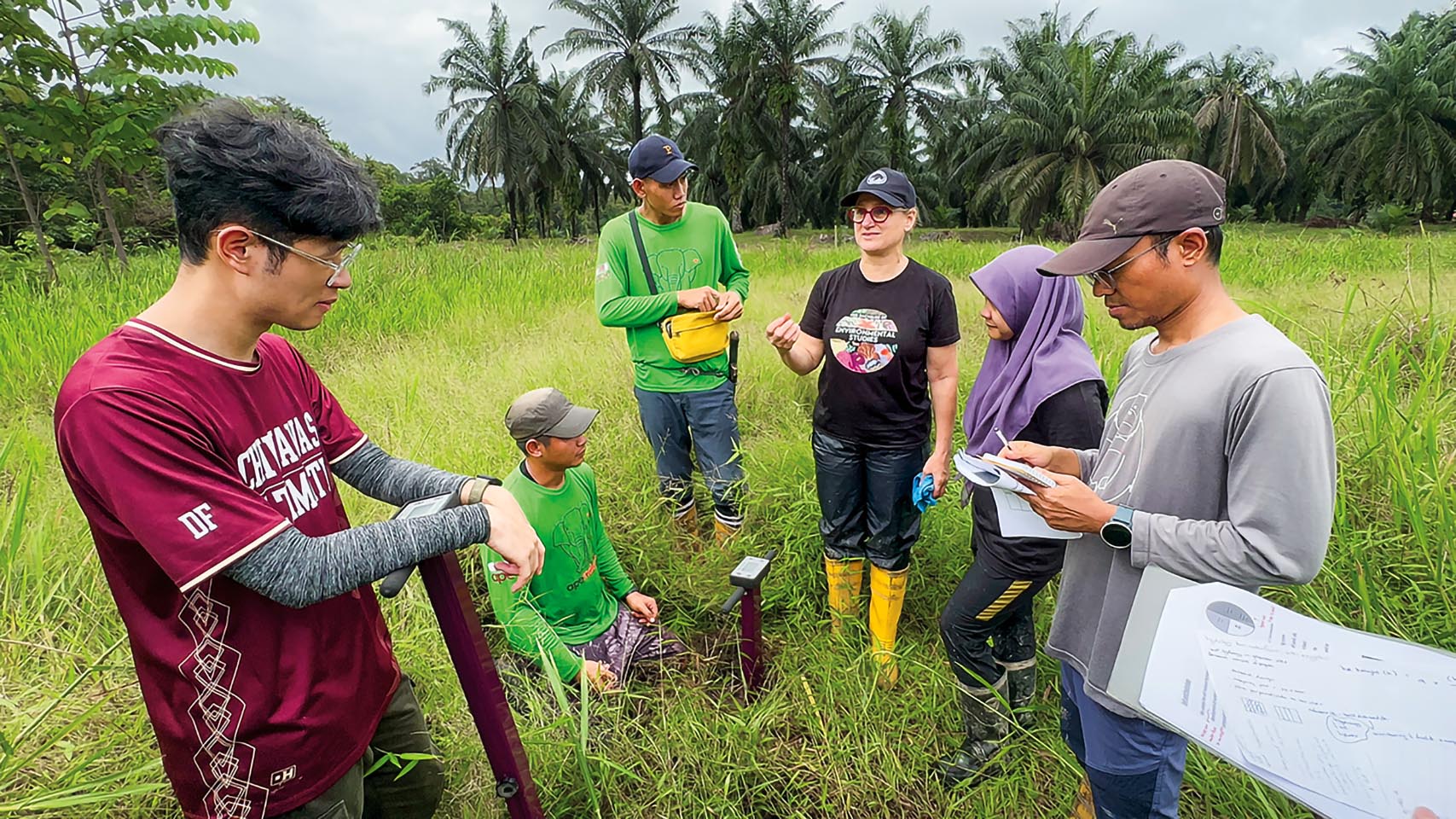
Now, at her Tropical Restoration Ecology Lab at NUS, Coffman’s team researches habitat restoration strategies and trains students and communities to monitor projects. She regularly leads students in field experiences across Laos, Thailand, Indonesia, and the island of Borneo — home to more than 15,000 species of plants and animals, many of which live nowhere else on Earth. Her team tackles habitat restoration where palm oil plantations, aquaculture, logging, and coastal developments have damaged ecosystems that plant, animal, and human communities need to thrive.
“Working on ecological restoration projects, I have often encountered challenges of small project sizes, short- term funding, and little monitoring of project success,” Coffman says. “Our team strives to scale up restoration efforts around Southeast Asia through engaging communities and youth.”
Exploration is so important, Coffman believes, because “people can’t protect or love what they don’t know.” By inspiring her students, she hopes they’ll join her in motivating others to help restore the wildlife diversity of the region. “At the same time, we’re exploring diverse project funding sources and novel ways communities can turn restoration into businesses that provide sustainable livelihoods and scale up efforts.”
In June 2023, Coffman, 16 students, and 20 community organizations convened their first Community-Based Ecosystem Restoration Conference. “Sitting in an open-air pavilion,” she recalls, “orangutans and proboscis monkeys around us, we shared knowledge about restoring tropical rainforests, coral reefs, seagrass meadows, and mangrove forests — ecosystems hundreds of millions of people depend on for food, storm protection, and jobs.”
Her research team traveled again last December, visiting communities with a wide range of restoration experience. Turning restoration into a livelihood is a challenge those communities share, so Coffman’s team helped train partner organization APE Malaysia to teach community members how to raise native tree species in family-owned nurseries so they can sell them back to conservation groups and help restoration efforts.
Coffman’s team filmed as they traveled, using 360-degree cameras. Through immersive films like their award-winning Roots to Reefs 360, “we’re bringing wild Borneo to more people,” she says. They show the films at festivals, to NUS students, and, with the aid of VR headsets, to community members. “We want to help people appreciate and better understand their surrounding ecosystems, so they’ll be inspired to protect them.”
Coffman recalls a student describing her as an eternal optimist. “The challenges to biodiversity loss are vast,” she says, “but I truly believe everyone can make a meaningful difference.”