


Illustration by Dan Page
Sharon Coyle ’86 Weston calls the work she does “culinary medicine.”
“It’s really a combination of a dietitian, a chef, and a doctor,” she says of her job. As a senior clinical specialist in pediatric nutrition at Boston Children’s Hospital at Peabody, she has combined these disciplines, through research and community outreach, into a career that helps people who need that kind of medicine the most.
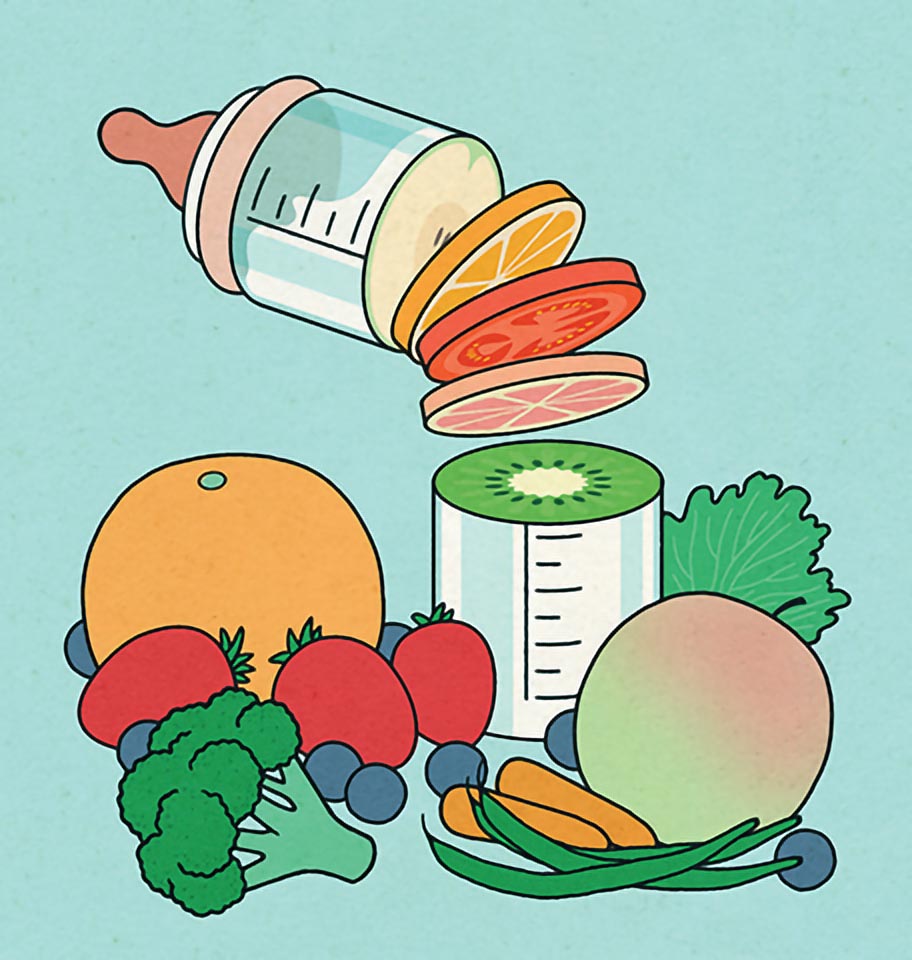
Coyle Weston’s research is heavily focused on blenderized formula, which is whole foods and purees that can be used in place of conventional synthetic formula. This approach to using “food as medicine” has gained significant momentum over the last decade, especially for pediatric patients who rely on formula as a major source of nutrition.
Some parents make their own blenderized formula; others use commercially prepared products and then add water to help with administration. That introduces a lot of variables, Coyle Weston says, and if the viscosity isn’t just right, it can’t move easily through a feeding tube, but if it is thinned too much, it may worsen symptoms related to reflux such as vomiting or retching.
Through her research, she is “trying to look at practical issues that are related to the delivery of blenderized formula,” she explains. That includes determining how best to test viscosity in the first place. She and her team started by using a viscometer, which measures the fluid flow and viscosity of liquids. But they realized that viscometers don’t quite give them the right results, because blenderized formula is a non-Newtonian liquid — which means its consistency changes based on factors around it, like temperature. “It’s more of a mixture than a solution,” she says.
The team then tried International Dysphagia Diet Standardisation Initiative (IDDSI) Testing, which measures flow or textural characteristics of something right at the time of testing. An IDDSI test, for example, can measure differences in how a liquid flows when it’s hot and when it’s cold, what happens if it’s stirred by hand instead of mixed by a blender, or at what point in the process water is added.
In a 2020 paper published in the Journal of Parenteral and Enteral Nutrition, she showed the effectiveness of using the IDDSI test on commercialized food-based blends to determine how much liquid was needed to reach an ideal consistency to run through an enteral feeding device pump.
Then, in 2022, she led a team that published a paper in the Journal of Pediatric Gastroenterology and Nutrition that determined the differences in viscosity when a nurse adds water to the bag that holds the food versus parents adding water in a blender. “We compared stirring it, shaking it, blenderizing it. It’s all a little bit different,” she says.
In addition to this research, Coyle Weston has focused on the practical parts of culinary medicine, like teaching people how to prepare meals, especially for those who need specialized diets. For 10 years, she’s been running monthly cooking classes through the Optimal Wellness for Life program, where she’s the lead registered dietitian.
Since the start of the COVID-19 pandemic, when classes went virtual, the program has been able to reach more people, on a variety of topics, including pediatric obesity and specialized diets. “For celiac disease, the only known treatment is a gluten-free diet. That’s easy to say, but how do you do that?” she says. “Culinary medicine classes instruct on different details related to dietary prescriptions from a medical perspective, and how you carry that out with the help of a dietitian and chef.”
Coyle Weston’s work doesn’t go unnoticed. In 2023 she was given the North American Society for Pediatric Gastroenterology, Hepatology and Nutrition’s Dietician of Excellence Award. She also recently received funding for the NASPGHAN Nutrition Committee Culinary Medicine Working Group (of which she is the co-chair) to create modules about food and different GI-related diagnoses, including fatty liver disease, celiac disease, and inflammatory bowel disease. These modules will provide continuing medical education for doctors.
“Physicians will be able to deliver more hands-on information to their patients and have a better understanding of how their patients can carry out specific diet prescriptions in order to use food as medicine,” she says.